- 24 July, 2026
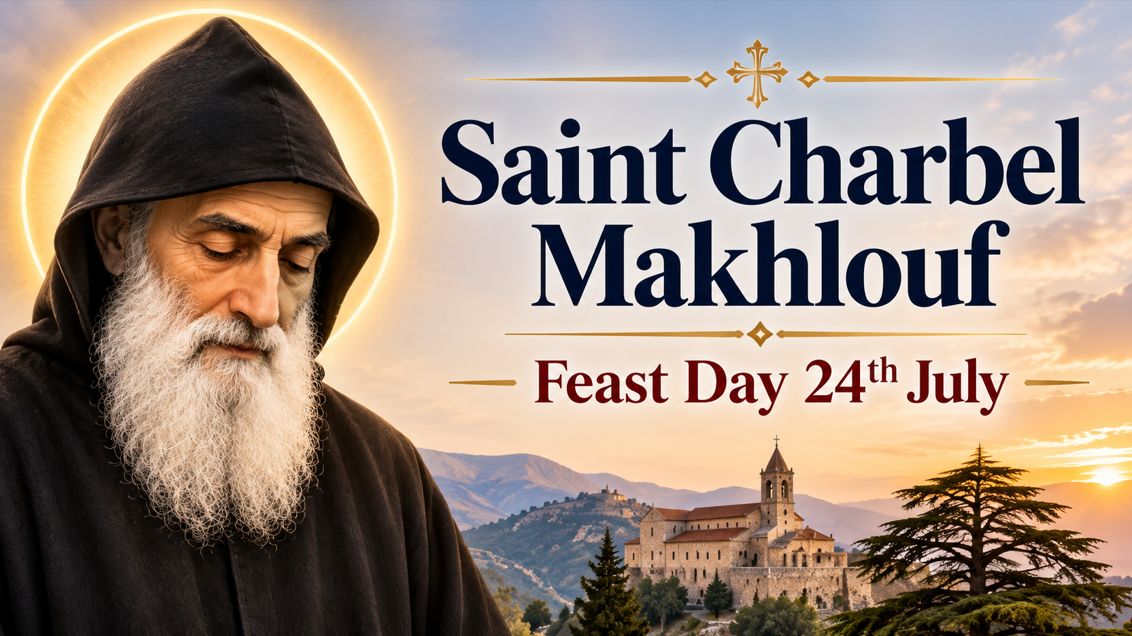
Lebanon, July 24, 2026: Why is Saint Charbel Makhlouf regarded as one of the greatest miracle-working saints of modern times? Discover the remarkable story of the Maronite monk whose hidden life of prayer, silence, and sacrifice has touched millions of believers through extraordinary miracles and unwavering devotion to Christ.


Feast Day: 24 July
Born: 8 May 1828, Bekaa Kafra, Lebanon
Died: 24 December 1898, Annaya Monastery, Lebanon
Canonized: 9 October 1977 by Pope Saint Paul VI


Patron of: Lebanon, those suffering from illness, and people seeking healing and spiritual strength
Known For: Life of prayer and solitude, Eucharistic devotion, miraculous healings, and extraordinary posthumous miracles
Title: Priest, Maronite Monk, and Hermit
Few saints have become as widely known for miraculous healings as Saint Charbel Makhlouf.
Although he spent most of his life in silence and solitude within the mountains of Lebanon, his witness has reached every corner of the world.
Thousands of pilgrims continue to visit his tomb each year, seeking his intercession for physical healing, spiritual renewal, and deeper faith.
His life reminds Catholics that true greatness is often found not in public recognition but in humble fidelity to God.
Saint Charbel was born Youssef Antoun Makhlouf on 8 May 1828 in the mountain village of Bekaa Kafra, one of the highest inhabited villages in Lebanon.
His father died when he was still a child, and Youssef was raised by his deeply religious mother and stepfather.
(CLICK HERE to follow Catholic Connect for regular News and Content)
As a young shepherd tending his family's flock, he often withdrew into nearby caves to pray.
From an early age, he showed a deep love for silence, contemplation, and the presence of God.
The example of two hermit uncles further inspired his desire to dedicate his life completely to Christ.
At the age of twenty-three, Youssef quietly left home and entered the Lebanese Maronite Order at the Monastery of Our Lady of Mayfouq.
Upon becoming a novice, he received the religious name Charbel, in honor of an early Christian martyr.
He later continued his formation at the Monastery of Saint Maron in Annaya, where he professed his solemn vows and devoted himself to prayer, manual labor, and study.
After years of preparation, he was ordained a priest in 1859.
His fellow monks admired his humility, obedience, and unwavering dedication to the Eucharist.
For sixteen years, Father Charbel faithfully served the monastery before receiving permission to embrace the life of a hermit.
He moved to the nearby Hermitage of Saints Peter and Paul, where he would spend the remaining twenty-three years of his life.
His days followed a simple rhythm of prayer, fasting, manual work, and prolonged adoration before the Blessed Sacrament.
He spoke little, avoided worldly distractions, and sought complete union with God through silence and self-denial.
His greatest joy was celebrating the Holy Eucharist, which he approached with profound reverence and devotion.
On 16 December 1898, while celebrating the Divine Liturgy, Father Charbel suffered a stroke.
He was carried back to his hermitage, where he endured several days of suffering with remarkable peace and patience.
On 24 December 1898, Christmas Eve, he surrendered his soul to God.
The monks buried him in the monastery cemetery, believing they had laid to rest a humble and faithful hermit.
They did not yet realize that God would soon reveal his holiness to the world.
Shortly after Saint Charbel's burial, mysterious lights were reportedly seen surrounding his tomb.
When his grave was later opened, witnesses found his body remarkably well preserved despite the passage of time.
Accounts also described a reddish fluid flowing from his body for many years, an occurrence that drew widespread attention.
As devotion spread, countless pilgrims began reporting remarkable healings after praying for his intercession.
Documented cures of serious illnesses and unexplained recoveries led Church authorities to investigate these events carefully.
The miracles attributed to Saint Charbel eventually contributed to his beatification in 1965 and canonization in 1977 by Pope Saint Paul VI.
Today, he is recognized as one of the most renowned miracle-working saints of the modern era.
Although Saint Charbel never left Lebanon during his lifetime, his reputation has spread across every continent.
Churches, shrines, and prayer groups dedicated to him now exist throughout the Middle East, Europe, the Americas, Africa, Asia, and Australia.
People of many different Christian traditions—and even individuals from other religions—have visited his shrine, inspired by testimonies of healing and answered prayers.
His monastery at Annaya has become one of the world's most important pilgrimage destinations.
The life of Saint Charbel offers timeless lessons for every believer:
His witness reminds Christians that holiness is not measured by fame but by complete surrender to God's will.
More than a century after his death, Saint Charbel continues to strengthen the faith of millions around the world.
He was a humble monk, devoted priest, faithful hermit, and extraordinary witness to the transforming power of prayer.
From the quiet mountains of Lebanon to the countless pilgrims who continue to seek his intercession, his life proclaims one enduring truth: Those who give themselves completely to God become instruments of His mercy and healing for the world.
Saint Charbel reminds Catholics that a hidden life lived in prayer, humility, and love can bear fruits that reach far beyond anything human eyes can see.
To know about more saints please visit the spiritual section.
By Catholic Connect Reporter
Saint Charbel Makhlouf, Saint Charbel feast day, Saint Charbel biography, Saint Charbel miracles, Maronite saints, Lebanese saints, Annaya Monastery, Catholic miracle saints, Saint Charbel healing, Eucharistic devotion, Catholic hermits, July feast days, Saint Charbel prayers, Catholic saints, Maronite Church, Saint Charbel shrine Lebanon



© 2026 CATHOLIC CONNECT POWERED BY ATCONLINE LLP