- 17 October, 2026

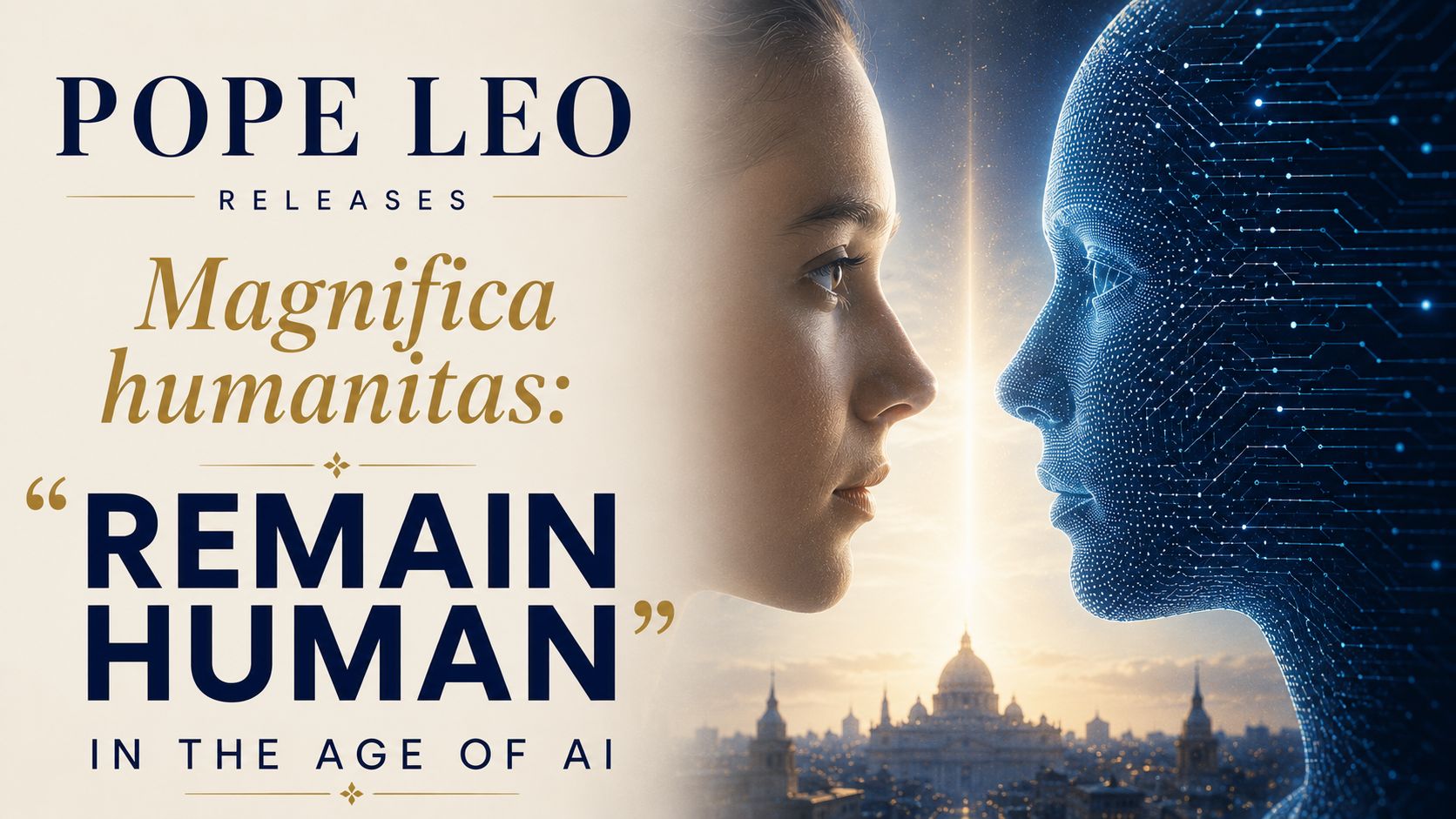
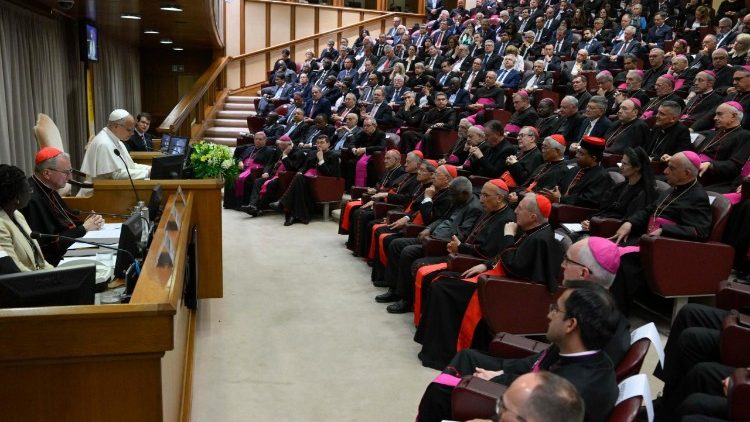
Vatican, May 25, 2026: Marking the 135th anniversary of 'Rerum novarum', Pope Leo XIV released his first encyclical, 'Magnifica humanitas: On Safeguarding the Human Person in the Time of Artificial Intelligence', on May 25 after signing it on May 15. Addressing artificial intelligence as one of the defining challenges of the modern age, the encyclical calls for the safeguarding of humanity, the promotion of truth, the dignity of work, social justice, and peace.


“Humanity, created by God in all its grandeur, is today facing a pivotal choice: either to construct a new Tower of Babel or to build the city in which God and humanity dwell together,” the Pope writes in the opening lines, summarising the central message of the document.
Church’s Social Doctrine
The first chapter, “A Dynamic Approach Faithful to the Gospel,” examines the Social Doctrine of the Church through recent magisterial teaching and the Second Vatican Council, emphasising its “dynamic character” (17).
Rather than serving as a rigid set of rules, the Church’s social teaching is described as a “theology of communion in history” (27), guiding the interpretation of events in the light of the Gospel.
Pope Leo recalls the contributions of previous Popes, beginning with Pius XII, who first used the term “Social Doctrine of the Church” in *Menti Nostrae* in 1950, and continuing through Pope Francis.
He highlights Pope Leo XIII’s 1891 encyclical *Rerum novarum* as “a milestone in the development of the Church’s social teaching” (30). Successive Popes, he notes, interpreted historical developments through the Gospel while emphasising themes such as human dignity, the value of work, solidarity, subsidiarity, care for creation, peace, and fraternity (45).
Safeguarding Human Dignity
In the second chapter, Pope Leo reflects on the “Foundations and Principles of the Social Doctrine of the Church”.
The Pope says the dignity of every human person, created in the image and likeness of God, forms the foundation of the Church’s social teaching. He warns that “the pressure of new ideologies or certain highly powerful interests” can reduce people to “a resource to be used and exploited” or judge them solely by productivity (51).
By contrast, he writes that “the fundamental dignity of each person…is neither acquired nor earned, nor does it need to be justified” (53).
Another foundation is the inviolability of human rights, beginning with the right to life “from conception to its natural end.” In this context, Pope Leo describes induced abortion, the killing of the innocent, and euthanasia as “choices that the Church considers gravely wrong” (55).
The encyclical also stresses the rights of minorities, especially women, calling for “concrete decisions” in laws, employment, education, and social and political responsibilities so that women may be genuinely heard and valued (57).
‘Gravely Immoral’ to Subjugate a Nation
Pope Leo identifies five principles of the Social Doctrine of the Church, beginning with the common good, which he defines as “the social expression of the dignity recognised in every person” (59).
He strongly states that promoting the common good cannot be separated from respecting the right of peoples to exist, preserve their identity, and contribute to the family of nations.
“Any attempt or plan to eliminate or subjugate a nation is gravely immoral and therefore unacceptable” (64), he writes.
Technology Must Not Be in the Hands of a Few
The second principle discussed is the “universal destination of goods.”
Throughout the encyclical, Pope Leo repeatedly warns against concentrating technology in the hands of a few people, which could deepen inequality between those included in and excluded from the digital revolution (67).
The third principle, subsidiarity (68), calls for overcoming paternalistic or welfare-based approaches to society in favour of shared responsibility.
The fourth principle, solidarity (73), is described as both “a principle and a virtue.” The Pope explains that solidarity opposes indifference and takes into account both present and future generations.
Social Justice and Migrants
The fifth principle is social justice. In the digital age, the Pope says social justice requires fair access to opportunities, protection of vulnerable people, opposition to hatred and disinformation, and public oversight of technologies so that profit is not the sole guiding principle, but rather “the dignity of every person and the common good of all people” (80).
Pope Leo describes migrants, refugees, and displaced persons as a “litmus test” for social justice. He says society’s treatment of migrants reveals whether justice is guided by fear or fraternity.
The Pope calls for protecting “the rightful hopes” of migrants through safe and legal pathways, dignified welcome, genuine integration, and efforts to address the root causes of migration while safeguarding the “right to remain” in one’s homeland in peace and security (81).
Abuse and Examination of Conscience
The encyclical says these five principles should also be applied within the Church.
Pope Leo calls the Church to undertake “an examination of conscience,” including “purifying ecclesial relationships and structures from distortions that give rise to inequality, lack of transparency and abuse of power.”
He specifically calls for listening to victims of “spiritual, economic, institutional, sexual and power-based abuse, as well as abuses of conscience.”
This process, he says, includes acknowledging harm, making just reparation, and taking steps to prevent abuse from happening again (89).
An Ethical Code for AI
The third chapter, “Technology and Dominance. The Grandeur of Humanity in Light of the Promises of AI,” emphasises vigilance regarding artificial intelligence.
Pope Leo warns against the “technocratic paradigm” criticised by Pope Francis, in which decisions are driven solely by efficiency and profit (92).
He states that while AI can imitate human beings, it does not possess moral conscience, empathy, or spiritual and relational capacities.
The Pope calls for clear accountability throughout AI development, including appropriate policies, legal frameworks, independent oversight, and user education. He also advocates for a shared ethical code grounded in social justice, warning that “a more moral AI is not enough if that morality is determined by a few” (107).
The encyclical additionally raises concerns about the environmental impact of emerging technologies, noting their significant use of energy and water resources (101).
Disarming AI
Pope Leo XIV says AI must be “disarmed” by freeing it from military, economic, and cognitive competition.
“To disarm does not mean rejecting technology, but preventing it from dominating humanity” (110), he writes.
The Pope criticises transhumanism and posthumanism for treating progress as the elimination of human limitations. Instead, he argues that fragility and finitude are essential aspects of human life because they foster relationships and openness to God and others.
“Humanity flourishes not despite limitations, but often through them” (118), he writes.
Technological Progress Without Regression of the Heart
The encyclical warns that pursuing technological progress by eliminating human limitations could lead to an anthropological regression.
Pope Leo insists that humanity “must never be replaced or surpassed.”
While technology can reduce suffering and create opportunities, it must not undermine humanity’s “capacity for relationship and love” (126).
The Pope says the real choice regarding AI is not between enthusiasm and fear, but between development that serves humanity and development shaped by power (129).
Communication, Schools, and Truth
The fourth chapter, “Safeguarding Humanity at a Time of Transformation. Truth, Work, Freedom,” calls for an “ecology of communication” grounded in truth.
The Pope urges transparency in content selection, protection of personal data, serious journalism based on verification, critical use of digital tools, and integration of different forms of knowledge.
He says the Church must also practise transparent and honest communication, especially in cases involving injustice and abuse.
Pope Leo calls for renewed commitment to education so that young people do not lose “the desire to ask questions” because of technologies that make human thought appear unnecessary (140).
He also emphasises the importance of schools as places where people learn to “seek and love the truth” (147).
The Dignity of Work
Addressing the “fourth industrial revolution” brought by the digital transition, Pope Leo stresses the need to protect the dignity of work through systems centred on the human person rather than performance alone.
“The ‘new ways’ of working are not necessarily better,” he writes, noting that AI often forces workers to adapt to machines instead of supporting workers (150).
The Pope says technology should relieve burdensome tasks but must not lead to unemployment driven by profit and cost reduction.
He also expresses hope for a renewal of labour organisations (155).
Peace and Development
Pope Leo says development should no longer be measured solely through GDP, but also through the dignity of work, shared prosperity, reduction of inequality, and environmental protection.
Finance, he writes, should support the development and creation of work (159-160).
Echoing Pope St. Paul VI, the encyclical highlights the relationship between peace and development, calling for international cooperation and support for vulnerable nations and communities.
Prosperity contributes to peace “only if it is widespread, inclusive, and sustainable” (163), the Pope writes.
Family and Freedom
The Pope reaffirms the importance of the family, describing it as founded on the stable union between a man and a woman.
The family is called a “primary social good” and the “fundamental and irreplaceable cell of every community organisation” (165).
He says families should be supported through labour policies that promote stability and humane rhythms of life.
The encyclical also addresses human freedom in a digital age shaped by platforms designed to capture attention and exploit vulnerabilities.
Pope Leo warns against systems of profiling and behaviour prediction, describing them as “a new form of power” (171) that risks discriminating against the weakest.
He criticises the “architecture of visibility,” which amplifies only what is visible and shapes public opinion.
New Forms of Slavery and Colonialism
The Pope warns that AI has created new forms of slavery, including exploitative labour connected to the extraction of rare earth elements needed for technology.
He reaffirms the Church’s condemnation of slavery, trafficking, and commodification of persons, while also acknowledging and apologising for the Church’s delayed condemnation of slavery in the past (174-176).
The encyclical also criticises the exploitation of personal data, including health and demographic information, describing it as a new form of colonialism that turns personal lives into exploitable information (178-179).
Overcoming ‘Just War’ Theory
In the fifth chapter, “The Culture of Power and the Civilisation of Love,” Pope Leo reflects on war and conflict in the digital era.
He says the digital revolution is transforming warfare and warns against decisions about life and death becoming increasingly impersonal through technological systems (182-183).
The Pope says a “culture of power” normalises war and promotes rearmament, while societies are also weakened by polarised media narratives and “a disconcerting loss of historical memory” (191).
He therefore reiterates that, while maintaining the right to legitimate defence in the strictest sense, the theory of “just war” must be overcome in favour of dialogue, diplomacy, and forgiveness (192).
Algorithms Do Not Make War Morally Acceptable
Pope Leo criticises the arms industry, the nuclear arms race, and armed groups that profit from conflict.
He warns especially against AI-driven weapons, writing that “there is no algorithm that can make war morally acceptable.”
The Pope says AI can make conflict faster, more impersonal, and more likely by lowering the threshold for violence and reducing victims to data.
He calls for strict ethical limits on such technologies, based on personal responsibility and protection of civilians (199).
Crisis of Multilateralism
The encyclical also highlights the crisis of multilateralism and the rise of “a disorderly and conflict-ridden multipolarism” marked by mistrust (201).
Pope Leo laments the replacement of the rule of law with the law of the strongest and says institutions created to protect the common destiny of peoples have been weakened.
He expresses hope for “profound reforms” of the United Nations that would renew commitment to the common good (226).
An Irresponsible Realpolitik
The encyclical says modern “hybrid” wars are fought not only militarily but also economically, financially, and digitally, often through disinformation campaigns designed to manipulate public opinion.
Pope Leo describes this as a “false realism” and an irresponsible Realpolitik that normalises war and presents peace as unrealistic (204-205).
He also warns that some leaders may view armed conflict as a means of distracting from domestic problems (208).
The Civilisation of Love
Pope Leo calls Christians to respond to the culture of power by building “the civilisation of love.”
He recalls the witness of saints and peacemakers, saying grace inspires resistance to evil and creativity in doing good (211).
The Pope outlines five paths of responsibility, including speaking truthfully, building peace through justice, standing with victims, rejecting false neutrality in unjust conflicts, and pursuing practical paths to peace.
Importance of Interreligious Dialogue
The encyclical emphasises the importance of interreligious dialogue and rejects the misuse of religion to justify violence.
“Those who use the name of God to legitimise terrorism, violence or war betray his true nature, for to fight in the name of religion means attacking religion itself” (223), the Pope writes.
He says the diplomacy of the Holy See is guided by mercy and concludes by urging prayer, since peace ultimately comes from God (227-228).
Grandeur of Humanity
Concluding his first encyclical, Pope Leo XIV invites the faithful to enter the new technological age guided by the Gospel and a “sober yet demanding program of Christian life.”
Even in the age of artificial intelligence, the Pope writes, humanity can continue to witness to “the grandeur of humanity, in which God has made His dwelling.”
Courtesy: Vatican News

© 2026 CATHOLIC CONNECT POWERED BY ATCONLINE LLP