- 20 October, 2026

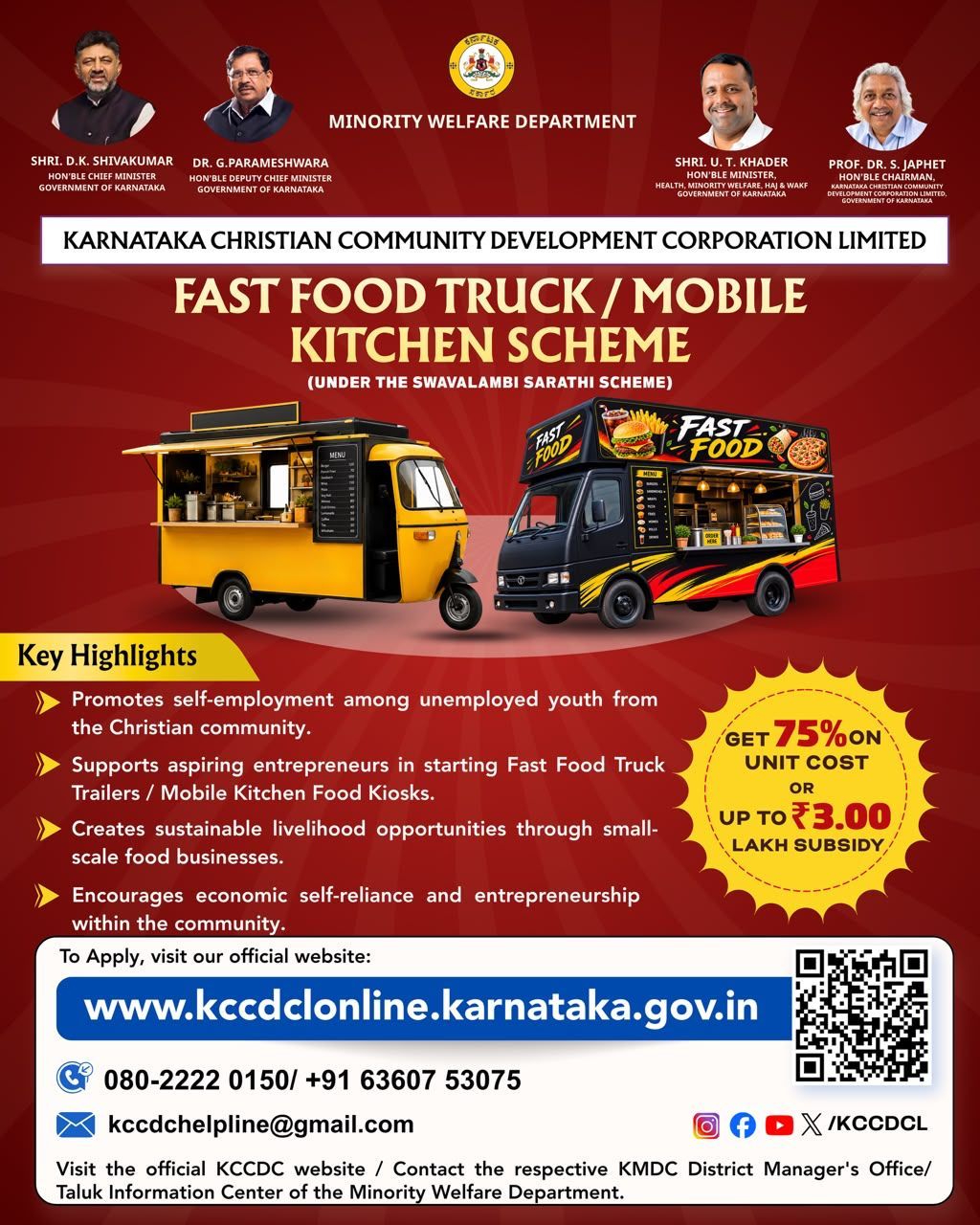
Bengaluru, AUGUST 17, 2026: Unemployed and aspiring young entrepreneurs from Karnataka’s Christian community have an opportunity to start their own mobile food business through the Fast Food Truck / Mobile Kitchen Scheme, operated by the Karnataka Christian Community Development Corporation Limited (KCCDC) under the Swavalambi Sarathi Scheme.



The scheme is designed to promote self-employment and create sustainable livelihood opportunities by helping eligible applicants purchase a new commercial food truck, trailer or mobile kitchen food kiosk. The initiative is aimed particularly at young people who want to establish small-scale food businesses in urban areas without the substantial investment normally required for a conventional restaurant.
One of the main attractions of the scheme is the financial assistance available to eligible beneficiaries.
According to the scheme details, applicants can receive a subsidy of 75 per cent of the unit cost, subject to a maximum subsidy of ₹3 lakh.
The mobile unit can be used for businesses involving fast food, snacks, beverages and catering. A properly equipped food truck can allow an entrepreneur to operate from different locations, potentially reducing some of the costs associated with renting and maintaining a permanent commercial premises.
(CLICK HERE to follow Catholic Connect and to stay updated with Catholic News & Content)
The scheme specifically supports the purchase of a new food truck vehicle. Applicants cannot use the assistance to modify or convert an old or second-hand vehicle.
The scheme is specifically intended for members of the Christian Minority community in Karnataka.
Applicants must be permanent residents of Karnataka and must be between 21 and 45 years of age. The applicant’s annual family income must not exceed ₹8 lakh.
A valid driving licence issued by the Regional Transport Officer is also required.
Another important condition is that the applicant, or members of their family, must not have previously received benefits under a scheme offered by the Corporation.
Applicants must also provide proof of residence and the other certificates required during the application and verification process.
The mobile food truck assistance is intended for businesses operating in urban areas and cities. The scheme does not apply to businesses operating in rural or village areas.
The subsidy is also specified for commercial three-wheeler or four-wheeler goods vehicles used for commercial purposes.
This means applicants should carefully establish that the proposed vehicle and business meet the scheme’s commercial and location requirements before proceeding with the application.
Applicants will need to provide a range of documents to establish their identity, residence, age, income and eligibility.
The required documents include details of the cost of the vehicle, body building, equipment and materials, along with a recent passport-sized photograph.
Applicants must submit their driving licence, proof of residence and an Aadhaar card, Voter ID card or ration card.
A caste and income certificate obtained from the concerned Taluk Tahsildar or Revenue Officer is also required, together with a self-declaration regarding unemployment.
For age verification, applicants can submit documents such as a birth certificate, transfer certificate or marks card.
Applicants must also provide a declaration confirming that they have not previously received a subsidy for the same purpose.
An affidavit concerning the non-sale, non-alienation or non-transfer of the unit for five years is another requirement.
During the Documentation & Recommendation by District Case Worker stage, applicants must submit an affidavit in the prescribed format.
The affidavit is required to be executed on ₹100 e-Stamp Paper. The first party is the beneficiary, while the second party is listed as NIL. The document must carry the signature and seal of a notary or Oath Commissioner.
The scheme information states that the guarantor should be a blood relative or family member of the borrower.
The affidavit contains several important undertakings. Applicants must confirm that the information they have provided is accurate and that they have not concealed any material facts.
They must also undertake to use the loan and subsidy strictly for the approved purpose and agree to provide bills, utilisation certificates and other documents when required.
The financial assistance comes with conditions that applicants should understand before applying.
Beneficiaries are required to repay the loan, interest and other applicable dues according to the agreed repayment schedule. The affidavit specifically states that timely repayment is mandatory.
The subsidy is also subject to a one-year lock-in period from the date of disbursal and compliance with the conditions of the scheme.
The subsidy should therefore not simply be regarded as an unconditional grant. The scheme document states that premature foreclosure or violation of the conditions may result in recovery of the subsidy, along with applicable interest and penalties.
Applicants are also required to provide security and a guarantee or surety as prescribed.
The Corporation reserves the right to monitor businesses established under the scheme.
Beneficiaries must consent to inspections of their business activities, assets and records by Corporation officials at reasonable times.
The affidavit also contains provisions relating to recovery in the event of default, misuse of funds or violation of scheme conditions.
Applicants are therefore advised to read the full terms carefully and ensure that they understand their financial and legal responsibilities before accepting assistance.
The Fast Food Truck / Mobile Kitchen Scheme is presented as an initiative to promote economic self-reliance and entrepreneurship within Karnataka’s Christian community.
Rather than providing assistance solely for conventional employment, the programme seeks to help beneficiaries establish their own businesses and develop independent sources of income.
A mobile food business can potentially provide opportunities in food preparation, catering, beverages and related services while allowing entrepreneurs to operate from suitable urban locations.
For unemployed young people with an interest in the food sector, the scheme could therefore provide a route towards self-employment, provided they meet all eligibility and financial requirements.
Eligible applicants can access further information and apply through the official website of the Karnataka Christian Community Development Corporation Limited.
Official website: Click Here
The scheme’s dedicated page is also available at: Fast Food Truck / Mobile Kitchen Scheme – KCCDC
Applicants seeking assistance can contact the Corporation through the following numbers:
Telephone: 080-2222 0150
Mobile: +91 63607 53075
Email: kccdclhelpline@gmail.com
The scheme information also advises applicants to contact the respective KMDC District Manager’s Office or the Taluk Information Centre of the Minority Welfare Department for assistance.
With the application deadline set for 30 September 2026, eligible applicants should begin preparing their documents well in advance.
The key requirements include Karnataka residence, membership of the Christian Minority community, an age between 21 and 45, annual family income of no more than ₹8 lakh, a valid driving licence and compliance with the Corporation’s conditions.
The scheme offers 75 per cent subsidy on the unit cost, up to ₹3 lakh, for eligible applicants seeking to establish a new commercial mobile food business.
For young people looking to turn an interest in food and entrepreneurship into a livelihood, the initiative provides an opportunity to explore self-employment with government-backed financial support.
By Catholic Connect Reporter

© 2026 CATHOLIC CONNECT POWERED BY ATCONLINE LLP