- 16 October, 2026
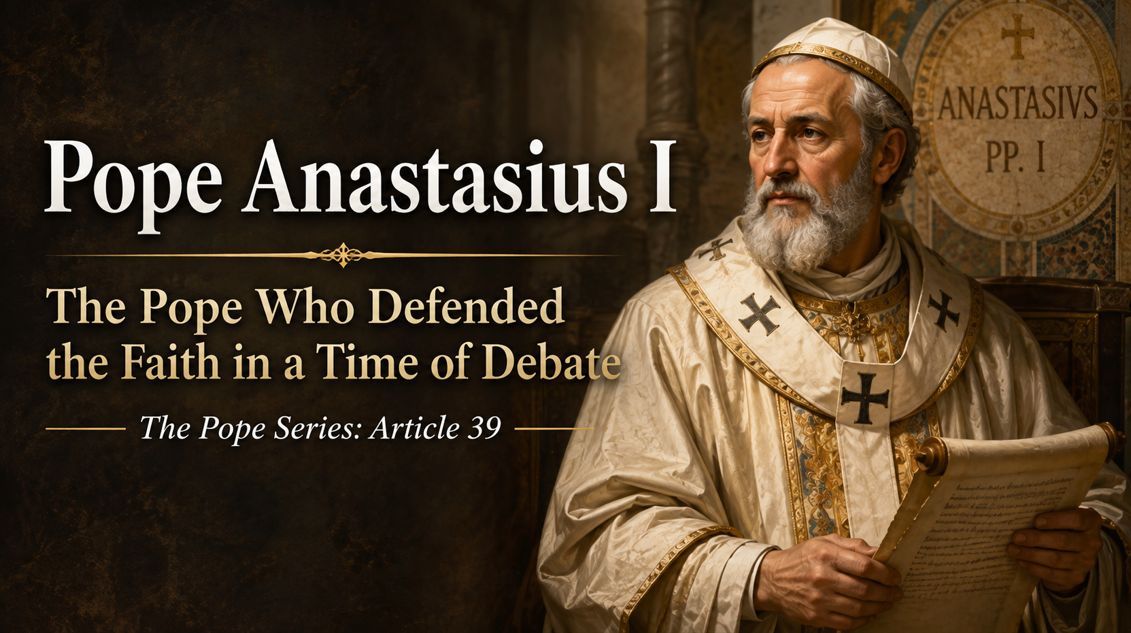
August 16, 2026: Pope Anastasius I, the thirty-ninth successor of St. Peter, led the Catholic Church from 399 to 401 AD. Though his pontificate lasted only about two years, he became known for his firm defence of Catholic teaching and his opposition to doctrines associated with Origen that he believed were inconsistent with the faith.


Anastasius also worked to preserve Church unity in North Africa and maintained close relationships with some of the leading Christian thinkers of his time, including St. Jerome, St. Augustine and St. Paulinus of Nola.
The late fourth century was a period when the Church was growing rapidly but still facing serious theological disagreements. Pope Anastasius I entered this challenging environment with a reputation for holiness, discipline and a strong commitment to orthodox Christian teaching.
(CLICK HERE to follow Catholic Connect and to stay updated with Catholic News & Content)
His short pontificate is particularly remembered for the Origenist controversy, a dispute surrounding interpretations of the writings of the influential Christian theologian Origen. Anastasius' response demonstrated the growing role of the Bishop of Rome in addressing doctrinal questions affecting Christians far beyond Rome.
Little is known about Anastasius' childhood. He was born in Rome and was the son of a man named Maximus. He became part of the Roman clergy and developed a reputation for holiness and simplicity.
St. Jerome, one of the great Christian scholars of the period, held Anastasius in high esteem and described him as a man of exceptional holiness. Anastasius was also connected with St. Augustine and St. Paulinus of Nola, reflecting his place within the intellectual and spiritual life of the Church.
Following the death of Pope Siricius, Anastasius was elected Bishop of Rome on 27 November 399.
He inherited a Church that was no longer facing the widespread imperial persecution of earlier centuries. Instead, the major challenges were increasingly internal: theological disputes, competing interpretations of Scripture and disagreements over Church discipline.
Anastasius approached these questions with a strong emphasis on preserving orthodox teaching.
Anastasius served during the final years of the fourth century, when the Roman Empire was undergoing major political and social changes.
The Church therefore needed leaders who could defend doctrine while maintaining unity among increasingly diverse Christian communities.
Anastasius is best remembered for his response to the Origenist controversy. Origen, an influential third-century theologian, had produced extensive writings on Scripture and Christian theology. Some ideas attributed to him later became controversial.
When these debates reached Rome, Anastasius examined the theological issues and rejected teachings that he considered contrary to the faith. His position helped demonstrate the responsibility of the Bishop of Rome in defending Christian doctrine.
Anastasius also supported the Church in North Africa in its struggle against Donatism, a movement that challenged the legitimacy of certain bishops and the validity of sacraments administered by clergy considered unworthy.
His support strengthened the Church's position that the validity of the sacraments does not depend simply upon the personal holiness of the minister.
Anastasius was also concerned with proper liturgical practice. Tradition credits him with instructing priests to bow their heads while reading the Gospel, reflecting the reverence due to the Word of God.
Anastasius was remembered as a man of holiness, simplicity and firmness.
His spiritual character was reflected in his close friendships with major Christian thinkers of the age.
St. Jerome particularly admired his holiness and described him as someone who was spiritually rich despite living with simplicity.
His life emphasised:
Anastasius' strongest challenge came from the complex Origenist controversy. His condemnation of certain teachings attributed to Origen was not without opposition, particularly from those who believed Origen's writings could be interpreted in an orthodox manner.
The controversy also involved St. Jerome and Rufinus of Aquileia, who disagreed sharply over Origen's theological legacy.
Anastasius' intervention showed both the importance and difficulty of papal involvement in theological disputes.
Although Anastasius left no famous body of theological writings, his life conveys a powerful message: Defending the truth requires both courage and fidelity.
Pope Anastasius I is honoured as a saint in the Catholic Church.
He is particularly remembered as a defender of the faith and for his commitment to preserving the Church's doctrinal unity.
Why does Pope Anastasius I matter today?
For the Church, his pontificate demonstrates the importance of safeguarding Christian teaching during times of intellectual and theological uncertainty.
For leaders, his example shows that even a short period of service can leave a lasting mark when leadership is guided by conviction.
For believers, his life is a reminder that faith requires both humility and the courage to stand for truth.
Anastasius died in Rome on 19 December 401 after only two years as pope. His legacy continues through the structured life of the Church today, carried forward by his successors.
To know more about the previous Popes, click here
By Catholic Connect Reporter
Pope Anastasius I, Pope Anastasius I biography, Pope Anastasius I 399–401, Saint Anastasius I, Pope Anastasius history, Pope Anastasius and Origen, Origenist controversy, Pope Anastasius and Donatism, 39th Pope, early Catholic popes, Catholic Church history, ancient popes, history of the papacy, Pope Anastasius feast day
© 2026 CATHOLIC CONNECT POWERED BY ATCONLINE LLP