- 16 October, 2026

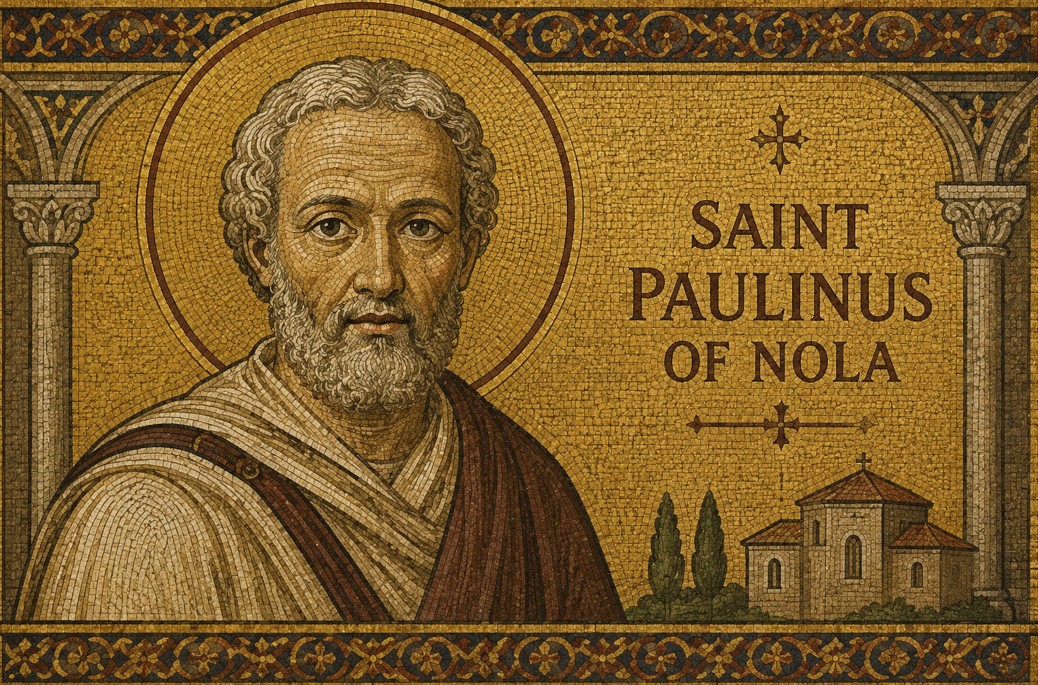
Italy, June 22, 2026: Why is Saint Paulinus of Nola remembered as one of the most inspiring converts of the early Church? Discover the remarkable story of the wealthy Roman senator who abandoned power, prestige, and immense riches to follow Christ, becoming a bishop, poet, and servant of the poor whose example continues to inspire Christians more than sixteen centuries later.


Feast Day: 22 June
Born: Around 354 AD, Bordeaux, Roman Gaul (modern-day France)
Died: 22 June 431 AD, Nola, Italy
Patron of: Bell ringers, widows, abandoned people, and those seeking spiritual renewal
Known For: Renouncing wealth, Christian poetry, charitable works, devotion to Saint Felix of Nola, and serving as Bishop of Nola
Title: Bishop of Nola and Servant of the Poor
Few saints illustrate the transforming power of God's grace as profoundly as Saint Paulinus of Nola.
Born into one of the wealthiest and most influential families of the Roman Empire, Paulinus seemed destined for a life of political success and social prestige. He possessed everything that society admired: education, influence, wealth, and a promising career.
Yet despite his accomplishments, he discovered that earthly success could not satisfy the deepest desires of the human heart.
His conversion led him to surrender his vast fortune, embrace a life of simplicity, and dedicate himself completely to Christ and the service of others.
Today, Saint Paulinus stands as a powerful witness that true riches are found not in possessions but in faith, charity, and devotion to God.
Paulinus was born around 354 AD in Bordeaux, in Roman Gaul, into a wealthy senatorial family.
He received an exceptional education under the famous poet and scholar Ausonius, one of the most respected teachers of the age.
Gifted with intelligence and eloquence, Paulinus quickly rose through the ranks of Roman society. He became a successful administrator and eventually served as governor of Campania in southern Italy.
His future appeared secure, and many expected him to achieve even greater political prominence.
Yet God was preparing him for a very different mission.
(CLICK HERE to follow Catholic Connect for regular News and Content)
Although Paulinus enjoyed success and prosperity, a series of personal experiences gradually drew him closer to Christianity.
His marriage to the devout Christian Therasia strengthened his faith, and together they began living a more prayerful life.
The death of their infant son profoundly affected both husband and wife. In their grief, they turned increasingly toward God, seeking meaning beyond the temporary realities of this world.
This painful loss became a turning point that transformed their priorities and deepened their commitment to Christ.
Inspired by the Gospel, Paulinus and Therasia made a decision that astonished Roman society.
They sold much of their vast property and distributed their wealth to the poor, the sick, and the needy.
Friends and former colleagues were shocked. Many could not understand why a respected senator would willingly abandon privilege and comfort.
For Paulinus, however, the choice was simple. He believed that following Christ required complete trust in God and generous love toward others.
His actions became one of the most celebrated examples of Christian detachment from wealth in the early Church.
As his reputation for holiness grew, Christians admired Paulinus for his humility and charity.
Around 394 AD, he was ordained a priest despite his reluctance to seek positions of authority.
He eventually settled in Nola, Italy, near the shrine of Saint Felix, a local martyr whom he deeply venerated.
There he established a religious community dedicated to prayer, hospitality, and service.
Pilgrims travelling to honour Saint Felix found welcome, encouragement, and spiritual guidance through Paulinus' ministry.
In 409 AD, Paulinus was chosen as Bishop of Nola.
As bishop, he combined spiritual leadership with practical charity. He cared for the poor, assisted refugees, and worked tirelessly to support those suffering from hardship.
His generosity became legendary.
One popular tradition tells how Paulinus offered himself into captivity to secure the freedom of a widow's son who had been taken by invaders. While historians debate the details of the story, it reflects the widespread belief that Paulinus was willing to sacrifice everything for others.
His life embodied Christ's teaching that true greatness is found in service.
Saint Paulinus was also one of the most important Christian writers of his era.
Using the literary skills he had developed as a young scholar, he composed poems, hymns, and letters that celebrated the Christian faith.
His writings reveal a deep love for Scripture, friendship, prayer, and the saints.
Through his poetry, Paulinus helped demonstrate that Christian faith and intellectual excellence could work together in harmony.
Many of his works remain valuable sources for understanding the spirituality of the early Church.
Paulinus lived during a remarkable period of Christian history and maintained friendships with several great saints.
He exchanged letters with figures such as Saint Augustine, Saint Jerome, Saint Martin of Tours, and Saint Ambrose.
These relationships enriched his spiritual life and connected him to some of the most influential Christian thinkers of the age.
His correspondence offers a unique glimpse into the challenges and hopes of the early Church as Christianity spread throughout the Roman world.
As he grew older, Saint Paulinus continued serving the people of Nola with humility and dedication.
Despite political instability and invasions affecting the Roman Empire, he remained a source of comfort and encouragement for his community.
On 22 June 431 AD, Saint Paulinus died peacefully after decades of faithful service.
The people mourned the loss of a bishop who had truly lived the Gospel he preached.
Saint Paulinus left behind a remarkable legacy of faith, charity, and Christian witness.
His life demonstrated that conversion is not merely a change of belief but a transformation of priorities and values.
He showed that wealth can be used generously, talents can be offered to God, and positions of influence can become opportunities for service.
For centuries, Christians have looked to him as an example of joyful sacrifice and wholehearted discipleship.
The life of Saint Paulinus offers important lessons for modern believers:
Saint Paulinus reminds Christians that lasting treasure is found not in what we possess but in how we love.
In a world often focused on wealth, status, and achievement, Saint Paulinus offers a refreshing alternative.
He was a senator who chose simplicity, a wealthy man who embraced generosity, a scholar who served the poor, and a bishop who lived what he preached.
From the cities of the Roman Empire to the modern Church, his example continues to inspire believers to place God above worldly success.
Saint Paulinus of Nola teaches a timeless truth: when we surrender everything to Christ, we discover riches that never fade.
To know about more saints please visit the spiritual section.
By Catholic Connect Reporter
Saint Paulinus of Nola, Saint Paulinus feast day, Bishop of Nola, early Church saints, Catholic converts, Christian poets, Roman saints, saints of June, Saint Felix of Nola, Catholic bishops, wealthy saints who gave away their riches, Christian charity, Church Fathers era saints
© 2026 CATHOLIC CONNECT POWERED BY ATCONLINE LLP