- 16 August, 2026

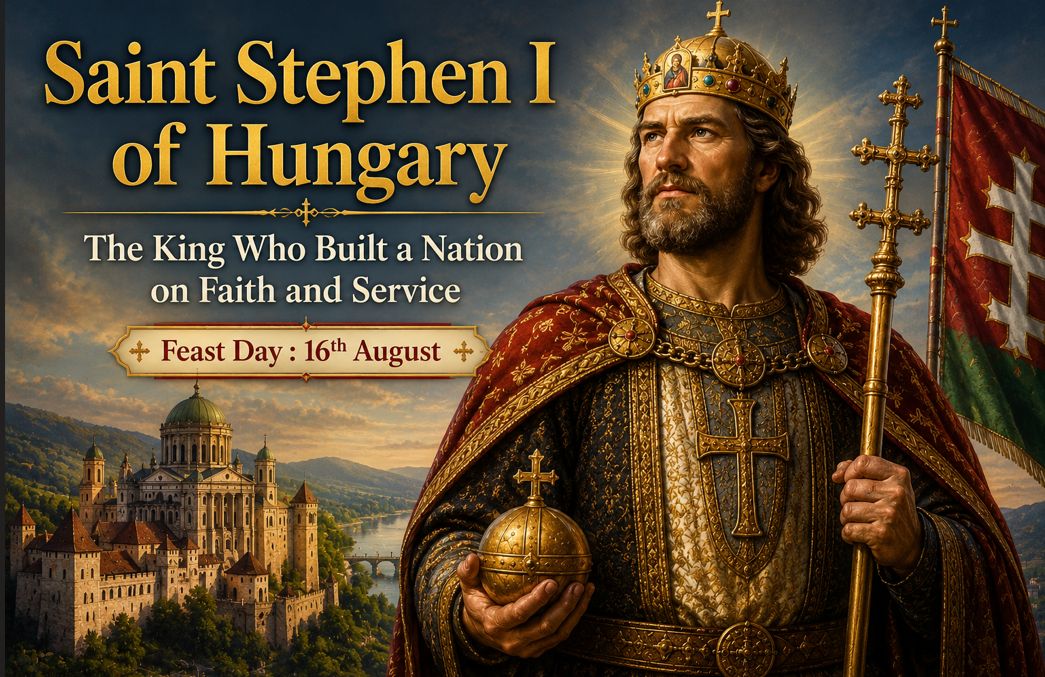
August 16, 2026: Why is Saint Stephen I of Hungary remembered not only as the founder of the Hungarian Christian state, but also as a model of Christian leadership? Discover the remarkable story of the king who embraced the Catholic faith, strengthened the Church in Hungary, and understood his crown not as a privilege, but as a responsibility to serve his people.


Feast Day: 16 August
Born: c. 975, Hungary
Died: 15 August 1038, Székesfehérvár, Hungary
Birth Name: Vajk


Religious Name: Stephen
Canonized: 1083 by Pope Gregory VII
Patron of: Hungary
Known For: First King of Hungary, establishing Christianity in Hungary, founding churches and dioceses, and strengthening the Hungarian Christian state
Title: King and Confessor; Apostle and Founder of the Church in Hungary
Saint Stephen I stands at the beginning of Hungary's Christian history.
Born Vajk, he was raised within the Hungarian ruling dynasty and later embraced Christianity, taking the name Stephen. His conversion became closely connected with the transformation of Hungary into a Christian kingdom.
(Click Here to follow Catholic Connect for regular News & Content)
Stephen understood that governing was more than exercising power.
For him, the crown was a responsibility.
Pope John Paul II later described him as the father of the country, apostle of the Catholic faith, and founder of the Church in Hungary.
Stephen married Blessed Gisela, and together they became part of Hungary's first saintly royal family. Their son, Saint Emeric, was also raised in the Christian faith.
Stephen worked to establish Christianity throughout his kingdom.
He supported missionaries, strengthened Church structures, and encouraged his people to embrace Christian life. Pope Paul VI later recalled Stephen's role in the establishment of the Catholic Church in Hungary and his exemplary devotion to God.
Around the year 1000, Stephen received his royal crown in connection with Pope Sylvester II.
Rather than treating kingship simply as an honour, Stephen understood it as a form of service.
Pope John Paul II emphasized that Stephen sought the good of the community entrusted to him by organizing and defending the kingdom while promoting both human and spiritual development.
His example presents leadership as responsibility rather than privilege.
Stephen established institutions that helped Christianity take lasting root in Hungary.
Churches, dioceses, monasteries, laws, and Christian customs developed during his reign.
His work gave Hungary a stable place among the Christian kingdoms of medieval Europe.
For this reason, the Church remembers him as more than a successful monarch.
He was a builder of Christian civilization.
As his life drew toward its end, Stephen entrusted his kingdom to the Blessed Virgin Mary.
Pope Paul VI recalled that Stephen commended his kingdom and people to Mary's maternal protection, helping establish the deep Marian devotion that became characteristic of Hungarian Catholic life.
This devotion remains an important part of his spiritual legacy.
Stephen died on 15 August 1038.
He was canonized in 1083 and became the principal patron of Hungary. The Church continues to remember him as the founder of the Hungarian Christian state and a powerful example of Christian leadership.
His feast is celebrated on 20 August, Hungary's great national and religious celebration.
Saint Stephen teaches that authority should become service.
He reminds leaders to seek the good of the people entrusted to them rather than personal glory.
His life also shows the importance of building a society rooted in faith, justice, compassion, and responsibility.
Most importantly, Stephen teaches that Christian faith is not merely something to profess privately.
It can shape families, communities, institutions, and nations.
More than a thousand years after his reign, Saint Stephen remains a central figure in Hungary's religious and national identity.
His legacy is not simply the crown he wore, but the Christian vision with which he governed.
He shows that true greatness does not come from possessing power.
It comes from using power faithfully, humbly, and for the good of others.
Saint Stephen's message remains simple and powerful: receive responsibility as a gift, serve others with faith, build what strengthens the common good, and place everything under God's care.
To know about more saints please visit the spiritual section.
By Catholic Connect Reporter
Saint Stephen of Hungary, Saint Stephen I, Stephen I of Hungary, Saint Stephen feast day, August 20 feast day, Hungarian saints, King Stephen, first King of Hungary, patron of Hungary, Catholic saints, Christian kings, Stephen of Hungary biography, founder of Christian Hungary, Hungarian Catholic Church, Blessed Gisela, Saint Emeric, Pope Sylvester II, Christian leadership, saints of Europe, Catholic kings
© 2026 CATHOLIC CONNECT POWERED BY ATCONLINE LLP