- 19 May, 2026

May 19, 2026: In the summer of 1877, in the quiet village of Gietrzwald (then called Dietrichswalde) in Warmia, the Blessed Virgin Mary appeared several times to two Polish peasant girls, Justyna Szafryńska (13) and Barbara Samulowska (12). What makes this event especially moving is that Mary spoke to them in Polish—simple, warm, homely Polish—at a time when that very language was being silenced by the state.


Poland without a map?
At the time of the apparitions, there was no independent Poland on the map of Europe. The country had been partitioned among Prussia, Russia, and Austria since the late 18th century, and the village of Gietrzwald lay in the Prussian part of this divided land. Under Prussian rule, the local Polish population faced pressure to Germanise, including in schools and public life, as part of the broader Kulturkampf campaign against the Catholic Church and Polish identity.
In this tense, hopeful‑yet‑oppressed atmosphere, the apparitions were seen as a quiet but powerful sign that heaven had not forgotten the Polish people. When Mary told the girls that priests would one day return to their “orphaned” parishes and that the Church would not be crushed, villagers heard a promise of spiritual and national resilience in the face of occupation and persecution.


A Mother who speaks Polish
The children testified that the Virgin appeared in the local woods and fields, often near a maple tree close to the parish church, and spoke to them in Polish rather than German. This simple detail carried enormous symbolic weight: Mary came not as a distant, foreign figure, but as a mother of the Polish people, using the language of their homes, prayers, and lullabies.
Historians and Church writers note that Poland had already been deprived of statehood for decades, and that in Warmia Polish‑speaking Catholics were being encouraged—sometimes forced—to use German in schools and public worship. In that context, a heavenly Mother speaking Polish became a sign of comfort and affirmation of their identity, showing that their faith and language were precious in God’s eyes.
The spring and the shrine
During the apparitions, which lasted from June 27 to September 16, 1877, Mary guided the girls to a nearby spring, promising that its waters would bring healing for both body and soul. As news spread, thousands of pilgrims—often traveling on foot—began making their way to Gietrzwald, praying the Rosary, drinking from the spring, and reporting graces.
By September 8, 1877 (the feast of Mary’s Nativity), witnesses spoke of around 50,000 people gathered in one day, a remarkable number for a small village under Prussian rule. Over the decades the shrine grew, and in 1977—exactly one hundred years later—the Church formally recognised the supernatural character of the apparitions, with Cardinal Karol Wojtyła (the future Pope John Paul II) presiding over the official approval.
(CLICK HERE to follow Catholic Connect and stay updated with Catholic News & Content)
Why the Polish language matters
Modern Polish bishops and theologians often emphasise that at Gietrzwald Mary “chose the tongue of the oppressed”: she spoke Polish at a time when the authorities wanted that language to fade. This has made the shrine a powerful symbol of cultural and spiritual survival, not only for Warmia but for the wider Polish nation. [polen](https://www.polen.travel/nl/monumenten/the-shrine-of-our-lady-of-warmia-in-gietrzwald)
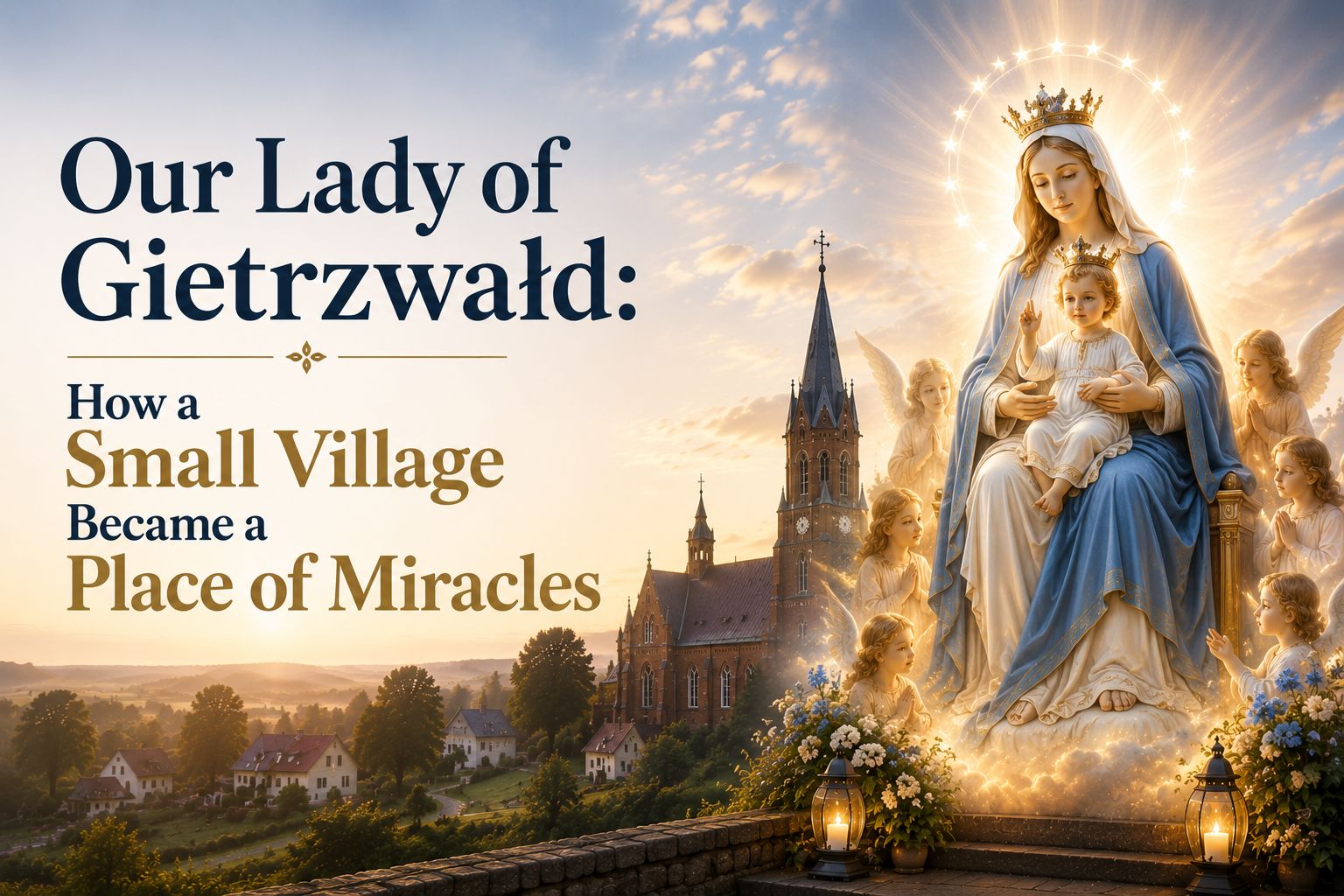
Today, the Sanctuary of Our Lady of Gietrzwald—often called the “Polish Lourdes”—continues to attract about a million pilgrims a year, many of whom come both to seek healing and to renew their sense of identity as a people who have known occupation, division, and yet outlived them. The quiet, smiling image of the Virgin with the Child, the simple woods, and the spring where she promised help all stand as a reminder that Mary enters history not only with grand signs, but also in the language of those who feel most overlooked.
By Catholic Connect Reporter
© 2026 CATHOLIC CONNECT POWERED BY ATCONLINE LLP