- 07 June, 2026

June 07, 2026:


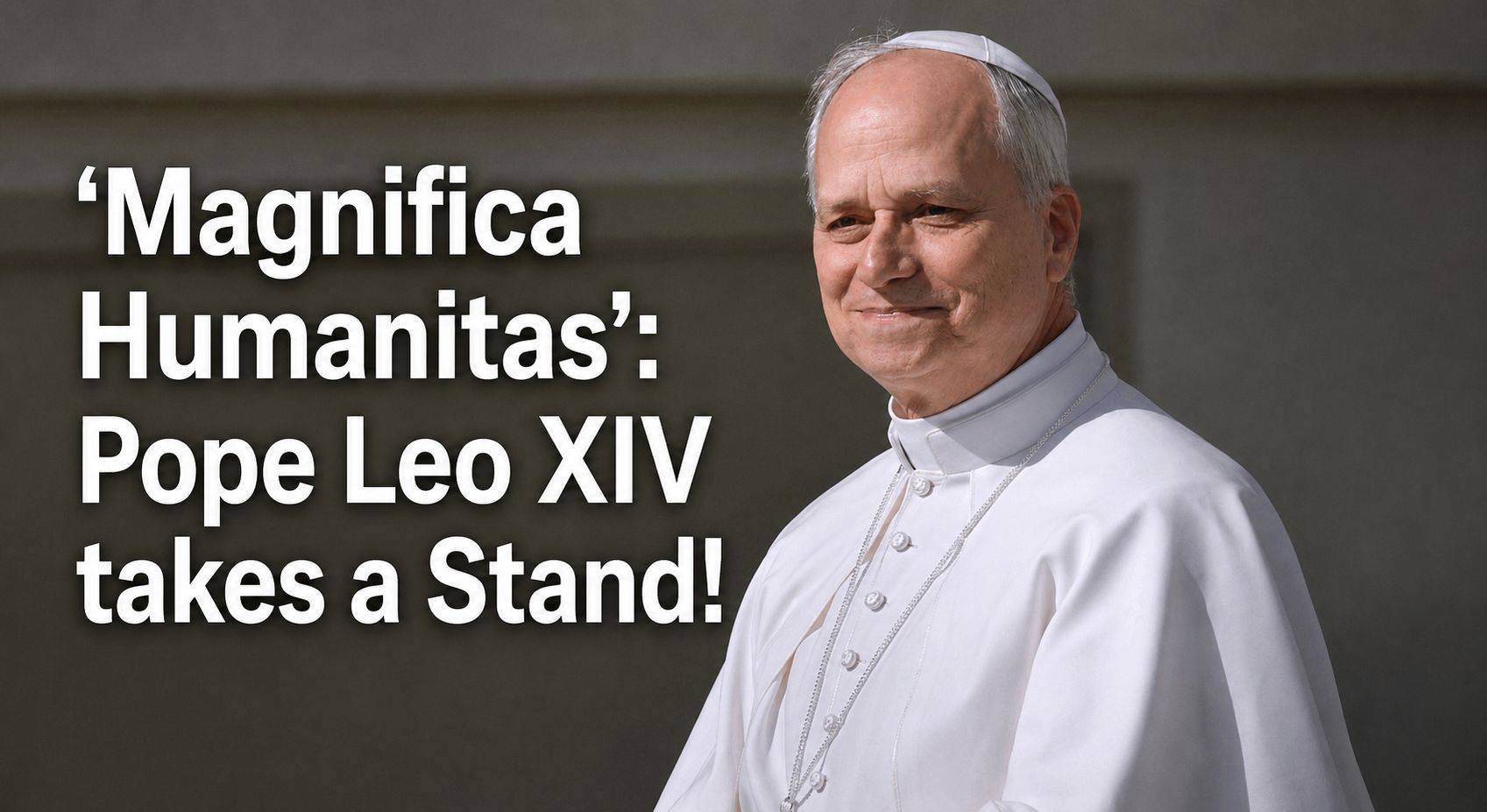
On 25 May 2026, Pope Leo XIV released his first Encyclical ‘Magnifica Humanitas’ (Magnificent Humanity): On Safeguarding the Human Person in the Time of Artificial Intelligence.
In the encyclical, he makes a passionate plea for safeguarding humanity, promoting truth and freedom, the dignity of work; he strongly advocates that the universal destination of goods, subsidiarity, solidarity, human rights, social justice and peace are not only fundamentals for human existence but are also non-negotiable!
Pope Leo signed the document ten days earlier, on 15 May, which was the 135th anniversary of the promulgation of Pope Leo XIII’s powerful 1891 encyclical ‘Rerum Novarum (Of New Things): On the Condition of Labour’. At that time, Pope Leo XIII addressed the severe social and economic upheavals brought about by the Industrial Revolution; for him, the worker was being made into a ‘cog’ for the machine.


‘Magnifica Humanitas’ is woven into a beautiful tapestry through five inter-related chapters.
The first chapter, ‘A Dynamic Approach Faithful to the Gospel’, traces the Social Doctrine of the Church in the magisterium.
The second chapter explores the ‘Foundations and Principles of the Social Doctrine of the Church’.
The third chapter, ‘Technology and Dominance: The Grandeur of Humanity in Light of the Promises of AI’, stresses the need to approach artificial intelligence with vigilance.
In the fourth chapter, ‘Safeguarding Humanity at a Time of Transformation: Truth, Work, Freedom’, the Pope calls for an ecology of communication based on truth.
In the fifth chapter, ‘The Culture of Power and the Civilization of Love’, Pope Leo XIV turns his gaze to war, saying “the digital revolution is changing the nature of conflict.”
Besides, in the Introduction, he gives us the raison d'être and the immediacy for the encyclical; the Conclusion points to the ‘road ahead’, giving one a spirituality for our time.
One needs to read, study, reflect, pray and discuss the document in its entirety to appreciate its wealth and relish its deep spirituality.
From start to finish, Pope Leo catechizes, contextualises, cautions, challenges and commits. He does not mince words as he lays bare the grim reality which grips humanity today. He is unequivocal in what he says and sets a road map for a new world order.
Some highlights of the encyclical include:
TONE
Pope Leo sets the tone and direction of his entire encyclical in his opening words:
“Humanity, created by God in all its grandeur, is today facing a pivotal choice: either to construct a new Tower of Babel or to build the city in which God and humanity dwell together...” (#1)
HUMANITY
For Pope Leo, it is ‘humanity first!’ He wants everyone to continue to remain human.
“With the heart of a shepherd and a father, I ask everyone to abandon the construction of yet another Tower of Babel and to join forces in building up the common good, so that humanity will never lose its beauty...” (#16)
TRUTH
The encyclical states that truth can never be compromised. Truth is a common good and belongs to all.
“The search for truth is an essential element of democracy” (#134).
Falsehood and the inability to distinguish truth from lies is the beginning of totalitarianism.
CRITICAL THINKING
With the onslaught of Artificial Intelligence (AI), we seem to lose our ability to think, reflect, critique, discern and be creative.
Schools and education in general should play a crucial role in fostering this.
“A genuinely healthy attitude is needed, requiring rhythms that incorporate silence, in-depth study, reading and judicious analysis, for without these elements inner freedom may be compromised.”
SOCIAL DOCTRINE
Pope Leo traces the Social Doctrine of the Church from Pope Leo XIII, through Vatican II and right up to Pope Francis.
The foundations (#48-58) are:
Pope Leo highlights five key principles (#59-81) of the Social Doctrine of the Church:
Christians, says Pope Leo, are called to respond to the culture of power by building “the civilization of love.”
ARTIFICIAL INTELLIGENCE
Pope Leo does not deny or denigrate AI; he cautions about the dehumanising dimensions of it.
He warns that a small group of firms now control vast amounts of data, computing power and digital infrastructure.
“When such power is concentrated in the hands of a few it tends to become opaque and evade public oversight...” (#95)
He warns that powerful groups could use AI to shape public opinion, influence democratic systems and steer economies for their own interests.
He also criticises the development of autonomous weapons, stating:
“Artificial Intelligence now demands to be disarmed, freed from logics that turn it into an instrument of domination, exclusion and death.” (#110)
CIVILIZATION OF LOVE
What this world needs is justice, forgiveness, peace and love.
Pope Leo takes a stand against every form of hate, new forms of slavery, violence, injustice and war.
Compassion must reach all — especially migrants and refugees, the poor and marginalised, the excluded and exploited.
THE WAY AHEAD
Pope Leo says:
“It is worthwhile pausing to reflect on some aspects of how we, each in our own way, can cooperate in building the civilization of love...” (#213)
He proposes five paths:
Though Pope Leo concludes his encyclical with the ‘Magnificat: The Song of Mary’ (#243-245), he challenges each one of us to become “weavers of hope” by acting now.
In ‘Magnifica Humanitas’, Pope Leo takes a stand for humanity.
Are we prepared to do likewise?
By Fr. Cedric Prakash SJ
Download Catholic Connect App for Daily News Updates:
Android: Click here to download
Continue Reading on Catholic Connect App
Get access to exclusive news articles & more.
© 2026 CATHOLIC CONNECT POWERED BY ATCONLINE LLP