- 20 October, 2026
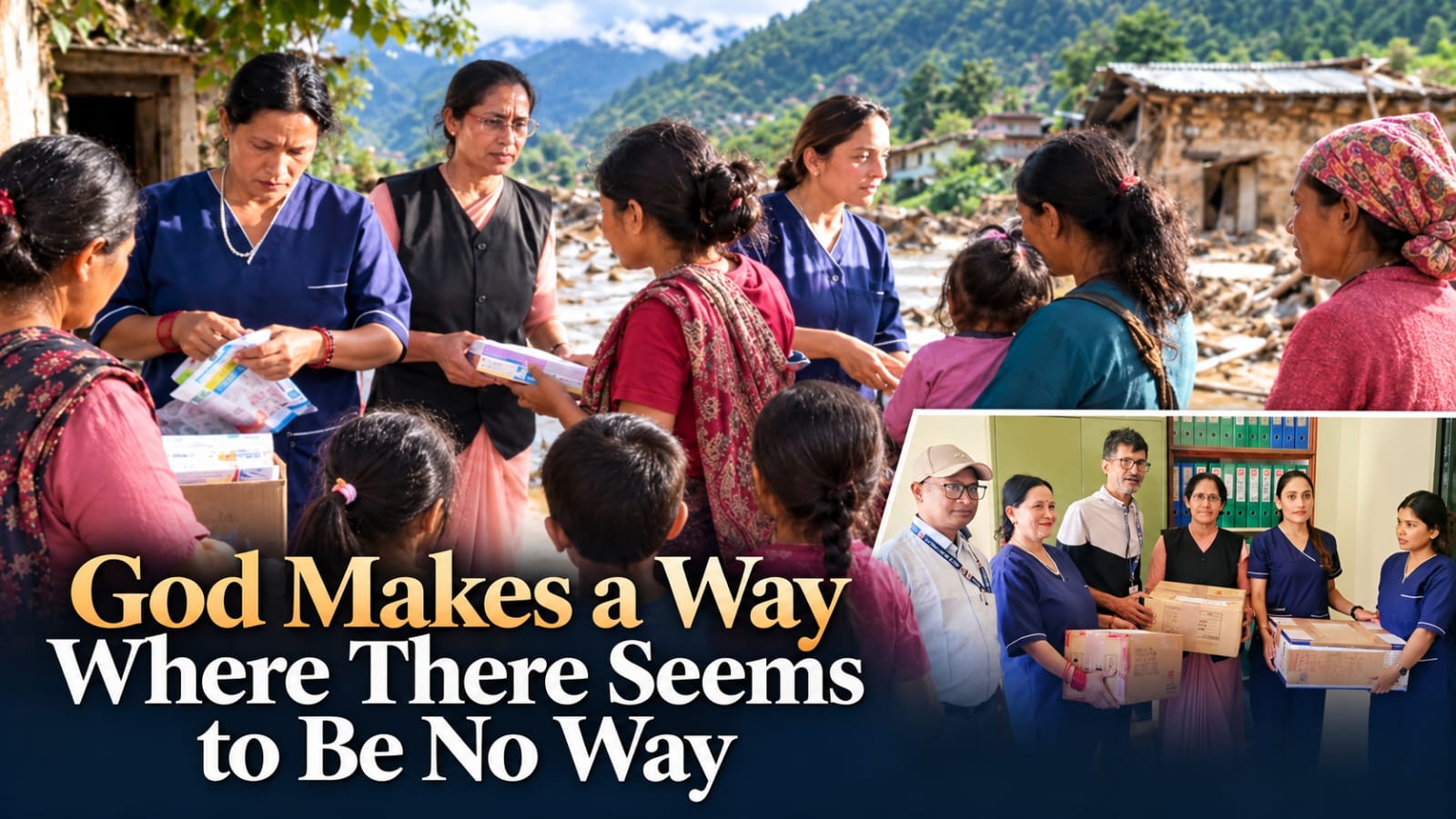
October 20, 2026: On 26 August 2026, devastating flash floods triggered by an ice-related disaster in the Himalayas swept through Nepal’s Rasuwa, Bhote Koshi and Trishuli river regions, destroying homes and bridges and claiming lives. In the aftermath, families faced bereavement, uncertainty and the urgent struggle to meet their most basic needs.

At Preranalaya, Baniyatar, Kathmandu, the tragedy reached us through heartbreaking reports from the affected areas. For two agonising days, we waited anxiously for news of loved ones and people known to us. The reports were devastating: a young boy had lost his mother, one of our hostel girls had lost her father, and several families were mourning their loved ones or desperately searching for missing relatives.
Behind every report of destruction was a human story—of a family torn apart, a child left grieving, or a community struggling to recover from sudden loss. We realised that these families needed more than sympathy. They needed people willing to stand beside them, listen to their pain and help them face the difficult days ahead.
We began visiting bereaved families, offering a listening ear, praying with them and providing food and essential supplies. These were modest interventions in the face of immense suffering, but they allowed us to respond to immediate needs while reminding families that they had not been forgotten.
Yet, the needs extended far beyond the families we could reach in Kathmandu. In remote mountain communities, damaged roads and landslides had made access difficult, while the need for medical care remained urgent. For people already struggling with the consequences of the disaster, distance and disrupted transport could become further barriers to receiving assistance.
We felt called to take our service closer to those communities. Through our mobile clinic mission, we hoped to bring essential medical assistance to people who might otherwise struggle to reach healthcare services.
One journey remains especially vivid in my memory: our mission to Uttargaya, Rasuwa, on 3 September 2026. It was a journey that tested our endurance and determination, but it also revealed the extraordinary power of solidarity and the grace that can sustain those committed to serving others.
Taking Healthcare Where It Is Needed Most
At 5 a.m. on 3 September, our mobile clinic team and I set out for Uttargaya, accompanied by a local health officer from the Rural Municipality. Our vehicle carried emergency medicines, and we were determined to reach the flood-affected communities.
For us, the journey was not simply about reaching a destination. It was about bringing healthcare closer to people whose lives had been disrupted and whose access to assistance had become increasingly difficult. Every mile forward represented an opportunity to serve families in need.
As we climbed into the mountains, the road became increasingly treacherous. Mud, landslides and broken stretches of road made travel hazardous, while long lines of trucks and relief vehicles crowded the damaged route.
Amid the destruction, however, we witnessed a powerful expression of humanitarian solidarity. Vehicles carrying relief materials and teams from different organisations were making their way towards the affected communities. People from different backgrounds were working towards a shared purpose: helping those who had lost so much.
Their efforts reminded me that disaster response is not the responsibility of one individual, organisation or community alone. It requires cooperation, courage and a willingness to put human need before personal convenience. Every relief vehicle and every team moving towards the affected areas represented a commitment to people who could not face the crisis alone.
As conditions worsened, other vehicles turned back. Ours was the only vehicle attempting to climb further into the mountains. Holding a small picture of Maria Bambina and my Rosary, I continued the journey with a prayer in my heart and the needs of the affected people before me.
Suddenly, a strong burning smell came from our vehicle, forcing us to stop twice. Concerned about our safety, I placed Maria Bambina’s picture on the dashboard and entrusted our journey to her maternal care. Soon, the smell disappeared, and we resumed our journey.
A little further ahead, a massive landslide had buried the narrow road beneath mud and boulders. The way forward seemed impossible. We paused, uncertain how we could proceed.
Then, unexpectedly, a JCB appeared along the mountain road and began clearing the debris. We did not know where it had come from, but it cleared enough space for our vehicle to pass.
For me, this unexpected assistance was a reminder that help can arrive when circumstances appear hopeless. It also reinforced the importance of perseverance when people are depending on us.
The challenges continued. Dark clouds gathered, and rain poured over the mountains, yet our vehicle remained untouched by the rain throughout the journey. After six hours on the road, the fuel gauge showed a dangerously low level, but the reading remained unchanged for the next eight hours. At another point, the engine suddenly stopped. After a moment of prayer, it started again.
Each difficulty tested our resolve. Yet, we remained focused on the purpose of our journey: to reach communities in distress and offer whatever medical assistance we could.
“Sister, You Have Brought Light to Us!”
By evening, darkness had enveloped the mountains. Exhausted, hungry and cold, we searched for shelter. Finally, a kind woman welcomed us into her home, shared the rice her family had left and offered us the only available room.
Her hospitality was a moving reminder that humanitarian service is never a one-way exchange. We had travelled to help others, yet we too depended on the generosity of someone who had very little to spare. In a disaster-stricken community, the willingness to share what remains can become an extraordinary act of solidarity.
Then, after nine days without electricity following the floods, the lights suddenly came on.
Looking at us in amazement, the woman exclaimed, “Sister, you have brought light to us!”
The electricity remained on throughout our stay but went off again about thirty minutes after we left the following morning. Her words stayed with me, reflecting the hope that even a brief moment of relief can bring to people living through prolonged hardship.
After sixteen hours of travel, we finally reached the flood-affected communities. Our arrival was an important step towards fulfilling the mission that had brought us there: making medical assistance more accessible to people facing the consequences of the disaster.
A mobile clinic is more than a vehicle carrying medicines. It is a means of bringing care to people when reaching a health facility is difficult. It represents an effort to reduce the distance between those who need help and those who can provide it. In disaster-affected areas, such outreach can be especially important for communities facing damaged infrastructure and disrupted access to essential services.
Our mission also called us to recognise the wider needs of survivors. Medical assistance matters, but so do food, shelter, emotional support and the reassurance that people have not been abandoned. Recovery is not achieved through a single visit or intervention; it requires sustained concern, cooperation and solidarity with affected communities.
We could not undo the destruction or take away every family's grief. What we could do was respond to the needs before us, offer practical assistance and accompany people through a difficult period. For us, this was the heart of humanitarian service: meeting people where they were, respecting their suffering and doing what we could with the resources available.
A Mission Beyond Religious Boundaries
The return journey was equally challenging. Throughout our travels, my non-Catholic staff members and driver had witnessed the unexpected assistance we received. At one point, they said with wonder, “Sister, your God is saving us, continue to pray till we reach back!”
Their words touched me deeply. Our shared experience had brought us together in a situation where concern for one another mattered more than our religious differences. We were united by a common purpose and the responsibility we felt towards the people we had gone to serve.
This, too, is an essential dimension of humanitarian work. Suffering does not distinguish between religions, communities or backgrounds, and our response must be equally inclusive. Every person deserves care, dignity and compassion. When people come together to serve those in need, they build bridges of understanding that can endure long after a crisis has passed.
Faith Expressed Through Service
Looking back, I am deeply grateful for the prayers of our community, the support of our Province, the solidarity of our entire Institute of the Sisters of Charity of Saints Bartolomea Capitanio and Vincenza Gerosa (SCCG), and the dedication of our mobile clinic team.
Our mission was made possible not by one person's efforts alone, but by a network of people who shared a commitment to serving those affected by the floods. The cooperation of our team, the assistance we encountered along the way and the generosity of the people who welcomed us all contributed to the journey.
Carrying a small picture of Maria Bambina and my Rosary, I had set out with faith and a determination to help. I returned with a deeper appreciation of the resilience of affected communities and the importance of making compassion practical.
This experience reaffirmed that faith must lead us beyond words and into action. Prayer sustained us through uncertainty, while humanitarian service called us to respond to suffering with courage and responsibility. Our mission was not to be spectators of another community's tragedy, but to become companions in its struggle towards recovery.
The needs of flood-affected communities cannot be met by goodwill alone. They call for continued medical outreach, essential supplies, cooperation among relief organisations and a sustained commitment to the dignity and well-being of survivors. Even when our resources are limited, we can contribute by listening, accompanying, sharing and responding to the needs within our reach.
I remain grateful for the opportunity to bring medical care and human companionship to people in their hour of need. The journey was dangerous, the obstacles formidable and the outcome uncertain, but the suffering of others gave our efforts a clear purpose.
Under the loving protection of Maria Bambina, we discovered anew that when the road ahead seems impassable, faith can give us the courage to continue—and compassion can show us why we must.
Indeed, God makes a way where there seems to be no way.
About the Author
Sr. Lenita D’Souza belongs to the Congregation of the Sisters of Charity of Saints Bartolomea Capitanio and Vincenza Gerosa (SCCG), popularly known as the Sisters of Maria Bambina. She has been serving in Baniyatar, Nepal, under the New Delhi Province, since January 2024. A 57-year-old gynaecologist, she hails from Mangalore.
By Sr. Lenita D’Souza, SCCG, Nepal
© 2026 CATHOLIC CONNECT POWERED BY ATCONLINE LLP