- 26 July, 2026

NEW DELHI, July 26, 2026: — The deaths of five Indian merchant seafarers in separate attacks on commercial vessels in the Black Sea within a matter of days have renewed concerns over the safety of civilian crews operating in conflict zones.


The incidents, linked to the continuing Russia–Ukraine war, have highlighted the growing risks faced by merchant mariners navigating waters increasingly exposed to missile and drone attacks. India, one of the world's largest suppliers of merchant seafarers, has strongly condemned the attacks and called for the protection of civilian crews and commercial shipping.
The latest fatality was Chief Officer Sagar Gupta, an Indian national who died after the Marshall Islands-flagged MV Omorfi came under attack while transiting the Black Sea on July 18.


According to India's Ministry of External Affairs, the vessel was carrying 10 crew members, including three Indians. Two Indian seafarers survived the attack, while Gupta was killed.
"India unequivocally condemns such attacks targeting commercial shipping and placing the lives of innocent civilian crew members at risk," the ministry said, warning that attacks on merchant vessels threaten freedom of navigation and international trade.
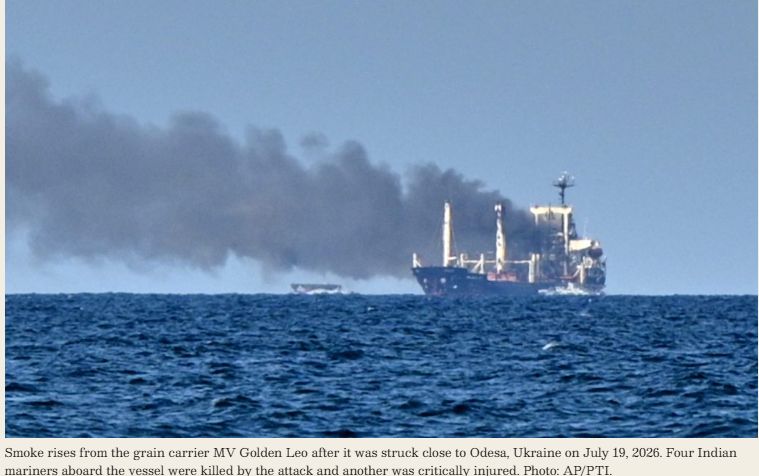
The incident came only days after another deadly attack on the MV Golden Leo, a Guinea-Bissau-flagged cargo vessel carrying grain from Ukraine's Odesa port. Shortly after leaving the port, the vessel was reportedly hit by three cruise missiles, triggering a fire that killed 10 people, including four Indian nationals and a Ukrainian maritime pilot.
Among the Indian victims were 26-year-old seafarer Akhil Joyan from Kerala and Gurpreet Singh Bath from Haryana. Another Indian crew member was critically injured.
The attack was among the deadliest involving a merchant vessel since the outbreak of the war and sent shockwaves through India's maritime community.
The attacks have also raised questions about the growing militarisation of Black Sea shipping routes. Although merchant vessels are civilian ships engaged in international trade, they increasingly find themselves operating amid military confrontations involving Russia and Ukraine.
The two sides have repeatedly accused each other of using commercial maritime routes and shipping infrastructure for military purposes, while denying deliberate attacks on civilian shipping.
Ukrainian authorities have attributed the attack on the MV Golden Leo to Russia. Reports surrounding the MV Omorfi, meanwhile, indicate that the vessel may have been caught in an operation involving Ukrainian drones targeting vessels associated with Russia's merchant fleet.
Regardless of responsibility, the incidents have underscored the vulnerability of civilian crews whose work is essential to the movement of food, fuel and other vital commodities across the world.
India accounts for more than 10 per cent of the global maritime workforce, with Indian officers and crew members serving on ships operating along major international trade routes. Many of them work in waters affected by armed conflicts, political instability and geopolitical tensions.
The Black Sea is not the only region where Indian seafarers face heightened risks. Earlier this year, Indian sailors were also affected by hostilities and disruptions to commercial shipping near the Strait of Hormuz amid escalating tensions in West Asia.
Following the attack on the MV Golden Leo, the Ministry of External Affairs summoned the Russian chargé d'affaires in New Delhi to register India's protest over the deaths of four Indian nationals.
After Gupta's death in the second incident, the Indian government again condemned the attack and called on all parties to respect international maritime law and ensure the safety of commercial vessels and civilian crews navigating international waters.
India has maintained a cautious diplomatic position on the Russia–Ukraine war, repeatedly calling for dialogue and diplomacy while stressing the protection of civilians and the need to safeguard international trade routes.
The deaths have also prompted concern among India's maritime organisations and seafarers' associations. Representatives of the sector have stressed that merchant sailors are civilians engaged in legitimate international commerce and are not participants in military operations.
They have called for stronger international coordination, improved maritime risk assessments and enhanced safeguards for commercial vessels operating in conflict zones.
For thousands of Indian families, seafaring remains an important source of employment and economic security. But the recent deaths have exposed the increasingly dangerous conditions faced by those who work aboard ships travelling through some of the world's busiest maritime corridors.
The loss of five Indian seafarers is a stark reminder that the human cost of war extends far beyond the battlefield. Men transporting grain, fuel and essential goods have become unintended victims of a conflict that continues to disrupt global trade and threaten maritime security.
As India mourns its fallen seafarers, the incidents have strengthened calls for all parties to armed conflicts to uphold international humanitarian law and protect civilian shipping. For the families left behind, however, such appeals come too late, leaving them to bear the personal cost of a war fought far from home but paid for with the lives of those who keep the world's commerce moving.
Courtesy : The Tribune
Photo Courtesy : AP/PTI.


© 2026 CATHOLIC CONNECT POWERED BY ATCONLINE LLP