- 26 July, 2026

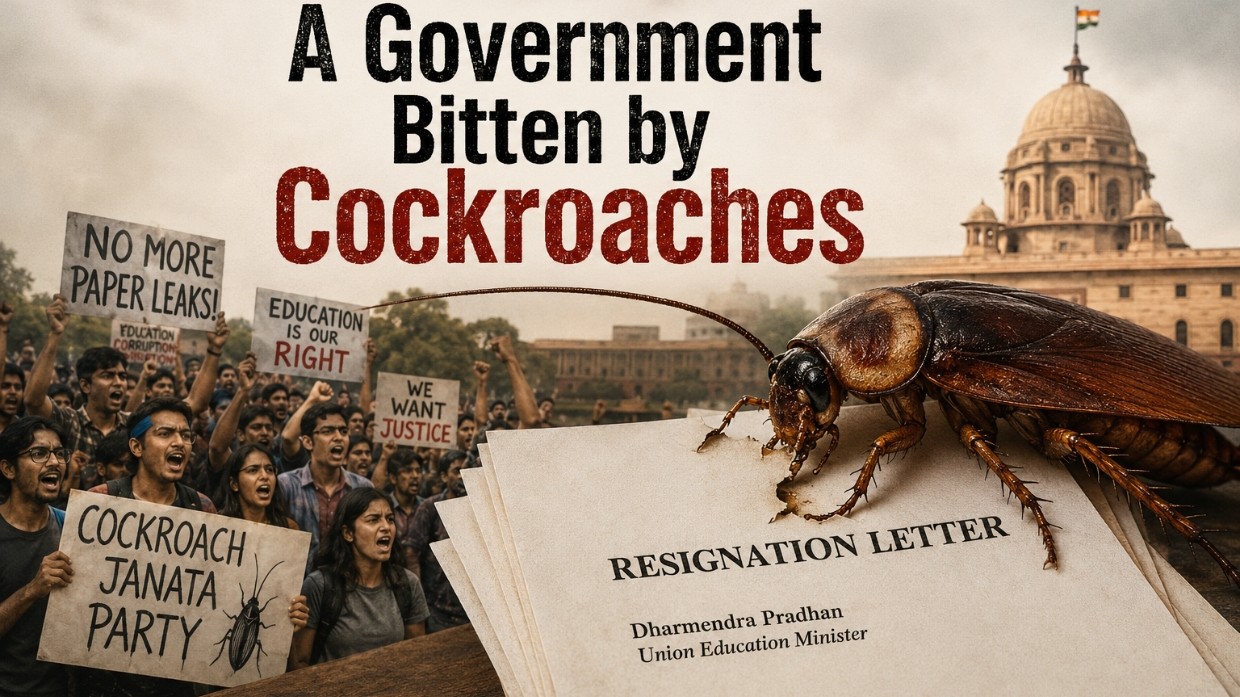
Delhi, July 26, 2026: The students and youths of India have done it—and they have done it meticulously. Union Education Minister Dharmendra Pradhan has put in his papers. Also, the government would give written assurances on their other demands by Tuesday.


A government which went hammer and tongs against the protesters led by the Cockroach Janata Party has ultimately thrown in the towel; an utter surrender to the protesters. To understand how this came about, we need to go back to Jantar Mantar in New Delhi. For the past 36 days, events unfolding there shaped the course of the government’s surrender to the Gen Z protesters. It is only by revisiting that Ground Zero that we can understand what ultimately led to Pradhan's resignation.
So, before we discuss why Pradhan put in his papers, let me take you to where it all began. I was at Jantar Mantar exactly 24 hours before the news of Pradhan's resignation broke. At 2:30 p.m. on Friday, July 24, I reached Janpath, from where one of the roads leading to Jantar Mantar begins, after walking nearly two kilometres in Delhi's hot and humid weather. Most Metro stations in the vicinity had been closed to prevent people from reaching the protest site.


What awaited me was astonishing. Every nook and corner in and around Jantar Mantar, and every road leading to the protest venue, was teeming with people. It was a sea of humanity.
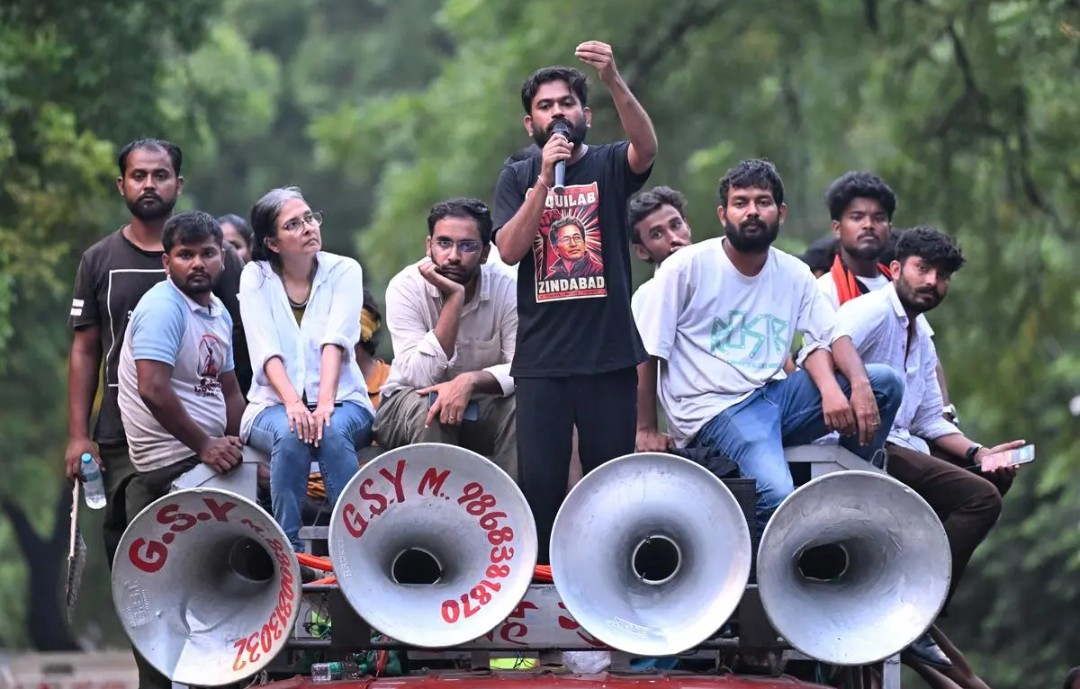
Remember, this was the 35th day of the protest, yet tens of thousands of protesters, mostly students and youths, were there in full force. Some shouted slogans; others held placards and caricatures mocking the government. Prime Minister Narendra Modi and Dharmendra Pradhan were the principal targets of the protesters' ire. Some groups sat on the ground singing protest songs, while others painted. There were many making reels and memes. Unlike traditional protest sites, the scenes here were diverse. In no time, these scenes were shared through social media across the globe.
On both sides of the roads leading to the main stage were tents erected by various student organisations. They were festooned with placards, banners, posters, and artwork reflecting the mood of the movement. Modi and his government were the target of attacks; they were the butt of jokes.
The protesters had travelled from every corner of the country. Jantar Mantar had become the microcosm of India. They had gathered to challenge a system that, in their view, had failed them—a system that had deprived them of seats in educational institutions and denied them opportunities in government jobs despite their qualifications.
Their anger was directed squarely at the Modi government. Their speeches, slogans, photographs, banners, memes, cartoons and videos were shared millions of times across social media platforms, amplifying their message far beyond the protest site.
The mounting public attention and the growing discontent among the country's youth placed the government under increasing pressure. As the protests gathered momentum, the political cost of ignoring them became harder to overlook.
As the protests gained momentum, two developments proved to be the last nails in the coffin.
The first was the removal of Sonam Wangchuk, the renowned educationalist from Ladakh who was on hunger strike at Jantar Mantar for 20 days, by the Delhi Police on the morning of July 18. The second was the police atrocities on the protesters who were marching to Parliament on July 20. Scores of protesters were beaten indiscriminately. The police resorted not only to water cannons and tear gas but also, according to reports, fired pellet rounds. Both these actions failed to break the protesters' resolve. If anything, it had the opposite effect. The crowds at Jantar Mantar swelled in the days that followed as more and more young people joined the movement. No police force could stem that tide.
It was at this point that the government decided to yield. Modi had underestimated the resolve of Gen Z. He may have believed that the protesters would eventually tire and disperse. Instead, their determination only grew stronger.
The government appears to have recognised the risks of allowing the agitation to continue unchecked. Unlike many protests organised by political parties, which often struggle to sustain public participation, the movement led by the Cockroach Janata Party drew support that appeared spontaneous and grassroots. It came from students and youths who believed they had been denied a fair chance at education and employment. They decided to take the bull by its horns. And the result is there for all to see.
From the epicentre of CJP protest – Jantar Mantar – many messages emerge, both for the government and the people.
• Narendra Modi appears to relent only when confronted with what he perceives as an electoral threat. As the CJP protest spread across the country and a social media–savvy generation amplified anti-Modi sentiment with remarkable speed, the government chose to remove Dharmendra Pradhan. Without that mounting political pressure, it is difficult to imagine such a decision being taken.
• Gen Z has shown that it cannot be intimidated by Central investigative agencies such as the ED and the CBI. Unburdened by fear, many young protesters were prepared to stand up to the might of the government.
• The success of the protest demonstrates that a united youth movement can become a formidable political force. It suggests that the collective strength of determined young people can outweigh the arrogance of those in power.
• The movement also illustrates that police action cannot suppress a large-scale protest sustained by conviction and moral uprightness.
• Finally, the agitation underscores a timeless democratic lesson: what cannot always be achieved in legislatures may, at times, be accomplished through peaceful, determined public protest.
• There is yet another important message from Ground Zero. The mainstream media has, to a large extent, lost its footing, voice, and relevance. Instead of consistently championing people's concerns, much of it is perceived as echoing the government's narrative. As a result, new media platforms have increasingly occupied the space once dominated by traditional media. They have emerged as powerful channels for public discourse, amplifying voices and issues that often receive little attention elsewhere. Their growing influence can no longer be ignored.
Now a bigger question continues to beg for an answer – will the resignation of one Pradhan solve a rotten system wherein paper leak is only a symptom? How will the problems that have left the country’s education in decay be solved?
As the education system becomes increasingly centralized, sidelining the states as part of a predetermined agenda, the country is being driven backwards at the expense of modern, inclusive, and equitable education. Can one expect the Centre to change its track after being bitten by cockroaches?
By Marydasan John
Continue Reading on Catholic Connect App
Get access to exclusive news articles & more.

© 2026 CATHOLIC CONNECT POWERED BY ATCONLINE LLP