- 06 May, 2026

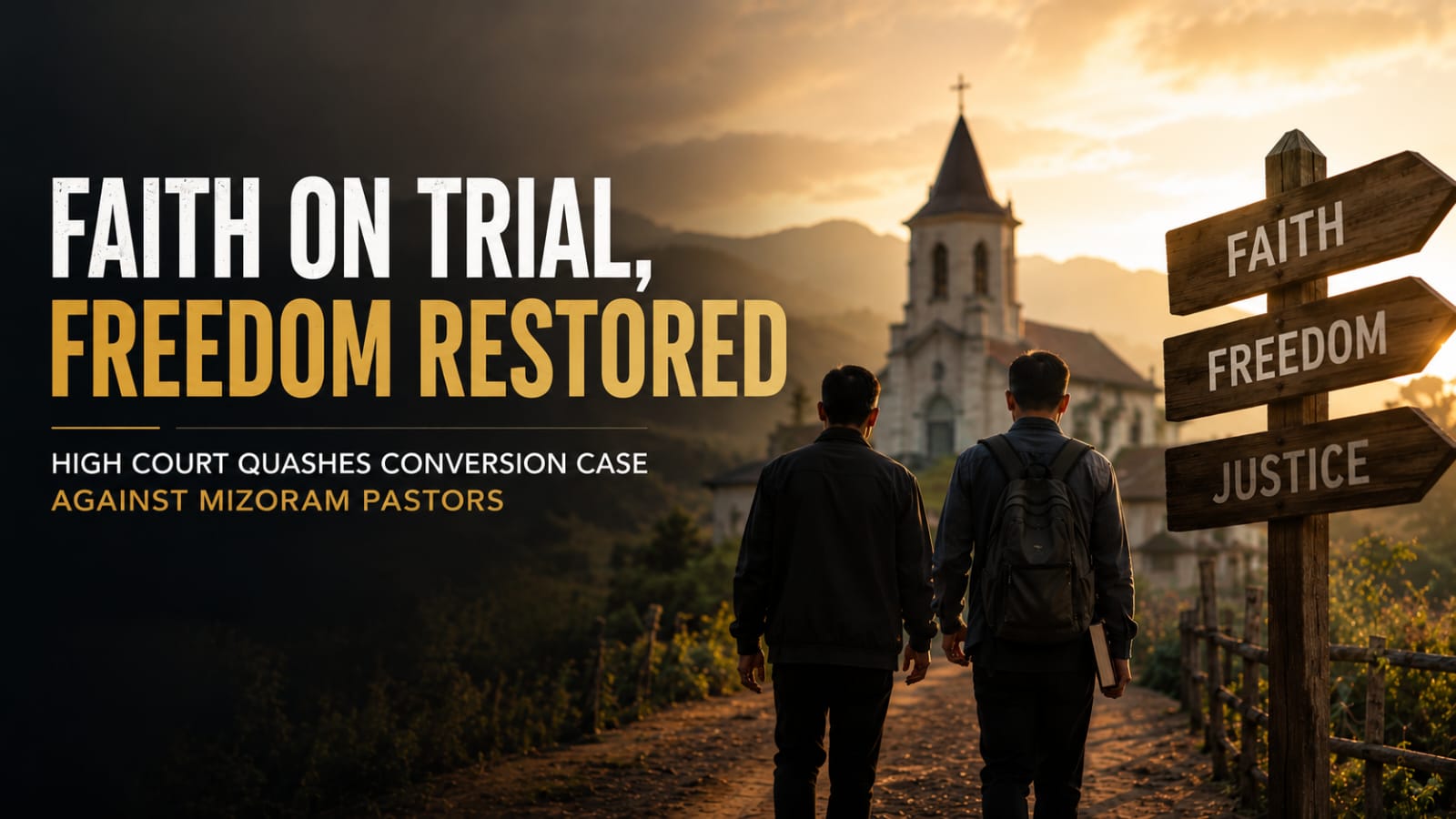
May 6, 2026: In a judgment that has reaffirmed the constitutional promise of religious freedom, the Allahabad High Court has quashed a controversial conversion case against two Christian pastors from Mizoram, bringing closure to a months-long ordeal marked by suspicion, detention, and legal uncertainty.


The case, which began with a simple pastoral visit in a village in Uttar Pradesh, unfolded into a stark illustration of the challenges faced by religious minorities in certain parts of India. Pastors Lal and Mawi (names changed), who were serving in Raebareli district, had travelled in January 2025 at the request of a local Christian couple seeking prayer.
What awaited them, however, was not a quiet moment of pastoral care. Their arrival drew the attention of a small group gathered nearby. Their distinct Northeastern features quickly became a point of suspicion. Accusations followed—of being “outsiders” and of coming with the intent to convert. Within minutes, the situation escalated as a crowd gathered.


Despite the tense atmosphere, the pastors fulfilled their purpose and prayed with the family. But as they prepared to leave, they were intercepted and taken to the police station. Soon after, a case was registered against them under the state’s anti-conversion law.
The charges were serious. They were accused of offering inducements such as money and medical assistance, coercing individuals into reading the Bible, and even misrepresenting Christian communion practices in alarming terms. Their arrest sent ripples of concern back to their home state of Mizoram, where their church community mobilised in prayer and support.
Legal assistance came through ADF India, whose allied lawyers took up their case. An initial bail plea was rejected by a lower court, prolonging their incarceration. It was only on January 23 that bail was granted, and even then, procedural delays meant the pastors were released from jail nearly a month after their arrest, on February 5.
As the case progressed, a deeper flaw in the prosecution began to emerge. When the matter reached the High Court under provisions of the Bharatiya Nagarik Suraksha Sanhita, it was revealed that the complaint had been filed in the name of an 80-year-old man—without his knowledge or consent. With the supposed complainant neither initiating nor supporting the allegations, the foundation of the case crumbled.
On April 10, 2026, the High Court decisively set aside the proceedings, quashing the charge sheet, summons, and all related actions. The ruling brought not only legal vindication but also a sense of spiritual affirmation for the pastors.
Reflecting on the experience, Pastor Lal described not fear, but endurance. The most difficult part, he said, was the prolonged separation from family and the uncertainty that accompanied it. Yet, he remained sustained by faith and the prayers of his community. “We were not afraid. God was with us,” he shared, recalling how he had been preparing a sermon on Saint Peter stepping into the storm—unaware that he himself would soon face one.
Beyond the personal relief of the two pastors, the case highlights a broader and troubling pattern. Studies, including analyses by Article 14, indicate that a significant number of cases under anti-conversion laws in Uttar Pradesh are initiated not by alleged victims but by third parties. Such practices raise serious questions about the misuse of legal provisions intended to protect vulnerable individuals.
This concern has also been echoed by the Supreme Court of India, which in October 2025 quashed multiple similar cases in Fatehpur district, noting the absence of genuine complainants and the role of vested interests.
At its core, the episode underscores the enduring relevance of Article 25 of the Indian Constitution, which guarantees every citizen the right to freely profess, practice, and propagate religion. As reaffirmed by the courts, this freedom cannot be curtailed by suspicion, social pressure, or the actions of self-appointed guardians of faith.
For the two pastors from Mizoram, the verdict marks a return—not only to their ministry, but to a renewed sense of mission shaped by trial and grace.
Courtesy: ADF

© 2026 CATHOLIC CONNECT POWERED BY ATCONLINE LLP