- 03 October, 2026

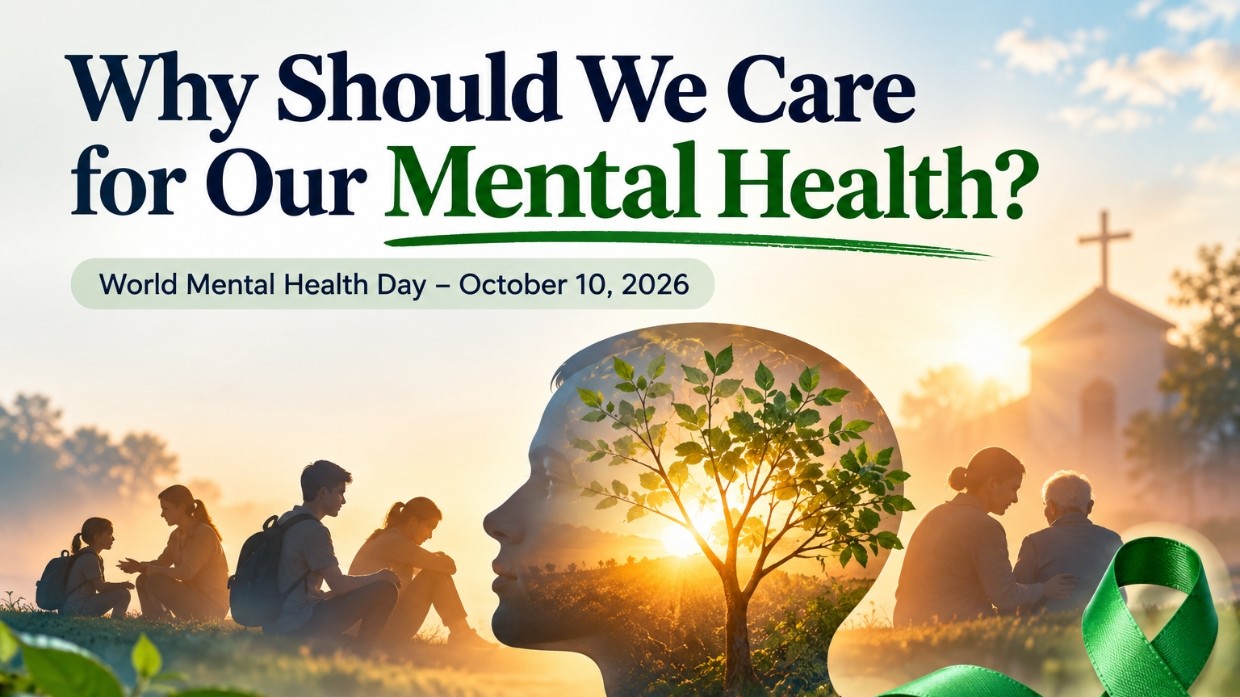
October 3, 2026: When our phone falls, we immediately check it. When our vehicle makes an unusual sound, we pay attention. When our body hurts, we seek medical help.



But what about the mind that carries us through every day?
What happens when it grows tired, gets hurt, becomes heavy with worry, or cries silently because there is no one to whom it can speak?
Behind every smile is a mind. Behind every tear is a mind. Through the mind, we love, dream, struggle, fall, hope and rise again. If we want not merely to exist, but to experience life, love it, enjoy it and live it fully, we must care for our mental health.
This is at the heart of the Catholic Mental Health Ministry of India: to build a culture in which emotional pain is noticed, people are heard without judgment, timely help is encouraged, faith nurtures hope, professional care is respected, and no one is left to struggle alone.
So let us ask ourselves: Why should we care for our mental health?
1. A Healthy Mind Helps Us Live, Not Merely Exist
Some people smile on the outside while breaking inside. Someone who is always there for everyone may quietly wonder, “Who is there for me?” A person carrying the weight of an entire family may not even realise when their own mind has become exhausted.
Mental health does not promise a life without pain. It helps us face pain without losing ourselves, rise after falling and rediscover joy.
And the pain of one person rarely remains with that person alone. When a parent is overwhelmed, the whole family may feel it. When that person begins to heal, conversation returns, affection returns and hope returns. When one mind is hurting, its shadow can fall across a home. When one mind begins to heal, its light can fill that home again.
Mental health care therefore belongs not only in hospitals and counselling rooms. It belongs in our homes, schools, parishes and communities—where people live, love, struggle, pray, work and grow. Mental health ministry begins when we notice before we judge, listen before we advise, accompany before we abandon, and help before a struggle becomes a crisis.
2. Every Season of Life Needs a Caring Mind
2.1 Let a Child Grow Up Saying, “I Can”
Tell a child repeatedly, “You can’t,” and one day that child may begin repeating those words within. But say, “You made a mistake. Try again. You can learn. I am here with you,” and we plant hope.
Children need more than food, education and protection. Their minds need love, safety, acceptance, appreciation and someone who listens. When a child cries, instead of merely trying to stop the tears, let us ask, “What happened?” The words we plant today may become a child’s inner voice tomorrow.
May that voice say: “I can. I matter. I am loved. Someone is there for me.” This is where mental health ministry begins—not only after a problem appears, but much earlier, by creating families, schools and faith communities where children feel safe, valued and heard.
2.2 Let a Young Person Dream Again
Young people carry beautiful dreams, but also face academic pressure, comparison, relationship difficulties, rejection, social media pressures, uncertainty and fear of failure.
A disappointing result may feel like, “My future is over.” A broken relationship may become, “Will anyone ever understand me?” At such moments, asking, “Is this really a problem?” may close a heart. But saying, “This seems hard. Would you like to talk? I’m listening,” can open it.
Young people do not always need answers. Sometimes they need someone who will simply stay and listen. One failure does not define a life. One rejection does not destroy a person’s worth. One painful chapter does not end the story.
Let us care for young minds so that they can dream again.
Our families, schools, colleges, youth groups and parishes must become places where young people can speak before their pain becomes unbearable—where listening becomes prevention, accompaniment becomes early intervention, and timely support restores hope.
2.3 Who Cares for the One Who Cares for Everyone?
Some people carry family, work, children, illness, financial pressures and responsibilities while continuing to say, “I’m fine.”
They may smile all day and cry only when no one is watching. Even the person who is everyone’s pillar needs a shoulder. Even the caregiver needs to be cared for.
Perhaps we know such a person. Perhaps we are that person.
Saying, “I am tired. I need rest. I need to talk. I need help,” is not weakness. Sometimes it is courage. A caring community does not wait for someone to collapse before asking how they are. It notices the tired face, the unusual silence, the withdrawn friend, the overwhelmed parent and the exhausted caregiver.
Sometimes mental health ministry begins with one sincere question:
“How are you—really?”
2.4 Give Our Elders More Than Medicine
We buy their medicines. We take them to hospitals. We make sure they have eaten. But when did we last sit beside them and ask, “How are you—really?” Sometimes the deepest pain of old age is not physical. It is the quiet feeling: “No one looks for me anymore.”
A phone call. A few minutes beside them. Listening to the same story again. Holding a hand. These simple gestures can say something enormous: “You still matter. You are not forgotten. Your life is still precious.” Mental health ministry is also a ministry of presence—helping another person feel seen, heard, valued and accompanied.
3. Listen Before the Mind Breaks
“I’m managing” does not always mean “I’m well.” Sleeplessness, irritability, withdrawal, loss of interest, strained relationships and persistent emotional distress may indicate that something within us is struggling.
We do not ignore a warning light in our vehicle. Why ignore the warning signs within us?
Sometimes we need to sit quietly and ask: “How am I—really? Am I living my life, or merely getting through my days?”
Emotional wounds deserve care just as physical wounds do. When someone finally says, “I cannot carry this alone anymore,” let us not call them weak. We do not know how many nights they may have struggled alone before finding the courage to say it. Asking for help is not giving up on life. It is reaching out to take hold of life again. And sometimes, one hand reaching back can change the direction of an entire life.
This is why we need communities that move from stigma to acceptance, from silence to conversation, from isolation to accompaniment, and from helplessness to hope.
4. Let No One Struggle Alone
Mental health is not the responsibility of mental health professionals alone. Families, teachers, clergy, religious, counsellors, health professionals, volunteers, friends and neighbours can all become part of a caring network.
Through the Catholic Mental Health Ministry of India, particularly its mission in Tamil Nadu and Pondicherry, we seek to strengthen this culture of care through dioceses, parishes, families, educational institutions and communities by promoting awareness, strengthening prevention, encouraging early intervention, supporting individuals and families, connecting people with appropriate professional care, and accompanying them with compassion and hope.
A parish can become more than a place where people pray together. It can become a community where no one has to suffer alone. A school can become more than a place of academic achievement. It can become a place where a struggling child is noticed. A family can become more than people sharing a house. It can become a safe place where someone can say, “I am not okay,” and still hear, “You are loved. We are with you.”
This is mental health ministry at its most human: notice the person, listen to the pain, stay beside the struggle, connect with appropriate help, strengthen hope, and walk together towards healing.
5. Faith, Care and Professional Help Can Walk Together
We check our phone battery repeatedly. When did we last check the energy left in our own mind?
Our minds need rest, sleep, physical activity, healthy relationships, recreation, nature, silence, prayer, spiritual nourishment and gratitude. When emotional distress persists or begins to affect everyday life, seeking qualified professional help is an act of wisdom and care.
Faith and professional care need not compete. Prayer can strengthen us. Relationships can hold us. Professional care can guide us. Faith can nourish meaning. Hope can keep us moving. Above all, the mind needs people. We may not be able to solve another person’s problems. But we can say:
“You are not alone. I am here.”
Sometimes a person does not need another piece of advice. They need someone who will not walk away. That is accompaniment. That is compassion. That too is mental health ministry.
6. Let Life Bloom Again
Think of a garden. We do not wait until a plant has withered before watering it. We care for it so that it can keep living, growing and blooming.
The mind is a garden too. Worry may grow like weeds. Disappointment may make its leaves fall. Sorrow may pour like rain. Loneliness may burn like summer heat. But we do not abandon the garden. We water it with love. We protect it through relationships. We renew it with rest. We strengthen it through faith. We plant hope. We seek help when needed. And we accompany one another until life begins to bloom again.
That is why we care for mental health: so that a child can say, “I can”; a young person can dream again; an exhausted caregiver does not collapse alone; an elderly person can still feel, “My life is precious”; and a family can share not merely a house, but their hearts. We care for our minds so that after falling, we can rise; after being wounded, we can heal; after crying, we can smile again; after failing, we can try again; and when darkness comes, we can still walk towards the light.
Conclusion
Life is not a journey without tears. It is learning to smile again after the tears. It is not about never falling. It is about rising again after the fall. Life is not about never facing darkness. It is about finding a light and walking towards it.
So let us notice the child who needs encouragement, the young person who needs someone to listen, the exhausted adult who has been strong for too long, the elderly person waiting for a call, and the friend who has suddenly become silent. And then, quietly, let us turn to our own minds and ask:
“How are you?”
Let our families become places of understanding, our schools places of emotional safety, our parishes communities of accompaniment, our dioceses networks of care, and our Church a compassionate presence that notices, listens, accompanies and connects people with the help they need.
Let us love our people while they are with us. Let us live our days while they are ours. Let us value life while it is still in our hands.
Let us not merely pass through life. Let us feel it. Love it. Share it. Live it.
Let Us Care for Mental Health; Let Us Celebrate Human Life!
Dr. Fr. J. Francis Xavier Nelson
Regional Director, Catholic Mental Health Ministry – Tamil Nadu and Pondicherry
Director, Kottar Diocesan Counseling Ministry, Nagercoil
Continue Reading on Catholic Connect App
Get access to exclusive news articles & more.




© 2026 CATHOLIC CONNECT POWERED BY ATCONLINE LLP