- 03 October, 2026

Oct 3, 2026: The Jubilee Year of St. Francis of Assisi marking the anniversary of his Transitus (passing into eternal life) arrives at a critical juncture for the Church and the world. We need him today not as a statue to be admired, but as a prophetic voice to be heard. The true question before us is not whether we remember Francis but whether we are prepared to be unsettled by the Gospel he lived.


Eight centuries after he surrendered himself to God, Francis’s witness remains strikingly contemporary. He lived in an era of war, social division and religious conflict. Today despite technological wealth we remain haunted by poverty, violence, ecological degradation and a profound crisis of fraternity. Therefore this Jubilee cannot merely be a commemoration; it must spark an introspection leading to conversion.
Francis did not simply preach the Gospel—he allowed it to dramatically reshape his existence. His transformation was cemented when he publicly stripped off his clothing before the Bishop of Assisi handing them back to his wealthy merchant father. In that act of renouncing his inheritance Francis declared his security lay not in wealth or status but in God alone. This radical evangelical poverty freed him to embrace the excluded and discover in creation a reflection of the Creator.
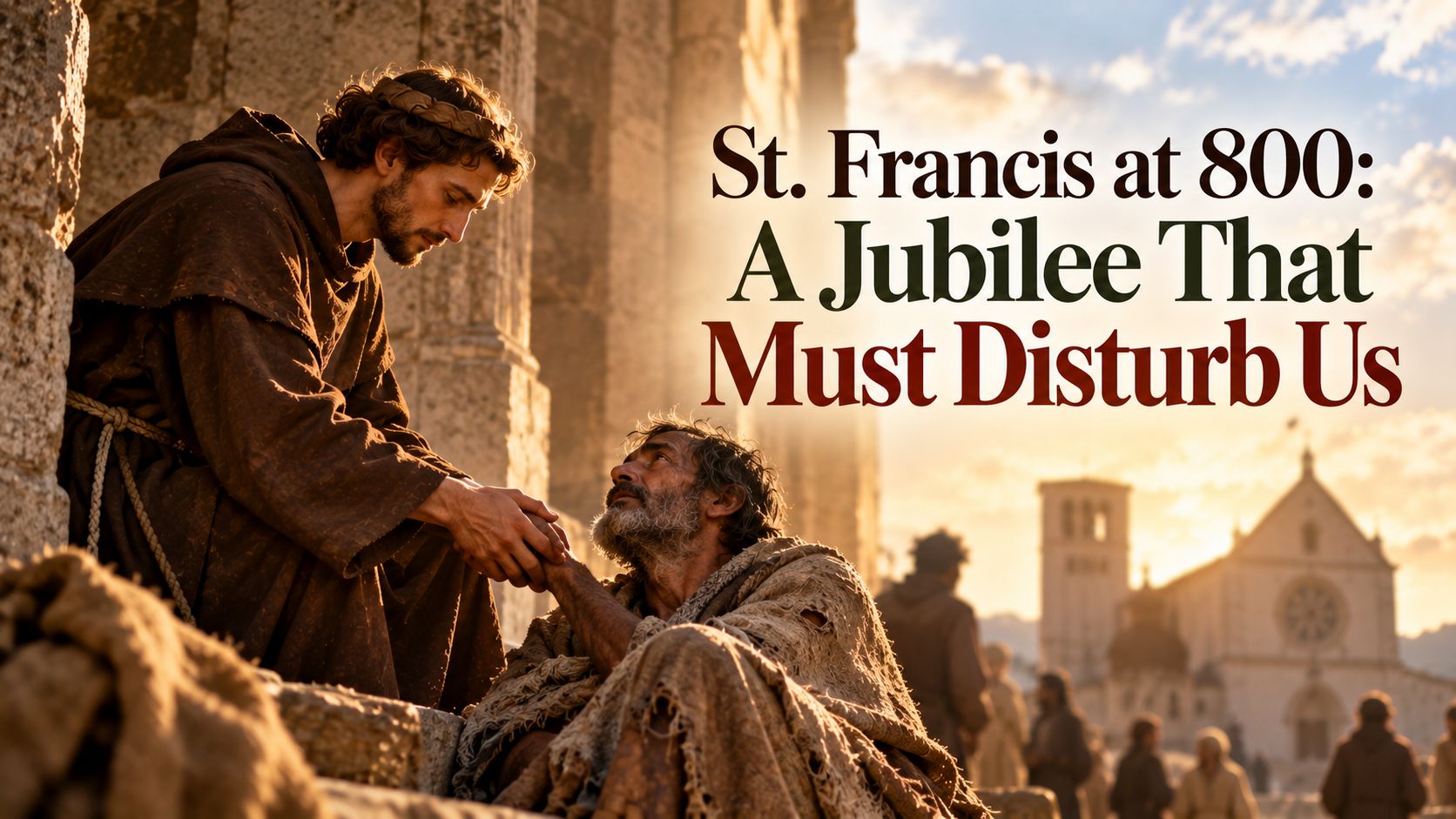
His greatness lies in making the Gospel credible by living it. When Francis embraced the leper outside Assisi—a person he had utterly despised—he realized he was embracing Christ Himself. His conversion was fundamentally a transformation in how he viewed the marginalized.
Few modern figures have channelled this spirit visibly as Pope Francis. By choosing the saints name he signalled a Church that remembers the poor reaches the peripheries and treats creation as a gift. Laudato Si’ placed ecological care at the heart of responsibility while Fratelli Tutti presented social friendship as the antidote to a fragmented world.
This spirituality emphasizes that love for Christ cannot remain purely interior. As Pope Francis noted in Dilexit Nos and Pope Leo XIV advanced in Dilexi Te, authentic Christian love must manifest in our care for the vulnerable. We cannot claim to love Christ while remaining indifferent to those He calls His brothers and sisters.
This Franciscan vision is particularly resonant in today’s India. The nation’s extraordinary diversity is increasingly strained by poverty, caste discrimination, religious polarization and social exclusion. Simultaneously an escalating crisis—pollution, deforestation and climate disasters—disproportionately impacts the poorest communities.
St. Francis offers no formula for these crises but rather a revolutionary way of seeing: the poor as persons of inherent dignity, the stranger as a sibling, creation as a divine gift and peace as the active fruit of reconciliation. In a divided society this perspective is desperately needed.
The Jubilee also calls the Church to look into herself. Early in his journey Francis heard Christ speak from the crucifix at San Damiano: "Go, Francis and repair my Church in ruins." Initially he rebuilt stone walls. Eventually he realized the true mandate was to rebuild the vitality of a wealthy powerful Church that had lost its Gospel compass.
Today we rightly take pride in the network of schools, hospitals and social centres built through generations of sacrifice. Yet institutions can become absorbed in self-preservation. When property, administration and expansion overshadow the mission the Gospel risks retreating behind walls. We must ask: What happens when service devolves into administration and leadership into status?
Francis reminds us that the Church’s credibility stems from the authenticity of its witness, not the size of its structures. Are the poor still at the centre of our ministries? Does our lifestyle reflect the simplicity we preach? Are we building bridges in a society tempted to build walls?
Toward the end of his life at Mount La Verna, his solidarity with the suffering Christ culminated in receiving the stigmata. He bore the wounds of Christ because he loved a broken world so fiercely.
This Jubilee calls us to move from admiration to imitation from charity to solidarity and from security, to missionary courage. The ultimate question facing the Church at 800 is unsettling but necessary: If St. Francis were to walk into our institutions today would he recognize the Gospel he spent his life trying to live?
The answer will determine whether this Jubilee is merely an anniversary—or the dawn of renewal.
By Fr Suresh Mathew OFM Cap


© 2026 CATHOLIC CONNECT POWERED BY ATCONLINE LLP