- 14 September, 2026

September 14, 2026: On 14 September, Catholics celebrate the Exaltation of the Holy Cross. Why exalt an ancient instrument of execution?

Because the Cross is inseparable from Jesus Christ. The Church does not glorify suffering for its own sake, nor does she adore wood or metal as possessing divine power. Catholics venerate the Cross because its honour is directed to Christ, who redeemed humanity through His Passion.
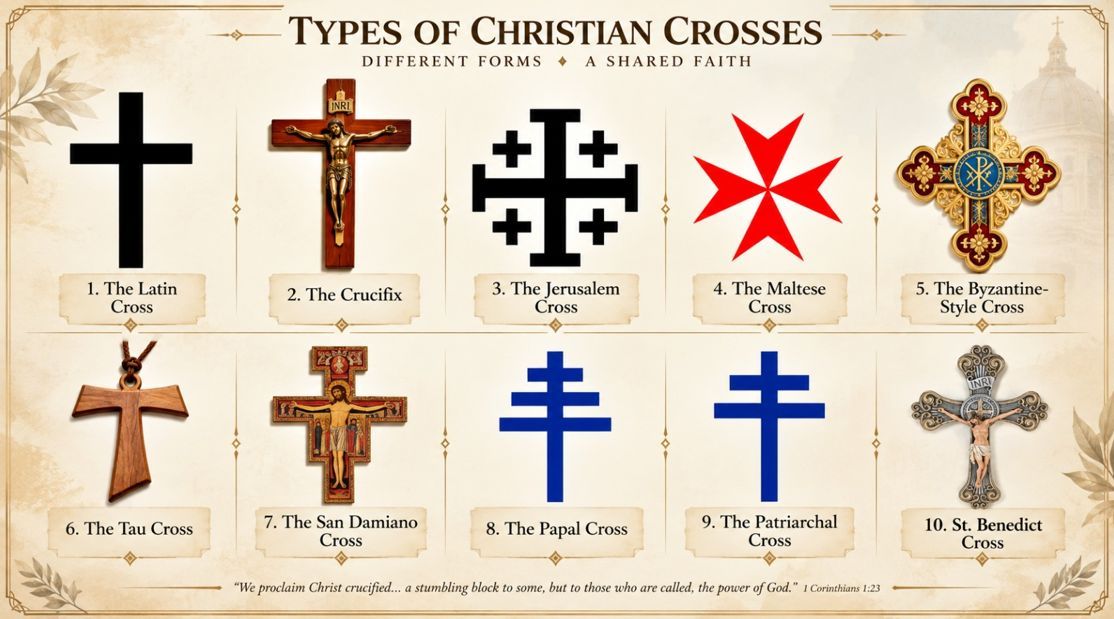
Catholic churches contain many forms of the Cross. Their different shapes do not represent competing beliefs, but the richness of Catholic tradition, history and devotion.

The Latin Cross has a long vertical beam and a shorter horizontal beam, reflecting the traditional Western representation of Christ's Cross.
Its proportions draw attention upward and downward, visually recalling Christ's Crucifixion and His descent into death and victory over it.
It became the most recognisable cross in Western Christianity and remains a central Catholic symbol of Christ's Passion and Resurrection.
A Crucifix is a Cross bearing the body of Christ, rather than showing the Cross alone.
The visible figure of Christ directs attention specifically to His suffering, sacrifice and self-giving love.
Its purpose is devotional: it helps the faithful contemplate that salvation came through Christ's Passion.
(CLICK HERE to follow Catholic Connect and to stay updated with Catholic News & Content)
The Byzantine-style cross often has three horizontal bars, with the lowest sometimes shown as a slanting footrest.
The additional bars reflect traditional representations of the inscription above Christ and the footrest beneath Him.
The meanings attributed to these elements vary among traditions and are devotional interpretations, not binding Catholic doctrine.
It is found in both Eastern Orthodox and Eastern Catholic traditions.
The Jerusalem Cross consists of a large central cross surrounded by four smaller crosses.
Its distinctive design is strongly associated with Jerusalem and the Christian heritage of the Holy Land.
The five crosses have traditionally been associated with Christ's five wounds; the four smaller crosses are also often interpreted as symbolising the Gospel reaching the four corners of the earth.
These are longstanding devotional interpretations, not Catholic doctrines.
The Maltese Cross has four V-shaped arms forming eight distinct points.
Its distinctive form is closely associated with the Sovereign Military Order of Malta and its history of service to pilgrims and the sick.
The eight points have traditionally been associated with the eight Beatitudes in devotional symbolism.
This interpretation should not be confused with binding Catholic teaching.
The Tau Cross is shaped like the letter T, without an upper extension above the horizontal bar.
Its simple form has ancient Christian associations and became particularly important to St Francis of Assisi.
For Franciscan spirituality, the Tau became a sign of conversion, humility and commitment to Christ.
The San Damiano Cross is a painted Crucifix rich in biblical figures surrounding Christ.
Its detailed composition places Christ at the centre while presenting witnesses to His Passion and Resurrection.
St Francis prayed before this Cross at San Damiano, giving the image a special place in Franciscan spirituality.
It is not, however, exclusively a Franciscan form of the Cross.
The Papal Cross is traditionally represented with three horizontal bars of different lengths.
The three-barred form became associated with the papacy and its ecclesiastical symbolism.
Its precise symbolic meanings have varied, however, and should be understood within historical and heraldic tradition rather than as binding doctrine.
The Patriarchal Cross generally has two horizontal bars, with the upper one shorter than the principal crossbeam.
It has been used in ecclesiastical and heraldic traditions associated with patriarchs and archbishops.
Its precise symbolism and usage have varied across history, so claims about its meaning should be treated as traditional rather than doctrinal.
The St Benedict Crucifix combines a Crucifix with the Medal of St Benedict, surrounding the Cross with inscriptions and symbols associated with the saint.
The letters CSPB mean Crux Sancti Patris Benedicti (“The Cross of our Holy Father Benedict”), while Vade retro Satana (“Begone, Satan”) appears among the traditional inscriptions.
The design expresses Christian faith in Christ's Cross and a rejection of evil, while the medal's symbolism is closely connected with the spiritual tradition of St Benedict.
Its use is devotional; Catholics should not understand the medal or Crucifix as possessing magical power.
Why so many crosses? Because Catholic Christianity contains diverse Eastern and Western traditions, religious orders, saints and devotional customs.
Their shapes may differ, but their ultimate reference is the same: Jesus Christ.
On the Feast of the Exaltation of the Holy Cross, Catholics do not celebrate suffering itself. They celebrate the mystery by which Christ transformed the Cross from an instrument of death into a sign of divine love, redemption and victory.
There may be many crosses in the Catholic Church.
But there is one Christ, one faith, and one Cross of salvation.
By Catholic Connect Reporter



© 2026 CATHOLIC CONNECT POWERED BY ATCONLINE LLP