- 19 September, 2026

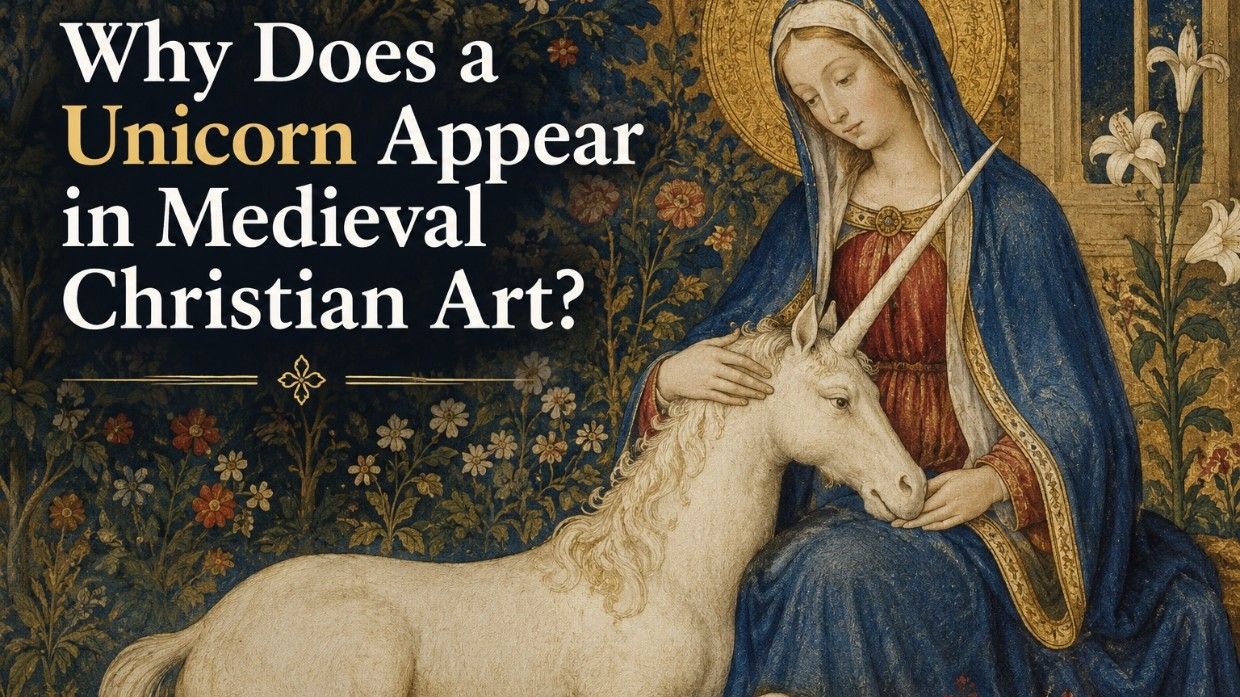
September 19, 2026: The unicorn may seem like an unusual creature to find in medieval Christian art. Yet medieval Christians sometimes used it as a symbolic image, especially to represent the mystery of Christ’s Incarnation and, by association, purity.


From ancient symbolism to Christian allegory
The unicorn was known in ancient and medieval traditions as a rare and untamable creature. Christian writers did not present it as an article of faith or as a creature mentioned in Christian doctrine. Rather, they used stories about it allegorically, drawing spiritual lessons from familiar cultural traditions.
The early Christian work known as the Physiologus tells that the unicorn could be captured only when it rested in the lap of a pure virgin. It interpreted this image as a symbol of the Incarnation: Christ, the divine Son, came into the world by being born of the Virgin Mary.

A symbol of the Incarnation
In this interpretation, the unicorn does not primarily represent Mary herself. Instead, the creature’s approach to the pure virgin points symbolically to Christ’s Incarnation through Mary.
The image therefore expresses a specifically Christian truth: the eternal Son of God truly became man and was born of the Virgin Mary. The unicorn’s legendary qualities served as a visual analogy, not as the foundation of the Church’s teaching about Christ.
Purity and virginity
Because the legend connected the unicorn with a pure virgin, the creature also became associated with purity, chastity and virginity in medieval symbolism. These meanings could support Marian devotion, since the Church venerates Mary as the Virgin Mother of Jesus.
Nevertheless, the unicorn should not be treated as an official or universal symbol of Mary. Its meaning depends on the context of the artwork, and in some cases the creature may have been included for decorative or imaginative reasons. Medieval art used animals—both real and legendary—to express virtues, vices and theological ideas.
Not the biblical “unicorn”
The unicorn of medieval Christian art should also be distinguished from the animal sometimes called a “unicorn” in older English translations of the Bible. The Hebrew word re’em most likely referred to a wild ox or aurochs, not the legendary one-horned creature.
Thus, the medieval Christian unicorn is mainly a product of allegorical tradition rather than a biblical animal.
Its appearance in Christian art shows how medieval artists used familiar stories and creatures to communicate truths about Christ. When connected with the Virgin Mary, the unicorn can remind viewers of the purity associated with her and, above all, of the mystery of the Incarnation: the Son of God became man and dwelt among us.
By Catholic Connect Reporter
Continue Reading on Catholic Connect App
Get access to exclusive news articles & more.







© 2026 CATHOLIC CONNECT POWERED BY ATCONLINE LLP