- 01 June, 2026

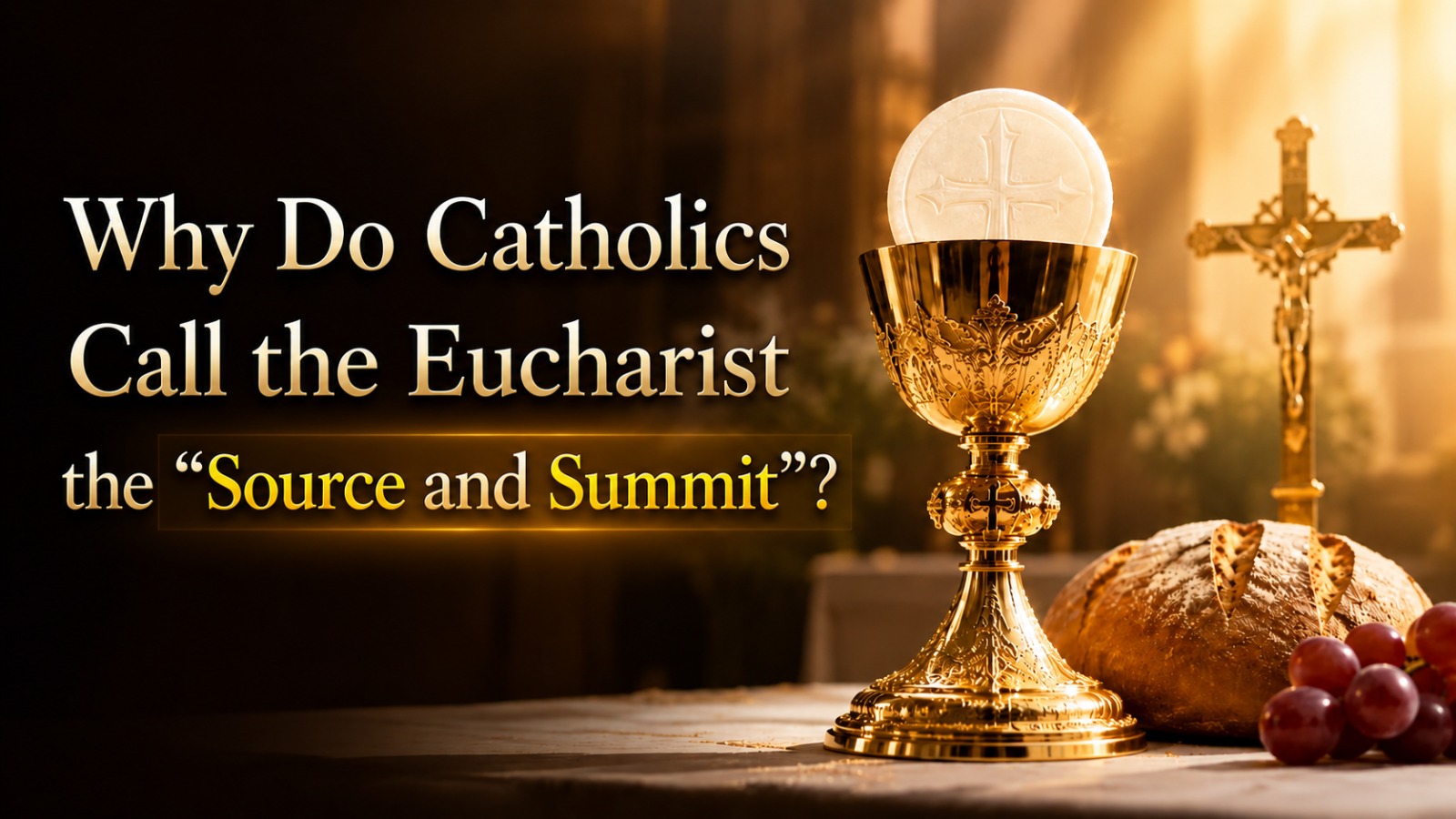
June 1, 2026: Every Catholic has heard the Eucharist described as the “source and summit of the Christian life.” It is one of the Church’s most important teachings, appearing in both Lumen Gentium of the Second Vatican Council and the Catechism of the Catholic Church (CCC 1324).


But what does the phrase actually mean?
At first glance, it may sound like theological language reserved for scholars and priests. Yet the idea behind it is surprisingly simple. The Eucharist is called the “source and summit” because it is both the beginning and the goal of the Christian life. It is where believers receive the grace to live their faith, and it is also the highest expression of their relationship with God.

A Source That Never Runs Dry
Imagine a spring high in the mountains. Water flows from it and gives life to everything in its path. Without the source, the river would not exist.
The Church teaches that the Eucharist is like that source. It is the wellspring from which Christians receive spiritual nourishment, strength, and grace for their daily lives.
This is possible because Catholics believe that the Eucharist is not merely a symbol. During Mass, bread and wine are transformed by the power of the Holy Spirit into the Body and Blood of Christ. This teaching, known as transubstantiation, means that Christ is truly, really, and substantially present in the Eucharist.
Because Christ Himself is present, the Eucharist contains what the Catechism calls “the whole spiritual good of the Church, namely Christ himself, our Pasch” (CCC 1324).
The Eucharist is also the source because it makes present Christ’s one redemptive sacrifice on Calvary. Catholics do not believe that Jesus is sacrificed again. Rather, His saving sacrifice is made present, allowing believers to participate in the mystery of redemption and receive the grace flowing from it.
(CLICK HERE to follow Catholic Connect for regular Catholic Content and News updates)
The Highest Point of Catholic Life
If the Eucharist is the source, it is also the summit.
A summit is the highest point of a mountain—the destination towards which climbers direct all their efforts. In the same way, the Eucharist is the highest point of Christian worship and life.
Every prayer, sacrifice, act of charity, ministry, and good work ultimately finds its fulfilment in communion with Christ. The Catechism teaches that all the sacraments, ecclesiastical ministries, and works of the apostolate are bound up with the Eucharist and oriented towards it.
This means that everything the Church does points in some way to the Eucharist. Baptism prepares believers for it. Confirmation strengthens them to live it. The Church’s mission of service and evangelisation draws its strength from it.
The Eucharist is therefore not one activity among many. It stands at the very centre of Catholic life.
Where Heaven and Earth Meet
One of the most beautiful aspects of the Eucharist is that it offers a glimpse of heaven.
The Catechism teaches that through the Eucharistic celebration, believers unite themselves with the heavenly liturgy and anticipate eternal life (CCC 1326). For this reason, the Eucharist is often described as a foretaste of heaven.
At every Mass, Catholics are reminded that their faith is not only about the present life but also about the promise of eternal communion with God. In the Eucharist, heaven and earth meet in a unique way.
This is why receiving Holy Communion is considered the most intimate encounter with Christ possible on this side of eternity.
The Sacrament of Unity
The Eucharist is not only about an individual’s relationship with God. It also brings believers together as one family of faith.
According to the Catechism, the Eucharist is “the efficacious sign and sublime cause” of the unity of the People of God (CCC 1325). By sharing in the one Bread and the one Cup, Catholics are united not only with Christ but also with one another.
This truth was understood by the early Church. St. Augustine reflected on the mystery of the Eucharist by teaching that believers become what they receive. While ordinary food becomes part of the person who eats it, the Eucharist works differently. Christ transforms those who receive Him, shaping them into His Body, the Church.
The Heartbeat of Catholic Life
The Catechism goes so far as to say that “the Eucharist is the sum and summary of our faith” (CCC 1327). That is a remarkable statement, but it explains why the Church gives the Eucharist such a central place.
It is the source because it gives believers the grace and strength to live as disciples of Christ. It is the summit because it is the highest expression of worship and communion with God. It is the sacrament that nourishes, unites, and directs the entire life of the Church.
For Catholics, the Eucharist is far more than a ritual performed on Sunday. It is the heartbeat of Christian life—the place where believers encounter Christ, draw strength for their journey, and catch a glimpse of the heavenly banquet to which they are ultimately called.
By Catholic Connect Reporter
© 2026 CATHOLIC CONNECT POWERED BY ATCONLINE LLP