- 06 August, 2026

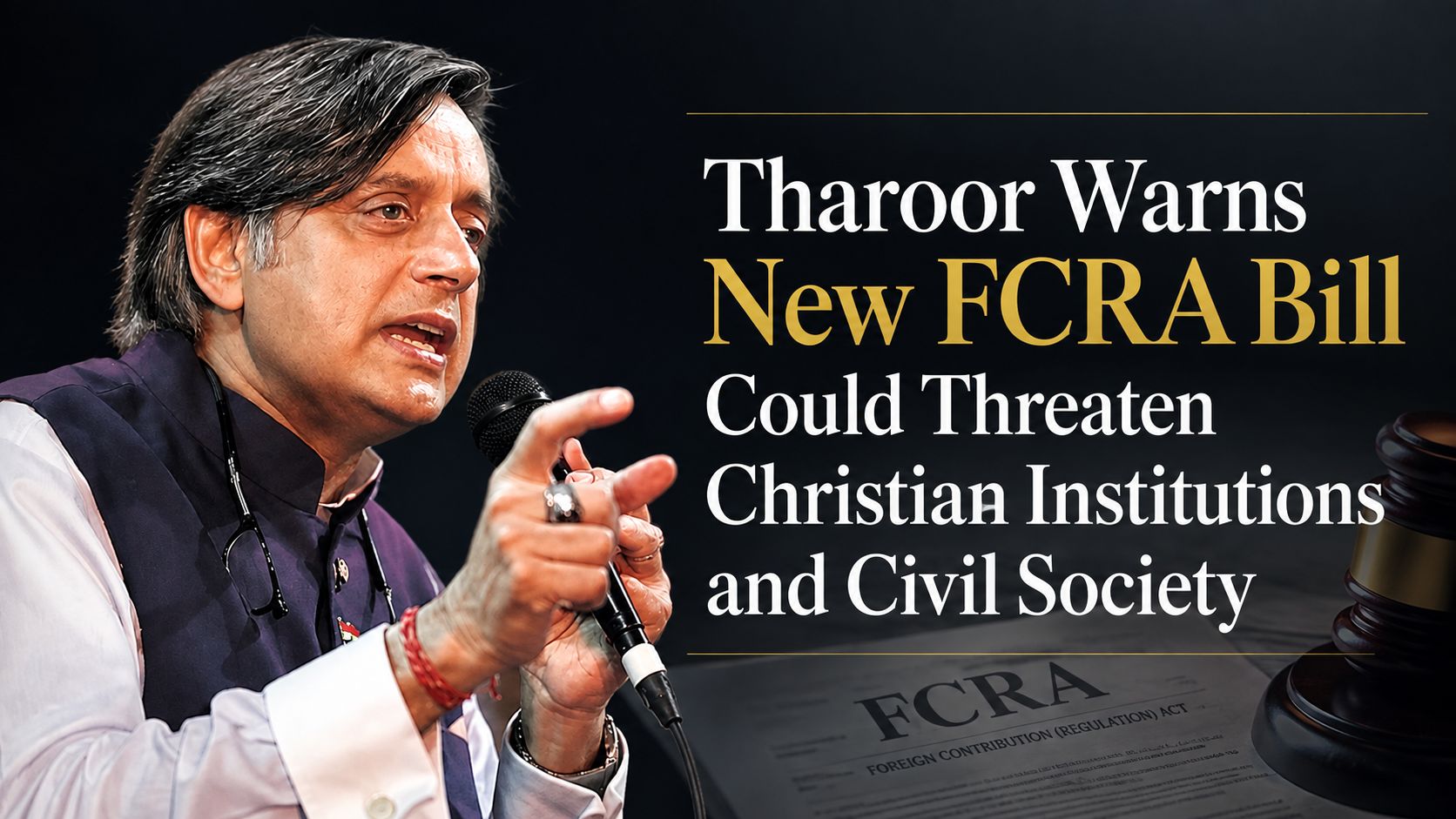
New Delhi, August 6, 2026: Congress MP Shashi Tharoor has criticised the proposed Foreign Contribution (Regulation) Amendment Bill, 2026, warning that its provisions could significantly expand executive control over non-governmental organisations and pose serious challenges to Christian institutions involved in healthcare, education and social welfare.


In an opinion article published in The Indian Express on August 6, Tharoor described the Bill, reintroduced in the Lok Sabha during the Monsoon Session after being withdrawn in April, as a move towards greater centralisation of executive power. He argued that the proposed legislation goes beyond transparency and regulatory oversight and could alter the relationship between the government and civil society organisations.
The Thiruvananthapuram MP expressed particular concern about the possible impact on long-established Christian charitable institutions, including hospitals, schools, medical colleges, diagnostic centres and welfare organisations.


According to Tharoor, these institutions often depend on a combination of domestic contributions, fees and foreign grants to provide healthcare, education and social services, particularly to marginalised communities.
One of his principal objections concerns provisions that would allow a government-appointed Designated Authority to take control of an organisation’s foreign-funded assets if its FCRA registration is suspended, cancelled or not renewed. Tharoor claimed that, under the proposed framework, such assets could ultimately be sold and the proceeds transferred to the Consolidated Fund of India.
He also raised concerns about the proposed concept of “deemed cessation”, under which an organisation could lose its FCRA registration if it failed to submit a renewal application within the prescribed period or if its renewal application was rejected by the Union Home Ministry.
Tharoor warned that linking the status of an organisation’s FCRA registration to control over physical property could create uncertainty for charitable institutions operating hospitals, schools and other public-service facilities.
He cited the example of a large charitable hospital potentially facing disruption if its FCRA registration were suspended, arguing that the immediate beneficiaries affected would be ordinary people dependent on affordable healthcare and social services.
The Congress MP further contended that the proposed provisions could raise constitutional questions concerning the right to property under Article 300A, equality before law under Article 14, and the freedom to practise and propagate religion under Article 25 and the right of religious denominations to manage their affairs and property under Article 26.
For Christian organisations, Tharoor argued, the implications are particularly significant because Catholic and other Christian institutions have operated educational, healthcare and social welfare facilities in India for generations.
He maintained that these organisations have contributed substantially to the country’s development by educating children, treating patients and providing assistance to vulnerable communities irrespective of caste or religious background.
Tharoor also criticised what he described as increasing regulatory pressure on non-profit organisations, referring to restrictions on sub-granting, limits on administrative expenditure and requirements concerning the handling of foreign contributions. He argued that such measures have made it increasingly difficult for grassroots organisations to function.
The Congress leader called for strong parliamentary scrutiny of the proposed legislation and urged Opposition parties to seek its referral to a Select Committee for clause-by-clause examination. He also called for public consultation and participation by civil society organisations before the Bill is considered further.
The FCRA Bill has emerged as a contentious issue during the ongoing Monsoon Session, contributing to a broader confrontation between the government and Opposition over the functioning of Parliament. The government has also reached out to Opposition leaders in an effort to break the parliamentary deadlock surrounding the legislation.
Tharoor’s intervention is likely to add to concerns among Christian organisations and other civil society groups over the potential consequences of the proposed changes, particularly for institutions that combine foreign contributions with domestic resources to provide education, healthcare and social services.
The debate over the Bill now centres on a larger question: how to ensure accountability and transparency in the use of foreign contributions without undermining the autonomy of legitimate charitable and civil society institutions.
Courtesy: Indian Express
© 2026 CATHOLIC CONNECT POWERED BY ATCONLINE LLP