
- 02 August, 2026

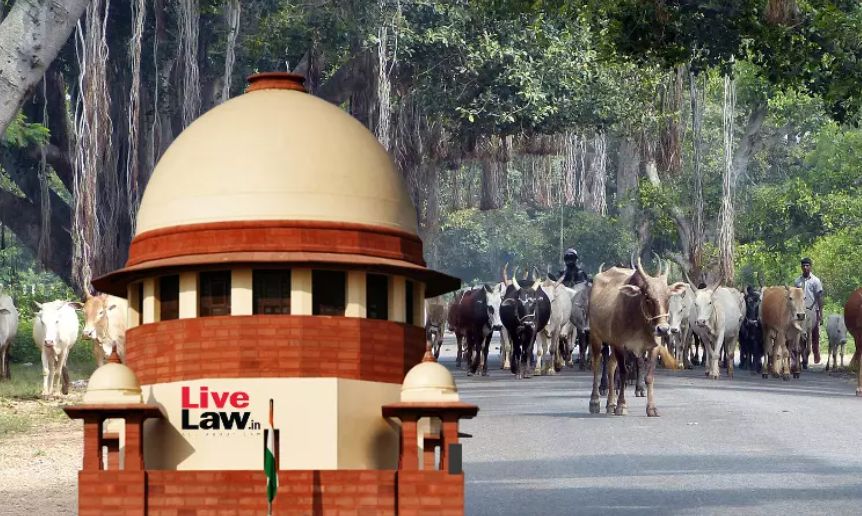
New Delhi, August 2, 2026: The Supreme Court has questioned the apparent contradiction in society’s treatment of cattle, observing that animals are often abandoned once they cease to be economically useful, while people simultaneously object when such animals are later used as food.


The observations were made during the hearing of a case concerning the death of a man following an attack by a stray bull in Sangrur, Punjab. A Bench comprising Justice Sanjay Karol and Justice N. Kotiswar Singh examined the wider problem of abandoned cattle on public roads and its implications for both animal welfare and public safety.
The Court noted that stray cattle have become a common sight on roads and highways across the country, posing risks to motorists, pedestrians and the animals themselves. Referring to cattle occupying public roads, the Bench remarked that they are “not meant to be natural speed breakers.”


The judges stressed that people who rear cattle for economic benefit have a responsibility to care for them throughout their lives. Financial difficulties faced by farmers and livestock owners, the Court observed, cannot justify abandoning animals in public spaces where they may cause accidents and suffer themselves.
A question of responsibility
The Bench also highlighted what it considered a moral inconsistency in public attitudes towards cattle.
The Court observed that, ideally, those who bring animals into their homes or rear them for economic purposes should continue to care for them throughout their natural lives. In practice, however, animals are often abandoned when they stop generating income.
At the same time, the Court noted, people may object strongly if abandoned cattle are subsequently slaughtered for food.
The observations raise a broader question of responsibility: whether concern for animal welfare can be separated from the obligations that accompany ownership. The Court’s remarks suggest that protecting cattle cannot simply mean preventing their slaughter while leaving abandoned animals to fend for themselves on roads.
Stray cattle a public safety concern
The Supreme Court referred to official figures indicating that more than 1,300 people die every year in India in accidents involving stray animals.
The Bench treated the issue as a nationwide public safety concern rather than merely a matter affecting individual communities. It called for coordinated measures by governments to prevent abandonment and improve the management of stray cattle.
Among its recommendations was mandatory digital tagging and identification of livestock, which could help authorities trace ownership and discourage owners from abandoning animals.
The Court also recommended comprehensive compensation schemes for people injured or killed in accidents involving stray cattle.
It further suggested that owners who can no longer care for their animals should be legally required to transfer them to registered shelters rather than release them on roads.
Balancing animal welfare and public safety
The Bench directed that copies of its judgment be sent to the Chief Secretaries of all States and Union Territories for consideration and implementation.
Noting that 24 States already have laws relating to cattle protection, the Court emphasised the need for stronger enforcement, better shelter management and effective administrative oversight.
The ruling comes against the backdrop of India’s complex cultural and religious relationship with cattle. While acknowledging the sensitivities surrounding cattle protection, the Court’s observations underline that such concerns must be accompanied by responsible ownership.
For a society that speaks strongly about compassion towards animals, the Court’s intervention also poses a deeper ethical challenge: care for creation cannot end when an animal ceases to have economic value. Animal welfare, responsible ownership and public safety, the proceedings suggest, must be addressed together.
Source: Live Law



© 2026 CATHOLIC CONNECT POWERED BY ATCONLINE LLP