- 02 August, 2026

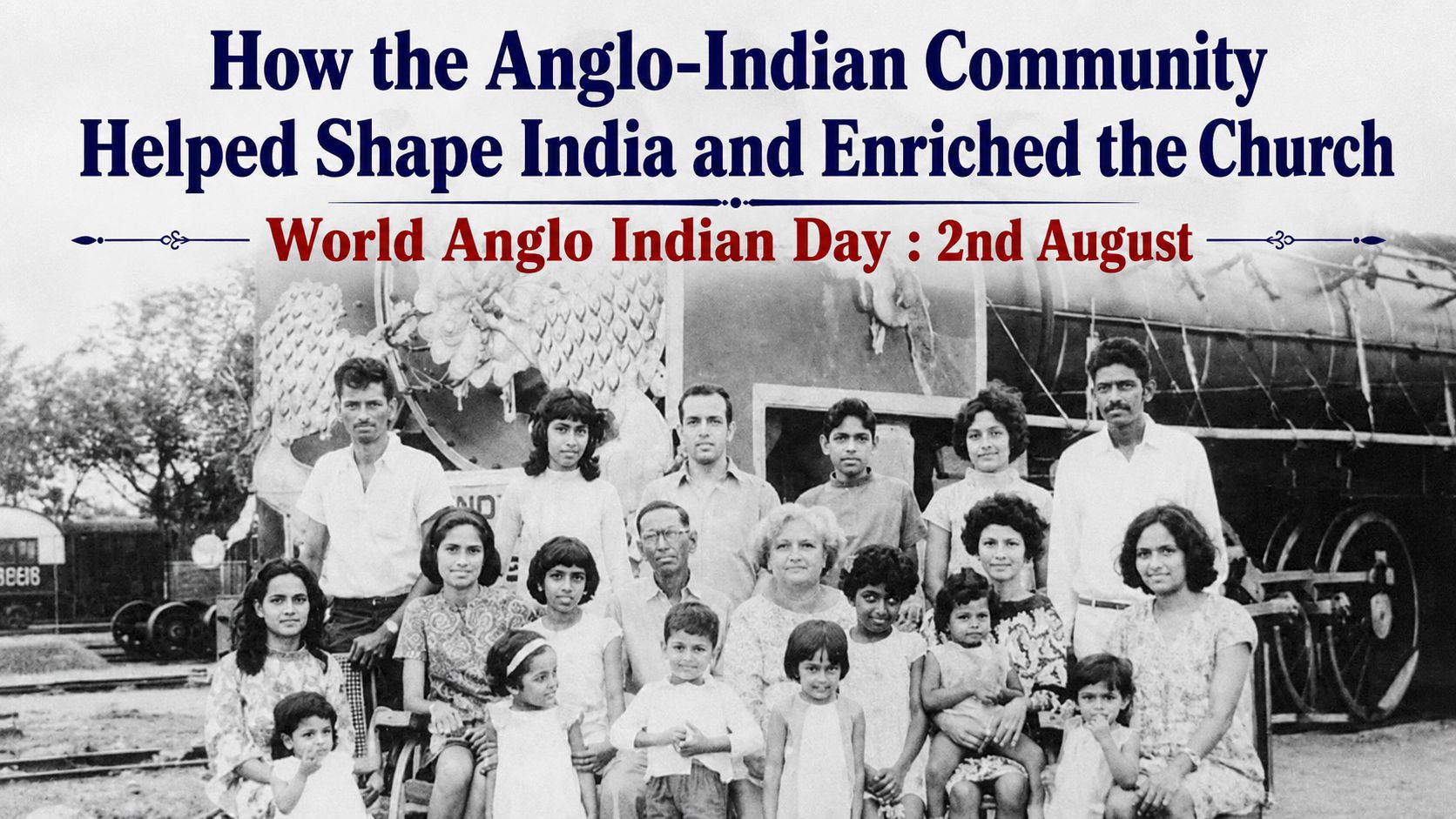
August 2, 2026:Every year on August 2, Anglo-Indians across India and the world celebrate World Anglo-Indian Day, a day that honours a community whose influence on India extends far beyond its numbers. For the Catholic Church in India, it is also an opportunity to give thanks for a people whose lives have been deeply rooted in faith, education, public service and a rich cultural heritage that continues to inspire generations.


The date commemorates August 2, 1935, when the Government of India Act, 1935 formally defined the term "Anglo-Indian" for the first time. After Independence, this definition was incorporated into Article 366(2) of the Constitution of India, recognising the community's unique identity. While constitutional safeguards such as nominated representation in Parliament have since come to an end, the Anglo-Indian community's true legacy has never rested on legislation alone. It has been built through Christian witness, service to society, and an unwavering commitment to nation-building.
The Anglo-Indian community traces its origins to centuries of interaction between Indians and European settlers, particularly the Portuguese, British, French and Dutch. Over time, these families developed a distinctive culture that beautifully blended Indian traditions with European influences.


(CLICK HERE to follow Catholic Connect and to stay updated with Catholic News & Content)
For many Anglo-Indians, especially those of Portuguese and Goan ancestry, the Catholic faith became the foundation of family and community life. Parish churches, Catholic schools, choirs, sodalities, youth groups and charitable organisations nurtured generations of faithful who lived out the Gospel in everyday life. Their identity has always been more than ancestry—it is one shaped by faith, compassion and a strong sense of community.
Today, World Anglo-Indian Day is celebrated not only in India but also by the global diaspora across Australia, the United Kingdom, Canada, New Zealand and beyond, reminding families that while they may live in different countries, their spiritual and cultural roots remain closely connected.
Few communities have contributed as profoundly to English-medium education in India as the Anglo-Indians. Catholic and Anglo-Indian schools have educated millions of students from every faith and background, producing leaders in every profession while promoting values of discipline, integrity and service.
One of the community's greatest sons was Frank Anthony, lawyer, parliamentarian and President of the All-India Anglo-Indian Association. As a member of India's Constituent Assembly, he worked alongside Dr. B.R. Ambedkar to secure constitutional protections for minorities and safeguard the future of Anglo-Indian educational institutions. His vision continues to shape schools that remain centres of academic excellence across the country.
Earlier, Henry Louis Vivian Derozio inspired the Young Bengal Movement, encouraging critical thinking and patriotism among Indian youth, while educators such as Albert Edward Thomas Barrow and Neil O'Brien strengthened educational institutions and promoted lifelong learning.
The constitutional provision for nominated Anglo-Indian Members of Parliament ended with the 104th Constitutional Amendment Act in 2020. Yet the community continues to preserve its heritage through organisations such as the All-India Anglo-Indian Association, educational institutions, and lay Christian initiatives that continue serving society.
The Anglo-Indian community has consistently answered the call to serve India with dedication and professionalism.
In sports, Anglo-Indians played a defining role in India's golden age of hockey. Legends such as Leslie Claudius, Richard Allen, Broome Pinniger, Carlyle Tapsell and Joe Gallibardy helped India dominate Olympic hockey while the Britto Sisters (Elvera, Rita and Mae) and Anne Lumsden represented the Indian women's national hockey outfit.
Athletes like Norman Pritchard, Kenneth Powell, Roger Binny and son Stuart Binny brought distinction to athletics and cricket.
Their service extended equally to the defence forces. The heroic Trevor and Denzil Keelor earned national acclaim during the 1965 war, while leaders such as Air Chief Marshal Denis La Fontaine, Air Marshal Malcolm Wollen and Vice Admiral Benjamin Abraham helped strengthen India's armed forces. Countless Anglo-Indian women also served with dedication in military nursing, healthcare and public hospitals, reflecting Christ's compassion through their vocation.
Behind the scenes, generations of Anglo-Indians built careers in the Indian Railways, customs, postal services, police and civil administration, helping lay the foundations of modern India through faithful and often unseen service.
The Anglo-Indian contribution to India's cultural life is equally remarkable.
Writers such as Ruskin Bond have captured the beauty of India's landscapes and people with warmth and simplicity.
In cinema and theatre, personalities including Michael Bates, Patience Cooper, Merle Oberon, Helen, Barry John, Diana Hayden, George Baker, Andrea Jeremiah and Jennifer Kendal have left an enduring legacy, while broadcaster Melville de Mellow became one of the defining voices of All India Radio.
Music has long been at the heart of Anglo-Indian culture. The community introduced jazz, swing and ballroom traditions to India through artists like Pam Crain, Tony Brent, and the Green brothers. International icons such as Cliff Richard, Engelbert Humperdinck, and Queen lead singer Freddie Mercury also trace their roots to India's Anglo-Indian heritage, demonstrating the community's global influence.
Faith and fellowship continue to define Anglo-Indian life. Parish feasts, Christmas Midnight Mass, choirs, family reunions, social dances, youth gatherings and charitable outreach remain cherished traditions that strengthen bonds across generations.
The community's cuisine reflects its unique identity. Beloved dishes such as Railway Mutton Curry, Dak Bungalow Chicken, Country Captain Chicken, Ball Curry with Yellow Rice, Kedgeree, and Mulligatawny Soup, together with festive favourites like Kul Kuls, Rose Cookies, and homemade Ginger Wine, are expressions of hospitality, family life and shared celebration.
Earlier this year, the 13th International Anglo-Indian Reunion in Kochi, Kerala, brought together families from around the world under the theme "Coming Back to Familiar Shores." Through prayer, fellowship, cultural programmes, food festivals and community celebrations, the gathering reaffirmed the enduring ties that unite Anglo-Indians across continents.
The story of the Anglo-Indian community is ultimately a story of faith lived in service. Whether in classrooms, hospitals, churches, sports fields, government offices or the armed forces, Anglo-Indians have quietly reflected the Gospel values of humility, excellence, hospitality and compassion.
World Anglo-Indian Day is therefore more than a remembrance of history. It is a thanksgiving for a community that has enriched both the Church and the nation. In an increasingly divided world, Anglo-Indians remind us that diversity is a gift, that cultures flourish when they are shared, and that faith finds its fullest expression in service to others.
As the Church joins Anglo-Indian families in celebrating this special day, we thank God for their enduring witness. Their legacy is not confined to the pages of history but lives on in every Catholic school that shapes young minds, every parish choir that lifts hearts in worship, every family that keeps its traditions alive, and every act of service offered in Christ's name.
Truly, the Anglo-Indian community remains one of India's most cherished blessings—a living testament to how faith, heritage and hope can together build a stronger Church and a stronger nation.
By Catholic Connect Reporter
Picture Courtesy : The New Indian Express
© 2026 CATHOLIC CONNECT POWERED BY ATCONLINE LLP