- 27 August, 2026

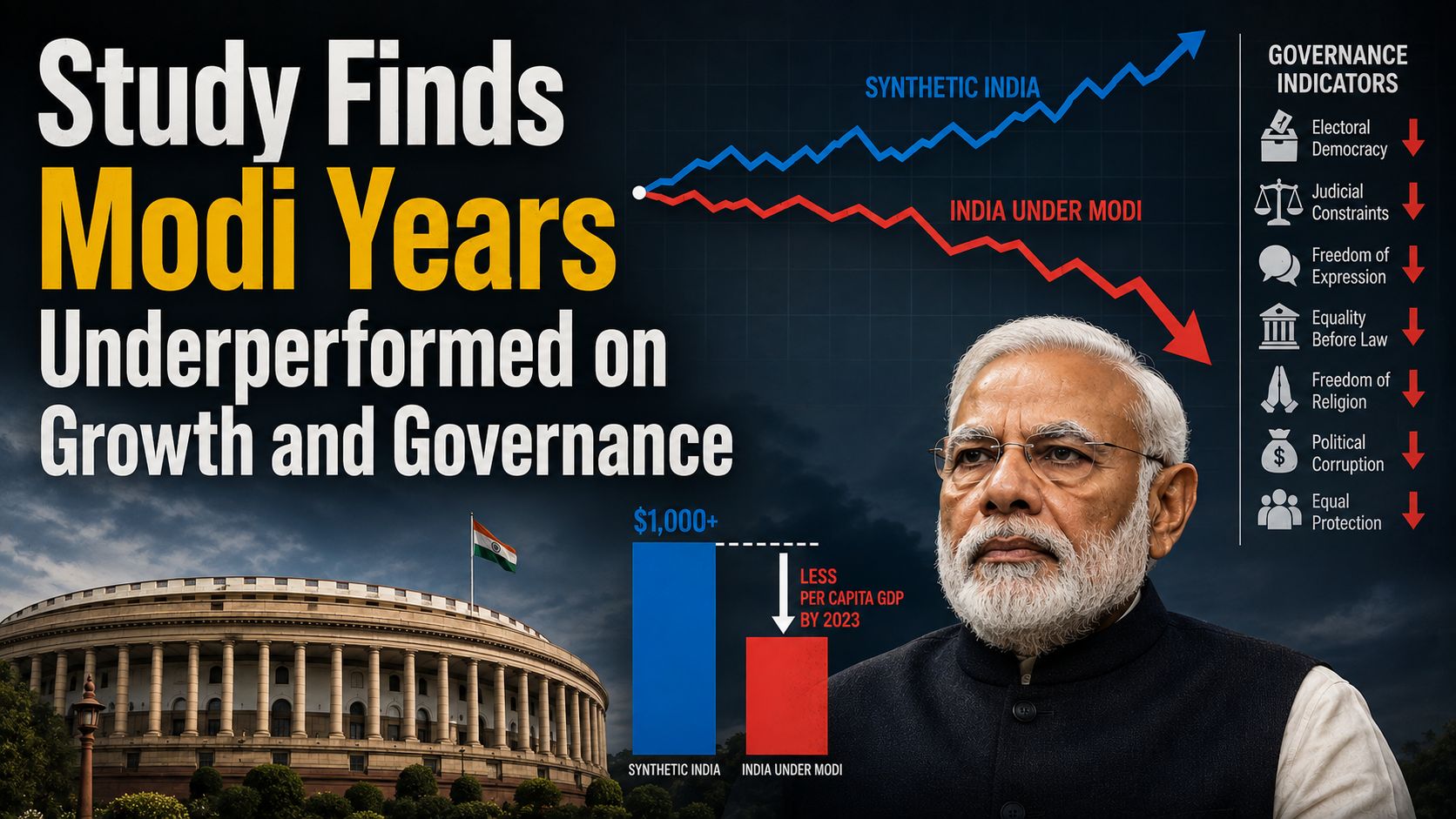
New Delhi, August 27, 2026: India’s economic growth and governance performance during Narendra Modi’s tenure from 2014 to 2023 fell short of what might have been expected under an alternative trajectory, according to a study by political scientists Kevin Grier and Robin Grier.


The study, titled Promises, Promises: Governance and Growth in India under Modi and the BJP, compares India’s actual performance with a statistically constructed “Synthetic India” designed to represent how the country might have performed without the Modi government.
The researchers stress that their findings do not suggest that India experienced no economic growth or change after 2014. Rather, the study examines whether India performed better than a counterfactual trajectory based on countries with similar characteristics before Modi came to power.


Synthetic India
The researchers use the synthetic control method, a statistical technique designed to estimate outcomes that cannot be directly observed. They construct a comparison country by combining data from countries that closely resembled India before 2014.
For the economic analysis, the study uses data from 1984 to 2013 to establish the pre-2014 trajectory and examines developments through 2023. Real per-capita gross domestic product from the Penn World Tables is used as the principal economic measure.
Governance is assessed using 10 indicators from the Varieties of Democracy database: electoral democracy, liberal democracy, legislative constraints on the executive, judicial constraints on the executive, political corruption, equality before the law, freedom of association, freedom of expression, freedom of religion and equal protection under the law.
The researchers say the synthetic controls closely tracked India before 2014, allowing the post-2014 divergence to be used to estimate the effects associated with the change in government.
Governance indicators deteriorated
The study reports that 96 of the 100 estimated governance effects moved in the direction of poorer performance compared with the synthetic counterfactual. Of these, 92 had a reported p-value of 0.00.
By the final year of the study period, the researchers estimate that electoral democracy was 60.2% lower than the synthetic counterfactual, while liberal democracy was 69.1% lower. Legislative constraints on the executive were 28.8% lower and judicial constraints 12.7% lower.
The study also estimates a 46.8% increase in political corruption, where a higher score represents greater corruption. Equality before the law was 30.4% lower, freedom of association 29.6% lower and freedom of expression 56.2% lower.
The largest reported divergence was in freedom of religion, which the researchers estimate was 168.7% lower than the synthetic counterfactual. Equal protection under the law was 26.1% lower.
The figures are calculated relative to India’s 2013 level and do not represent simple percentage declines in the absolute value of each indicator. The researchers also note that equality before the law and equal protection initially improved before subsequently falling below their synthetic counterparts.
Economic performance also lagged
The study finds a similar pattern in economic performance.
India’s real per-capita GDP began to fall below the Synthetic India trajectory soon after 2014, with the gap widening over the following years. The estimated shortfall started at about $400 per person and eventually exceeded $1,000.
By the end of the study period, the researchers estimate that the average Indian earned approximately $1,000 less annually than the model projected under the alternative trajectory.
The finding, however, is not that India’s economy contracted or failed to grow. Instead, the researchers conclude that economic performance did not exceed the counterfactual path generated by their model.
Robustness checks
The researchers conducted placebo tests by assigning a hypothetical “treatment” to other countries in the donor pool and comparing their outcomes with India’s. They report that India’s governance effects were more extreme than the placebo effects across all 10 indicators.
They also examined the influence of Ethiopia, which received a significant weight in the economic Synthetic India. After removing Ethiopia from the analysis, the estimated negative effects became larger, while Bangladesh received a substantially greater weight in the synthetic comparison.
The study addresses potentially confounding events as well. The researchers treat the 2016 demonetisation as part of the Modi government’s effect because it was a deliberate policy decision. COVID-19, by contrast, is treated as a global shock.
According to the researchers, excluding the final four years of the treatment period does not materially change their overall assessment.
Limitations acknowledged
The authors acknowledge limitations inherent in constructing a counterfactual from other countries. Economic spillovers and other events affecting countries in the donor pool could influence the results, and some of these assumptions cannot be fully tested.
The study also addresses concerns over V-Dem’s expert-coded democracy indicators and the possibility that coding practices could exaggerate recent democratic decline. The researchers cite other work finding no evidence that coder bias explains the decline and argue that because the same measurement system is applied to the comparison countries, broad changes in coding should largely be reflected in the synthetic control as well.
The researchers caution against interpreting the findings as definitive proof that declining institutional quality caused weaker economic performance. They say the results are consistent with such a relationship but call for further research using modern causal-inference methods.
A narrower political claim
The authors also make clear that the study is not an argument for a return to Congress rule and does not seek to portray previous Congress governments in a favourable light.
Their conclusion is narrower: on the 11 dimensions examined—economic performance and 10 governance indicators—the Modi government and the Bharatiya Janata Party performed worse than their respective counterfactuals.
The study therefore differs from a conventional before-and-after comparison. Rather than asking whether India is better off than it was in 2014, it asks whether the country performed better than it might have under an alternative trajectory constructed from comparable countries and pre-2014 trends.
On the measures examined, the researchers conclude that India’s economy underperformed its synthetic counterpart and all 10 governance indicators moved unfavourably relative to their synthetic comparisons.
The central finding, they emphasise, is not that India experienced no change after 2014, but that the changes measured in the study did not amount to the outperformance tested by their analysis.
By Catholic Connect Reporter





© 2026 CATHOLIC CONNECT POWERED BY ATCONLINE LLP