- 27 August, 2026

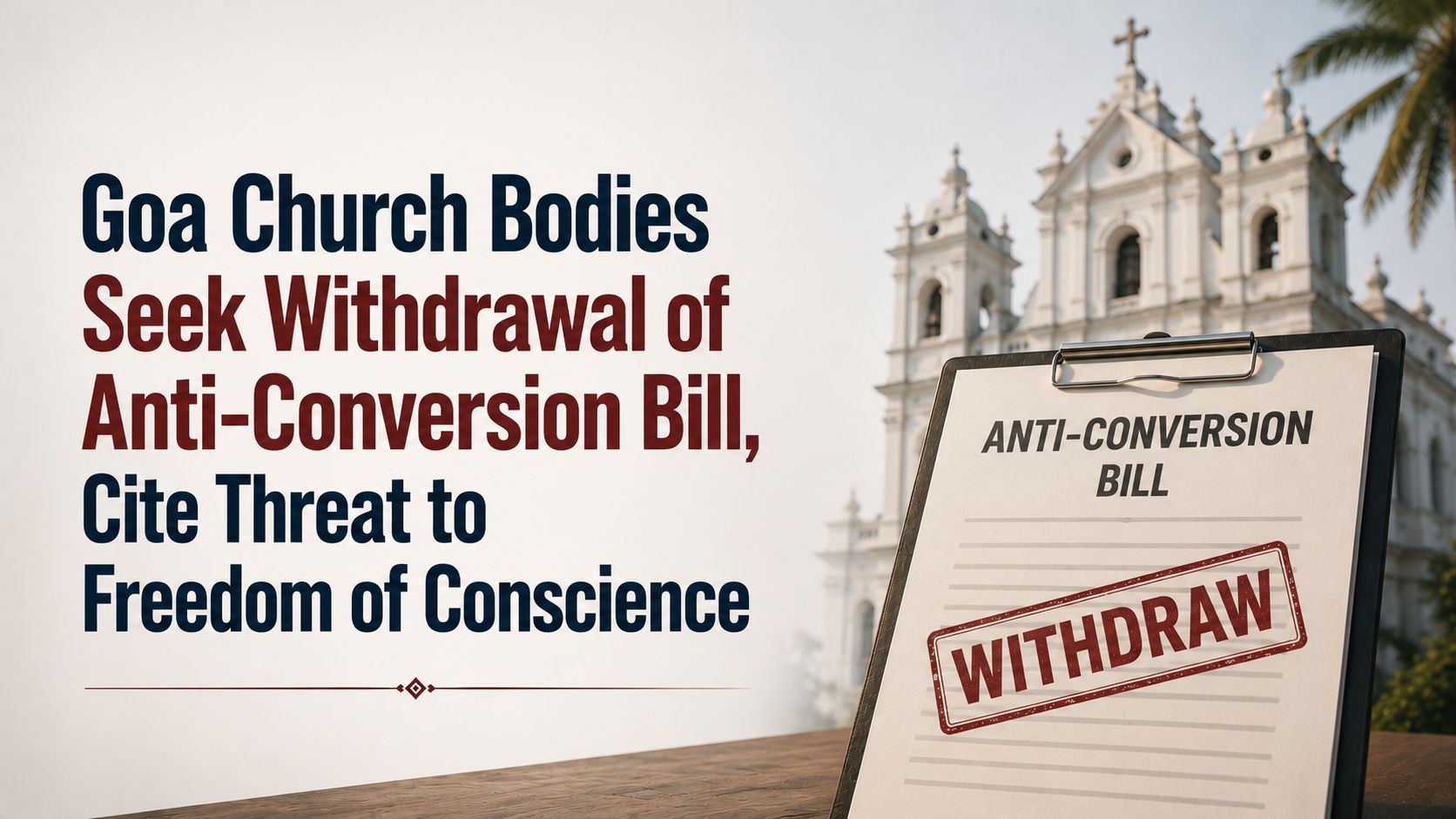
Panaji, August 27, 2026: Two Catholic organisations in Goa have called for the immediate withdrawal of the proposed Goa Prohibition of Unlawful Conversion of Religion Bill, 2026, warning that its provisions could undermine freedom of conscience, strain interfaith relations and disturb the state’s tradition of religious coexistence.


The Council for Social Justice and Peace (CSJP) of the Archdiocese of Goa and Daman and the Catholic Association of Goa (CAG) made the demand in a joint statement on Thursday ahead of the proposed introduction of the Bill in the Goa Legislative Assembly.
The organisations said they opposed conversions carried out through force, fraud, threats or coercion, but argued that such acts are already punishable under existing criminal laws. They maintained that the Catholic Church does not practise forced conversion.


Referring to Canon Law and the Rite of Christian Initiation of Adults, they said adults seeking baptism are required to make a free and informed decision after adequate religious instruction. The process, they noted, normally extends over several months.
(CLICK HERE to follow Catholic Connect and to stay updated with Catholic News & Content)
The organisations, however, cautioned against using the prevention of coercion as a justification for state intervention in personal religious choices, interfaith relationships and legitimate religious activities such as prayer, religious instruction, pastoral work and charitable service.
Concerns over definitions and penalties
CSJP and CAG expressed particular concern over reported provisions of the proposed legislation covering conversion through “force, coercion, undue influence, allurement, fraudulent means or marriage.”
They said the Bill, as reported, could provide for severe penalties, including imprisonment of up to life, a minimum fine of ₹50,000 and compensation of up to ₹5 lakh.
They also raised concerns about a reported requirement for a person intending to convert to give prior notice to the District Magistrate and provisions allowing complaints to be filed by third parties, including relatives and other individuals.
The organisations said the term “allurement” could become particularly problematic if interpreted broadly to include education, healthcare, relief work, prayer for healing or ordinary acts of assistance.
They warned that such provisions could result in legitimate Christian service and religious witness being portrayed as inducement.
Appeal to protect freedom of conscience
Invoking the Constitution’s guarantee of freedom of conscience and the right to profess, practise and propagate religion, the organisations argued that any legislation affecting these freedoms must meet standards of clarity, necessity and proportionality.
They also referred to Supreme Court rulings recognising an adult’s autonomy in matters concerning faith and marriage as part of personal liberty and dignity.
CSJP and CAG said provisions permitting complaints by informants or third parties could encourage interference in private religious and family matters. Such mechanisms, they warned, could create an atmosphere in which relatives, political activists or vigilante groups monitor personal relationships, prayer meetings and individual decisions concerning faith.
A law intended to protect communal harmony could consequently, they argued, become a source of mistrust and social tension.
Questioning need for new legislation
The organisations also questioned whether there was sufficient evidence of widespread forced conversion in Goa to justify a new law.
They opposed what they described as the adoption of similar legislation simply because such laws exist in several BJP-governed states, arguing that lawmaking should be based on Goa’s own social realities and constitutional principles rather than political imitation.
They further warned that the legislation could be vulnerable to political misuse and could encourage the emergence of self-appointed groups seeking to enforce religious conformity.
Demand for consultation
CSJP and CAG urged the Goa Government to withdraw the Bill immediately.
If the government proceeds with the legislation, they called for the complete draft to be made public and for consultations with religious communities, constitutional experts, civil-society organisations and representatives of interfaith families.
They also demanded a transparent legislative review of the proposed provisions.
Emphasising that freedom of conscience applies equally to people of all faiths and to atheists, the organisations warned that state scrutiny of religious conversion could eventually lead to wider interference in citizens’ personal beliefs and choices.
“Goa does not need a bureaucracy to oversee conscience,” the statement said, calling instead for greater confidence in constitutional freedoms, citizens’ maturity and the state’s tradition of peaceful coexistence.
The joint statement was issued by Fr. Savio Fernandes, Secretary of the Council for Social Justice and Peace, and Cyril A. Fernandes, President of the Catholic Association of Goa.
By Catholic Connect Reporter

© 2026 CATHOLIC CONNECT POWERED BY ATCONLINE LLP