- 26 October, 2026

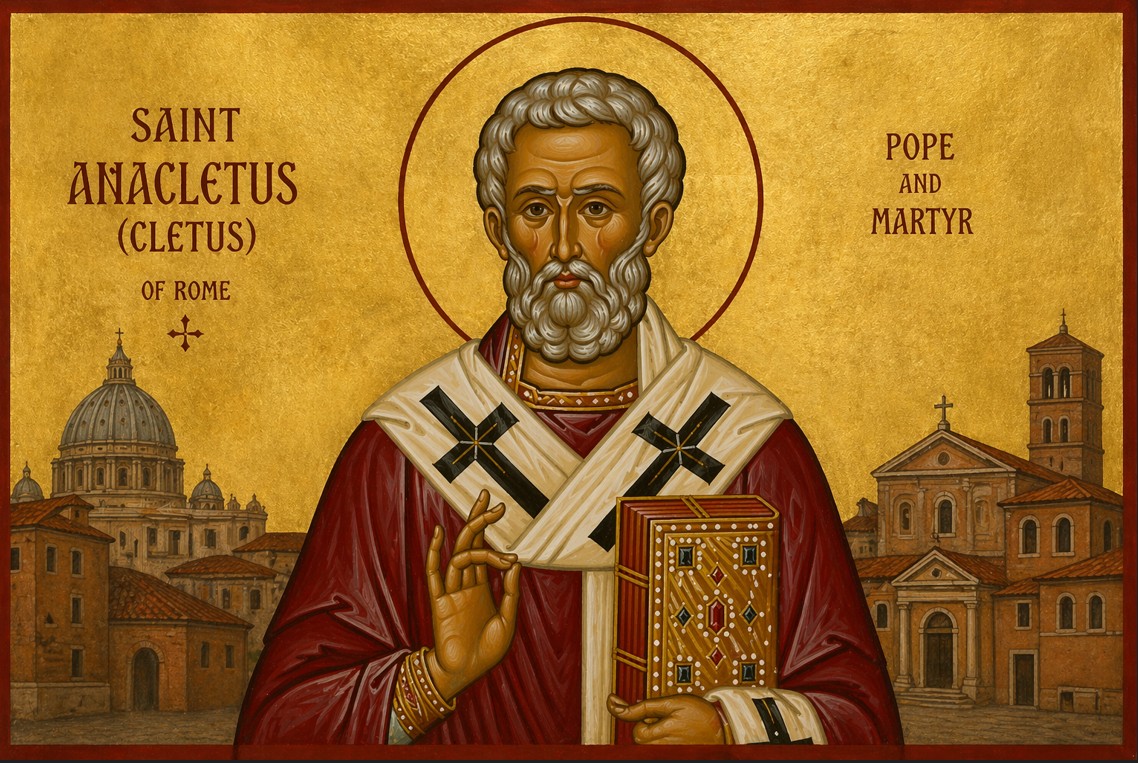
Pope Anacletus, also known as Cletus, succeeded Pope Linus and continued guiding the early Church during a time of quiet growth and ongoing uncertainty.


As the third successor of St. Peter, Anacletus played a crucial role in strengthening the structure of the early Church. Though not widely known, his contributions helped shape the organization and stability of Christian communities in their formative years.
Historical details about Anacletus’ early life remain scarce, as was common for figures of the first-century Church. Tradition suggests he was either Roman by birth or of Greek descent. He likely grew up in a pagan environment before embracing the Christian faith, possibly influenced by the apostles themselves.
After the death of Linus, Anacletus was chosen as Bishop of Rome. His election reflects the continued practice of apostolic succession, ensuring that the authority entrusted to Saint Peter was faithfully passed on.
Anacletus led the Church during the later years of the first century, under the Roman Empire.
Although the intense persecution under Emperor Nero had subsided, the threat of hostility still lingered.
Tradition credits Anacletus with important developments in the early Church:
These efforts were vital in transforming a loosely connected group of believers into a more organized and pastoral community.
Anacletus is remembered for:
His spirituality reflects a shepherd’s heart—guiding, organizing, and caring for the faithful in a time of uncertainty.
Like his predecessors, Anacletus faced several challenges:
While no major controversies are clearly documented, the difficulty of leading in such an early stage cannot be understated.
Although no direct writings of Anacletus survive, his life conveys a lasting message:
The strength of the Church lies in faithful service and strong foundations.
Tradition holds that Anacletus died a martyr in Rome.
He is venerated as one of the early pillars of the Church who helped preserve and organize the Christian community after the apostles.
St. Anacletus represents:
His work ensured that the Church could grow not only spiritually but also structurally.
Why does St. Anacletus matter today?
His legacy continues through the unbroken line of papal succession, reaching to leaders today.
To know more about the previous Popes, click here
By Catholic Connect Reporter



© 2026 CATHOLIC CONNECT POWERED BY ATCONLINE LLP