- 27 September, 2026

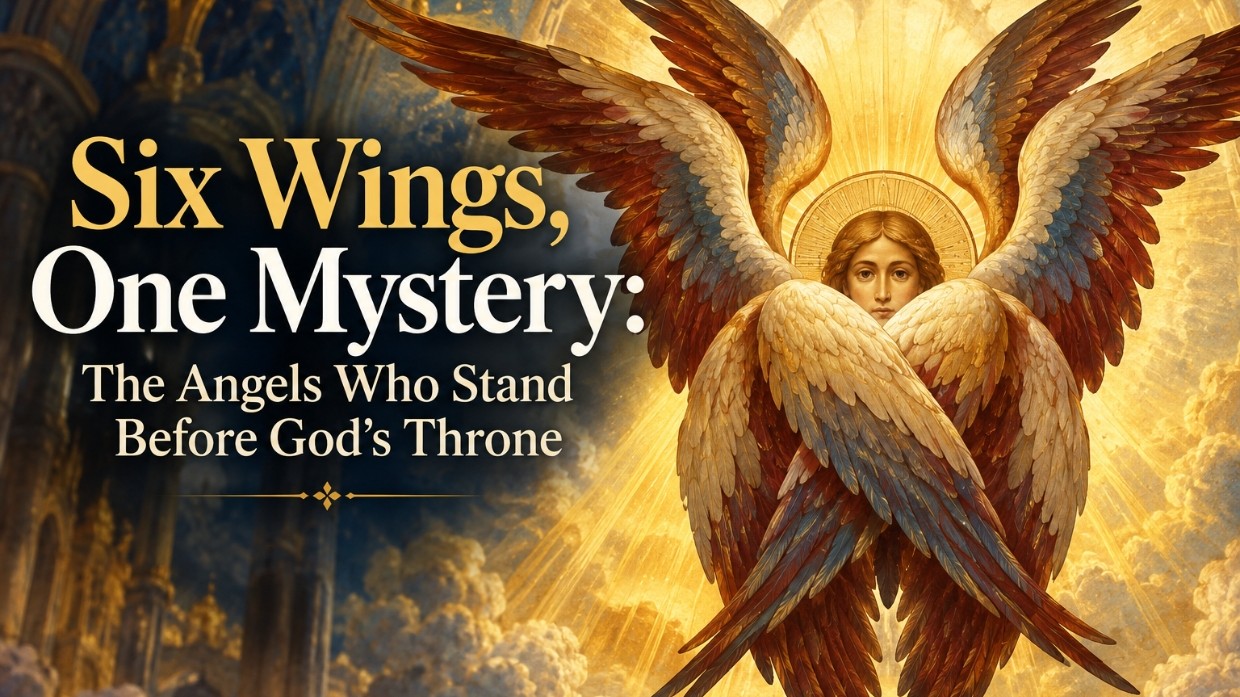
In some Catholic churches, an angel seems almost to vanish beneath a whirl of six wings. This striking image isn’t fantasy: it comes from Isaiah’s vision of heaven, where the seraphim surround God’s throne and cry, “Holy, holy, holy.”


Six-winged heavenly figures in Christian art are usually seraphim, drawn from the prophet Isaiah’s vision of God’s throne. Their image recalls the worship of heaven and the holiness of God.
Isaiah’s vision
Isaiah describes seraphim attending the Lord: each has six wings—two covering the face, two covering the feet, and two for flying. They call to one another, “Holy, holy, holy is the Lord of hosts; the whole earth is full of his glory.” One seraph then brings a live coal from the altar to touch and purify Isaiah’s lips.
The passage does not explain every detail of the wings’ meaning. They belong to the vision’s symbolic imagery and show the seraphim in reverent service before God. It is reasonable to associate the covered face and feet with reverence and humility, but those meanings should not be presented as an explicit explanation given by Scripture.
Who are the seraphim?
Catholic teaching understands angels as created spiritual beings, not gods or semi-divine powers. Seraphim are named in Scripture among the heavenly beings who attend God and proclaim His glory. Isaiah’s vision is their principal biblical description; the text does not provide a complete account of their nature or appearance.
From Scripture to sacred art
Artists have represented seraphim with six wings to recall Isaiah’s vision. The precise style varies: some works show a face surrounded by wings, while others depict winged figures. These are artistic representations of spiritual beings, not claims that angels have ordinary physical bodies or feathers. Sacred images use visible forms to direct the mind toward realities that cannot be seen.
The Church’s liturgy also joins the earthly assembly to the worship of the angels, repeating the “Holy, holy, holy” in the Eucharistic celebration. St. Cyril of Jerusalem explains that this hymn invites the faithful to share in the praise of the heavenly hosts.
So when you see a six-winged angel in a church or icon, the image points beyond its unusual form to Isaiah’s vision: the heavenly seraphim praising God’s holiness and glory.
By Catholic Connect Reporter
Continue Reading on Catholic Connect App
Get access to exclusive news articles & more.





© 2026 CATHOLIC CONNECT POWERED BY ATCONLINE LLP