- 14 October, 2026
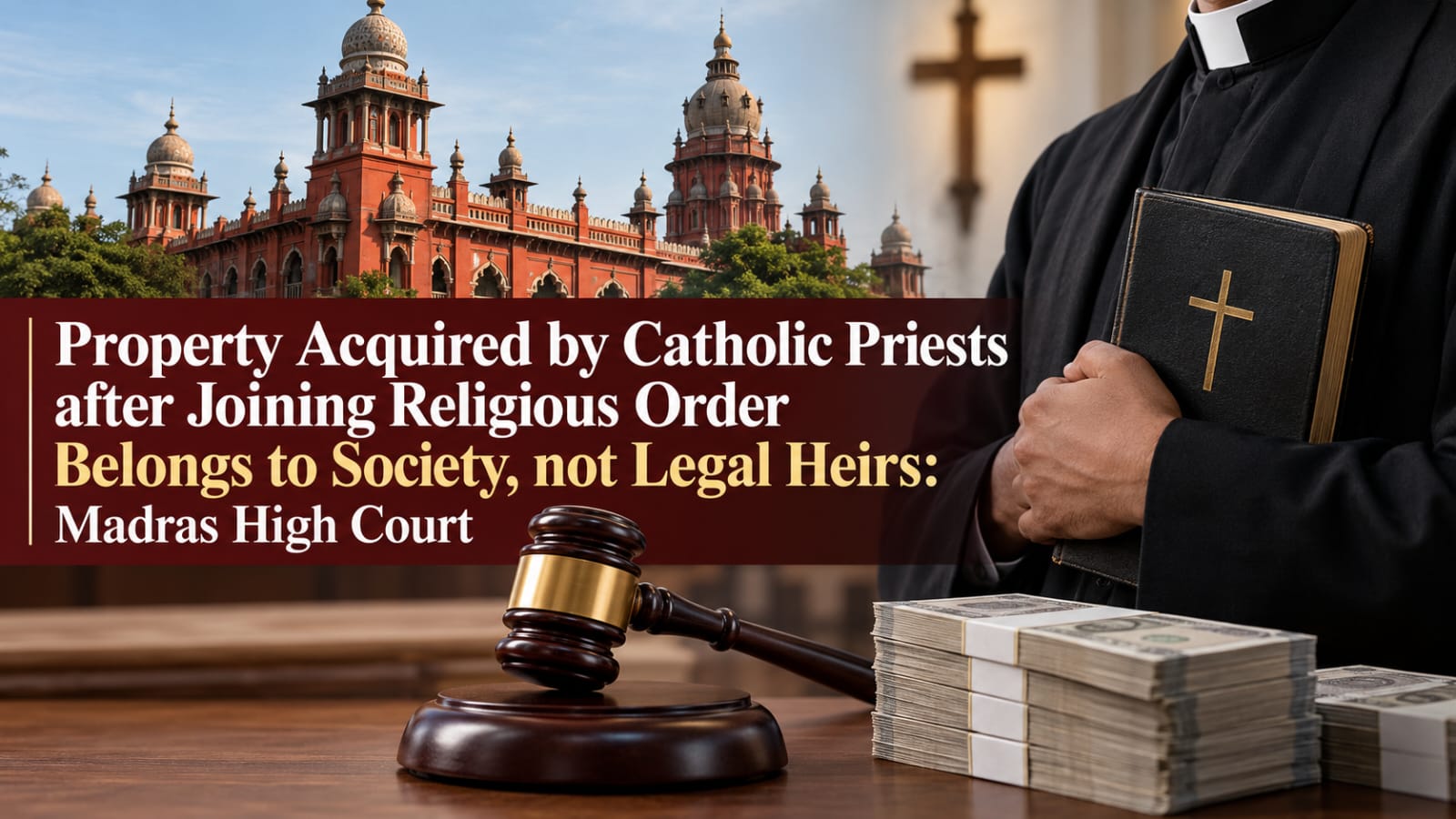
CHENNAI, October 14, 2026: The Madras High Court has ruled that property acquired by members of Catholic religious orders after taking religious vows belong to their religious society rather than their legal heirs, depending on the obligations governing the order and the circumstances of acquisition.


A Division Bench of Justices N Anand Venkatesh and K K Ramakrishnan delivered the ruling while allowing appeals filed by the ABVM Society of the Catholic Apostolate (Pallottines) against a district court order granting succession rights to the relatives of a deceased priest over fixed deposits worth ₹56 lakh.
The dispute concerned deposits left by Fr Devakumar Arulanantham, which his brothers and niece claimed after obtaining a succession certificate.
The High Court held that ownership could not be determined solely by the fact that the deposits stood in the priest’s individual name. Instead, the court said, the religious obligations he had undertaken and the institutional circumstances in which the assets were acquired were central to deciding ownership.
The Bench clarified that the concept of “civil death” associated with entering a religious order refers to the renunciation of worldly interests and relationships. It does not mean that a religious professed member ceases to exist as a legal person or loses all civil rights.
The judgment distinguished property acquired after entering a religious order from assets owned beforehand. It also clarified that property independently inherited from family members does not automatically become the property of a religious society.
The court further differentiated between diocesan priests and members of religious orders who have taken perpetual vows, observing that becoming a diocesan priest does not, by itself, entail the same obligations concerning personal possessions.
A key piece of evidence was a handwritten document executed by Fr Devakumar in 1988. He had stated that his personal belongings would go to the Society, while property inherited from his family would remain subject to his family’s rights.
Although the document did not qualify as a valid Will because it lacked the prescribed statutory attestation, the Bench considered it evidence of the priest’s religious undertaking and obligations towards the Society.
After examining Canon Law, the Society’s rules and the circumstances surrounding the acquisition of the deposits, the High Court recognised the Society’s entitlement to the money and set aside the succession certificate issued in favour of the priest’s relatives.
The court directed the relatives to return the amounts received to the Society within one month. Failure to comply would attract interest at nine per cent per annum.
The judgment also referred to Biblical teachings on renunciation, the dangers of attachment to wealth and the duty to make restitution. Citing Matthew 6:24, the Bench observed that Christ’s teaching against serving both God and money admitted of no institutional exception.
It also invoked the Ten Commandments, particularly the injunction against stealing, while discussing the obligation to return money received without a legitimate entitlement. The court clarified, however, that Biblical references were used to illustrate the moral principle of restitution and not as independent sources of legal authority.
The ruling in ABVM Society of the Catholic Apostolate v. Deiva Nayagan underscores the importance of examining the vows, governing rules and circumstances of acquisition when determining whether assets held in an individual religious member’s name belong personally to that member or to the religious institution.
News Credit: Bar and Bench



© 2026 CATHOLIC CONNECT POWERED BY ATCONLINE LLP