- 04 July, 2026

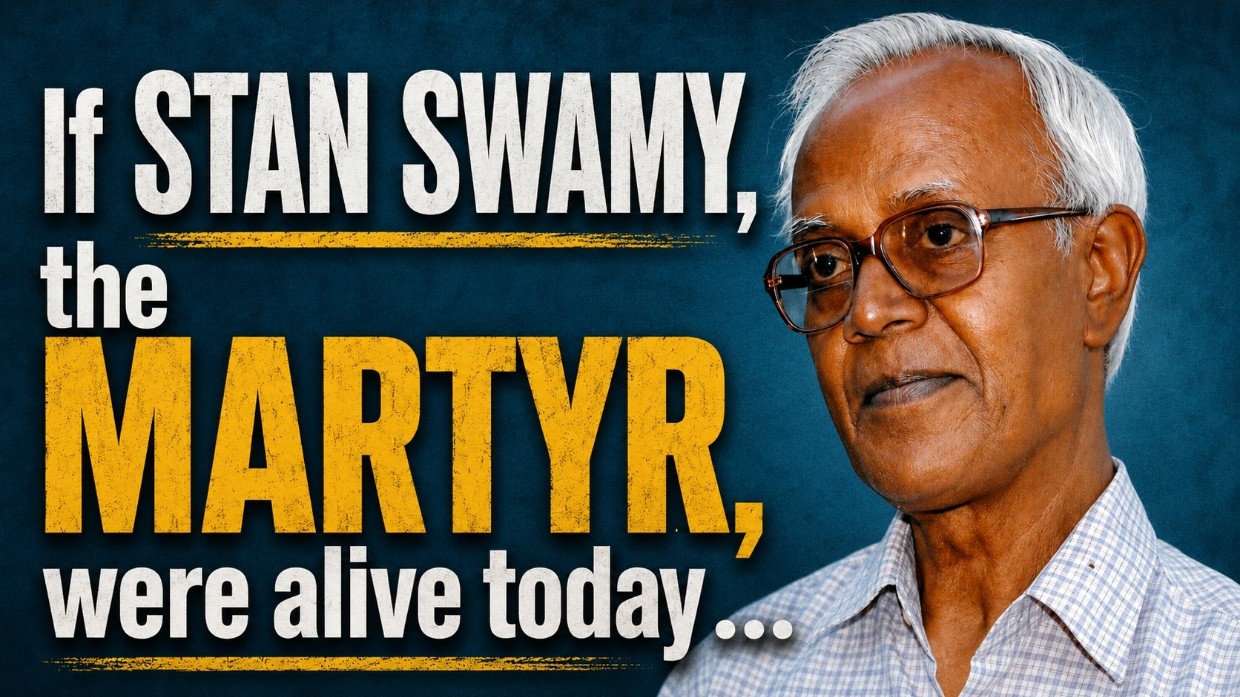
4 July, 2026: Exactly five years ago, on 5 July 2021, Jesuit Father Stan Swamy was murdered. He was killed because he refused to kow-tow to a brutal, fascist regime. He was killed because he took a stand for justice and truth. He was killed because he accompanied the Adivasis and other subalterns in their struggle for a more dignified, equitable and humane life. He was killed because he refused to compromise with corrupt, communal, anti-people and anti-Constitutional forces. He was killed because he believed in humanity and in the power of ordinary people.

What Stan's murderers never bargained for is that Stan the martyr will never die. Stan was a martyr for justice—he lives in the hearts, souls and minds of millions today and forever.
Stan Swamy, the martyr, is no longer around today—but if he were physically present in this world, what exactly would he be doing?


If Stan Swamy, the martyr, were alive today, he would be in the midst of the Adivasis. His life would be simple and frugal. He would eat their food, sing their songs and dance with them. He would identify with them completely. He would be deeply disturbed by any attempt to destroy their identity, culture, traditions and values. He would master their language and walk alongside them.
If Stan Swamy, the martyr, were alive today, he would accompany the Adivasis and other marginalised communities in their relentless search for justice. He would boldly confront those who deny them their legitimate jal, jungle and jameen rights. He would expose those who exploit India's natural resources for personal gain and challenge systems that destroy the environment and fragile ecosystems in Jharkhand, the Aravalli Hills, the Nicobar Islands and elsewhere.
He would continue fighting for the land rights of Adivasis. He would stand with Adivasis, Dalits, other subaltern communities and civil society in opposing unlawful land acquisition for mining, mega projects and infrastructure development. He would challenge corporate encroachments and protest state-sponsored violations of democratic rights. He would question the non-implementation of the Fifth Schedule of the Constitution and the neglect of the Panchayats (Extension to Scheduled Areas) Act (PESA). He would remind the nation of the significance of the 1997 Samatha Judgment, speak against the weak implementation of the Forest Rights Act, 2006, oppose amendments to the Land Acquisition Act, 2013, and criticise the creation of "Land Banks," which he regarded as a deliberate attempt to dispossess Adivasi communities.
If Stan Swamy, the martyr, were alive today, he would be with young people. He would embrace the call of Jesuit Superior General Fr. Arturo Sosa to accompany young adults in their search for a hope-filled future amidst growing violations of human rights, environmental destruction, war and disregard for human life. Through the Persecuted Prisoners' Solidarity Committee, he would challenge the indiscriminate arrest of thousands of young Adivasis branded as "Naxals" for resisting unjust land alienation. He would also stand in solidarity with young protesters at Jantar Mantar.
If Stan Swamy, the martyr, were alive today, he would openly oppose the Special Intensive Revision (SIR) of electoral rolls, viewing it as a serious threat to citizens' constitutional right to vote. He would be deeply concerned about the disenfranchisement of Adivasis, minorities and other vulnerable communities who lack official documents. He would stand with civil society organisations protesting the exclusion of citizens in Bihar, West Bengal and elsewhere.
He would also champion the cause of small farmers and workers. He would oppose policies that place them at the mercy of powerful corporations, including the four labour codes, and continue speaking for those whose livelihoods are threatened.
If Stan Swamy, the martyr, were alive today, he would have welcomed Magnifica Humanitas, the first encyclical of Pope Leo XIV, which strongly upholds the dignity of every human person, the universality of human rights and the pursuit of justice and peace. Stan would insist that these values are precisely what the Church must continue to defend.
He would rededicate himself to the spirit and values of the Constitution of India, defending justice, liberty, equality, fraternity, dignity, secularism and pluralism. He would call for women's equal representation in Parliament, oppose manipulative practices such as delimitation and delisting, defend the right to dissent, and challenge laws such as the Unlawful Activities (Prevention) Act (UAPA), under which he himself was imprisoned.
Stan would also repeat the powerful words he spoke before his arrest on 8 October 2020:
"Over the last two decades, I have identified myself with the Adivasi people and their struggle for a life of dignity and self-respect… If this makes me a 'deshdrohi', then so be it. I am not a silent spectator but part of the game and ready to pay the price, whatever it may be… What is happening to me is not unique. Many activists, lawyers, writers, journalists, student leaders, poets, intellectuals and others who stand for the rights of Adivasis, Dalits and the marginalised are being targeted. Grateful to all who have stood in solidarity with me all these years."
If Stan Swamy, the martyr, were alive today, he would challenge each one of us. In his quiet and gentle way, he would say:
"Wake up! It is high time you realise what is happening to the country and to our people. Do something about it—urgently and together."
If Stan Swamy, the martyr, were alive today…
But Stan Swamy never truly died. He lives on.
By Fr. Cedric Prakash SJ
Continue Reading on Catholic Connect App
Get access to exclusive news articles & more.
© 2026 CATHOLIC CONNECT POWERED BY ATCONLINE LLP