- 13 August, 2026

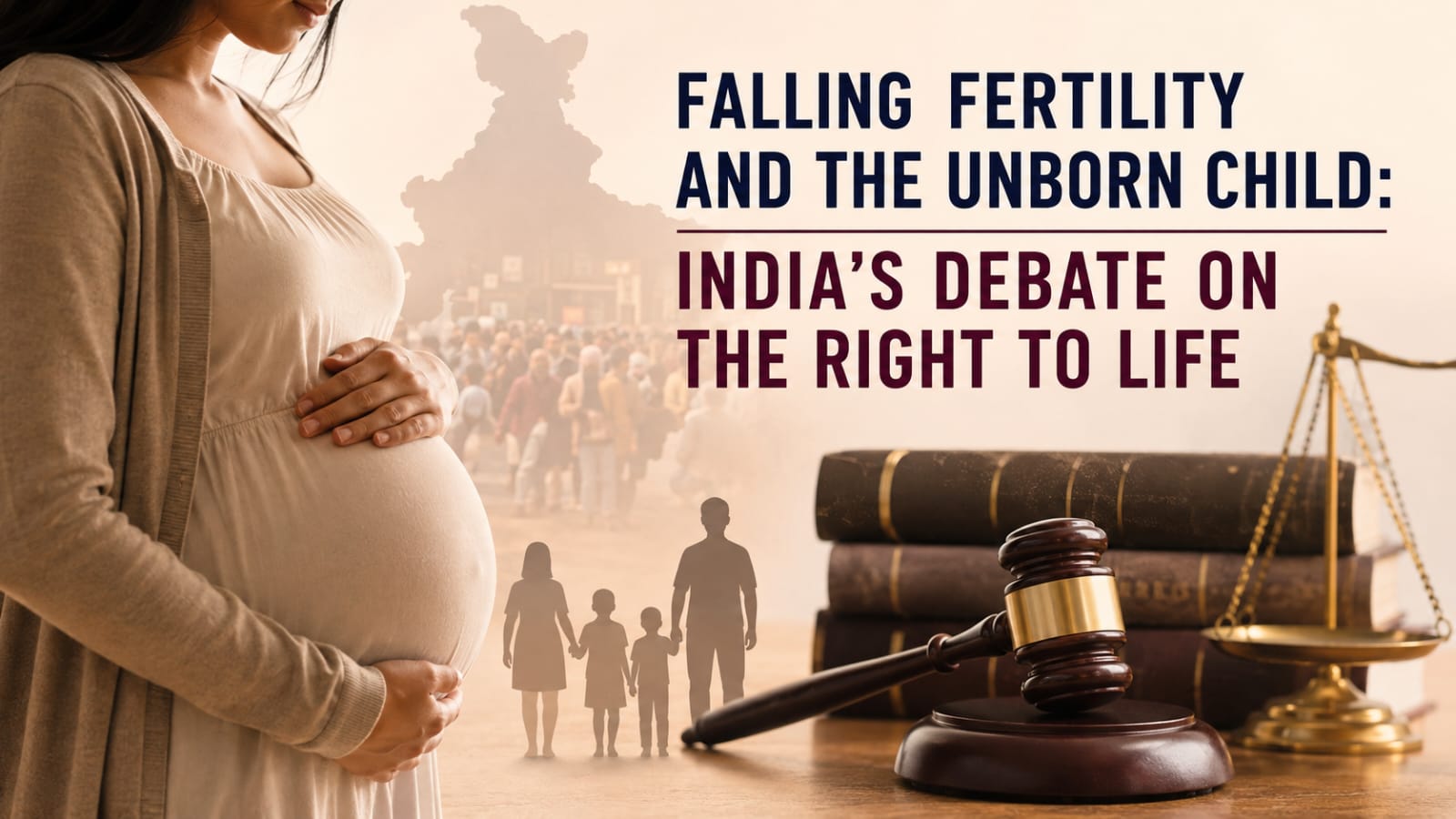
CHENNAI, August 13, 2026: Declining fertility rates and a rapidly ageing population in southern India are prompting renewed debate over family size, childbirth and the protection of unborn children, with political leaders, courts and Christian groups addressing different aspects of the issue.


Tamil Nadu Health Minister K. G. Arunraj, speaking at a workshop of the Obstetrics and Gynaecological Society of South India on August 9, expressed concern over the state’s Total Fertility Rate (TFR), which has fallen below 1.4, compared with the replacement level of 2.1.
Nearly 16 per cent of Tamil Nadu’s population is now above the age of 60, he noted, describing the demographic transition as a growing public health challenge. Fertility rates in other southern states have also declined, with Andhra Pradesh and Karnataka at about 1.7, and Kerala and Telangana at around 1.8.


Andhra Pradesh Chief Minister N. Chandrababu Naidu has similarly called attention to the state’s declining birth rate. Speaking at Tamrapalli village in Srikakulam district on May 16, he said his government was considering measures to encourage larger families, including financial incentives.
“Children are our wealth,” Naidu said, urging families to recognise the importance of childbirth.
The chief minister has previously linked declining fertility with the ageing population and its possible long-term demographic and political consequences. In October 2024, he appealed to families to have at least two children and announced plans for legislation that would restrict eligibility to contest local-body elections to people with two or more children.
Tamil Nadu Chief Minister M. K. Stalin also spoke about the issue in October 2024, referring to the traditional Tamil expression “pathinarum petru peru vazhvu vazhga,” associated with prosperity and the possession of 16 forms of wealth.
Stalin noted that changing population patterns had created a situation in which people could interpret the expression literally as an appeal to have 16 children, rather than promoting smaller families. His remarks came in the context of concerns surrounding the proposed delimitation exercise.
The question of childbirth and changing attitudes towards family size was also raised at the ‘March for Life’ gathering held at Stella Maris College, Chennai, on August 9.
Tamil Nadu Assembly Speaker J. C. D. Prabhakar recalled the shift from the earlier slogan “We two, for us two” to “We two, for us one” and, increasingly, to postponing childbirth.
Referring to his personal experience, Prabhakar said he respected his wife’s decision not to undergo an abortion. His remarks did not call for punishment or public condemnation of women who have abortions. Instead, he stressed the need to provide pregnant women with material and emotional support.
He also referred to the Tamil Nadu government’s scheme offering one gram of gold to babies born in government hospitals under the Thai Maaman Thanga Mothiram Thittam.
“Why is all this?” Prabhakar asked, arguing that such measures were intended to encourage safe childbirth and ensure that children are born.
His comments reflected concerns about the state’s falling fertility rate that had previously been voiced by the chief minister.
Human rights and the unborn child
The demographic debate has also intersected with a wider legal and ethical question: whether international human rights law recognises and protects the unborn child.
In Human Rights and the Unborn Child, author Rita Joseph argues that international human rights instruments provide grounds for such recognition. She examines the origins of the 1948 Universal Declaration of Human Rights (UDHR) and subsequent international instruments dealing with the rights of children.
Particular attention has been given to the 1959 UN Declaration of the Rights of the Child (DRC), which states in its preamble that children, because of their physical and mental immaturity, require special safeguards and care, including legal protection, “before as well as after birth.”
Joseph argues that the language of the declaration, read alongside its reaffirmation of the rights and freedoms contained in the UDHR, supports an interpretation that includes the unborn child.
The issue has gained renewed significance as international human rights debates increasingly address abortion, reproductive rights and the legal status of the foetus.
Indian courts and compensation for unborn children
Recent Indian judicial decisions have added another dimension to the debate by recognising the legal interests of unborn children in cases involving accidental death.
In March 2026, the Allahabad High Court held that an unborn child of five months or more could be treated as equivalent to a child already born for the purpose of compensation following an accidental death. The court ruled that the Railways could be liable for separate compensation for the death of the unborn child, in addition to compensation payable for the mother.
The Punjab and Haryana High Court had reached a similar conclusion in April 2025 in a motor accident case, holding that a child in the womb at the time of an accident was entitled to compensation under the Motor Vehicles Act. The court awarded an additional Rs. 9.29 lakh.
In May 2026, the Gujarat High Court also held that a stillborn child of a pregnant railway passenger who died in an accident was entitled to independent compensation under the Railways Act.
Justice J. C. Doshi observed that where a foetus is treated as a child, its death could constitute an independent loss apart from the death of the mother, making the stillborn child eligible for compensation under the law.
These rulings have brought into sharper focus the distinction between the legal recognition of unborn children in cases involving accidental death and the legal framework governing abortion.
A continuing legal and ethical debate
The developments raise broader questions about consistency in the legal treatment of unborn life. Courts have recognised the unborn child as a separate legal interest when parents seek compensation following accidental death, while Indian abortion law permits termination of pregnancy under specified circumstances, including in later stages of pregnancy in certain legally defined situations.
The debate surrounding Prabhakar’s remarks has also extended beyond the substance of his message to the context in which it was delivered. His comments came at a Christian gathering, where the protection of unborn life is closely associated with Catholic and broader Christian teaching.
At the same time, the wider demographic concern is not confined to religious groups. Political leaders and public health authorities in southern India have increasingly drawn attention to declining fertility, delayed childbirth and the economic and social consequences of an ageing population.
The convergence of these debates places the question of the unborn child at the intersection of demography, public policy, law, human rights and religious ethics.
At its core, the discussion raises a fundamental question: to what extent does the right to life of the unborn child receive recognition and protection in Indian law and in the broader human-rights framework?
By Mr. Joseph John Chittilapilly

© 2026 CATHOLIC CONNECT POWERED BY ATCONLINE LLP