- 23 April, 2026
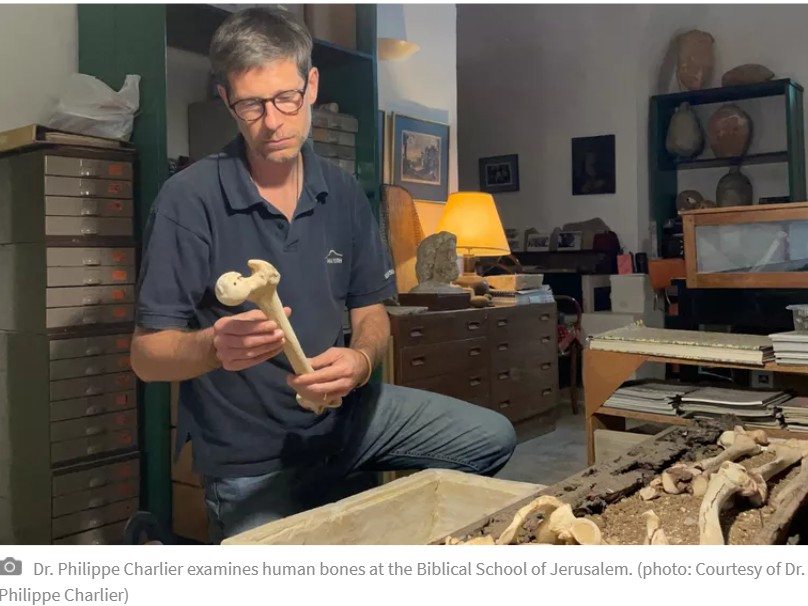
France, April 23, 2026 : In the quiet halls of museums, ancient churches, and hidden crypts across Europe and the Middle East, one man walks with an unusual perspective. Where others see relics, devotion, or history, French forensic pathologist Philippe Charlier sees patients. To him, the past is not distant—it is waiting to be examined, understood, and, in some sense, revived.

Over the past two decades, Charlier has earned a reputation as one of the most intriguing figures in modern forensic science. Often described as the “Hercule Poirot of forensic medicine,” he has applied cutting-edge scientific methods to the remains of some of history’s most revered and controversial figures—saints, kings, philosophers, and even dictators. His work bridges an unlikely divide: the deeply spiritual and the rigorously scientific.
At the heart of his research lies a simple yet profound mission—to uncover truth. In doing so, he often challenges long-standing narratives. For instance, he demonstrated that King Louis IX did not die of the plague, as widely believed, but likely succumbed to complications from scurvy. Similarly, his analysis of Thérèse of Lisieux suggested that her death involved not just tuberculosis, but also the effects of mercury treatments common in her time.


Perhaps one of his most captivating projects involved reconstructing the face of Mary Magdalene. Using fragments of a skull, hair, and preserved tissue, Charlier and his team created a scientifically grounded image of a woman believed to have lived in the Mediterranean region around the age of fifty. While it does not definitively prove tradition, it offers a compelling bridge between faith and historical possibility.
Yet, not all discoveries affirm belief. In some cases, Charlier’s work reveals uncomfortable truths—such as relics once thought sacred turning out to be misidentified remains. But rather than undermining faith, these findings aim to purify it, grounding devotion in authenticity rather than myth.
Interestingly, many of these investigations are commissioned by the Church itself. In an era where skepticism and secularism are on the rise, religious institutions are increasingly turning to science—not to validate faith blindly, but to examine it honestly. This reflects a broader cultural shift. Over the past 15 years, especially after the COVID-19 pandemic, there has been a renewed global interest in relics and tangible expressions of belief.
Charlier believes this resurgence speaks to something deeply human. Faith, he suggests, often seeks something physical—something that can be seen, touched, or felt. Even traditions that reject material symbols tend to create their own anchors. Science, in this context, does not replace faith; it gives it a firmer foundation.
What makes Charlier’s work truly compelling is the duality he embodies. A practicing Catholic, he approaches each case with both reverence and detachment. He speaks of having “two hemispheres”—one that believes, and one that analyzes. This balance allows him to stand at a rare intersection where devotion and evidence coexist.
His recent exploration into the mysterious “odor of sanctity”—a fragrance reportedly associated with the remains of certain saints—illustrates this blend perfectly. Collaborating with experts from fields as diverse as perfumery and chemistry, he seeks to understand whether this phenomenon is spiritual, natural, or perhaps a combination of both.
In the end, Philippe Charlier is more than a scientist. He is, in many ways, a storyteller—one who uses bones, fragments, and traces of the past to tell deeply human stories. Stories of life, suffering, belief, and legacy.
And perhaps that is why his work resonates so deeply. Because in bringing the dead closer to us, he reminds us that faith and reason are not enemies—but companions on the same journey toward truth.
Courtesy Solène Tadié (National Catholic Register)
Photo: Courtesy of Dr. Philippe Charlier


© 2026 CATHOLIC CONNECT POWERED BY ATCONLINE LLP