- 23 April, 2026

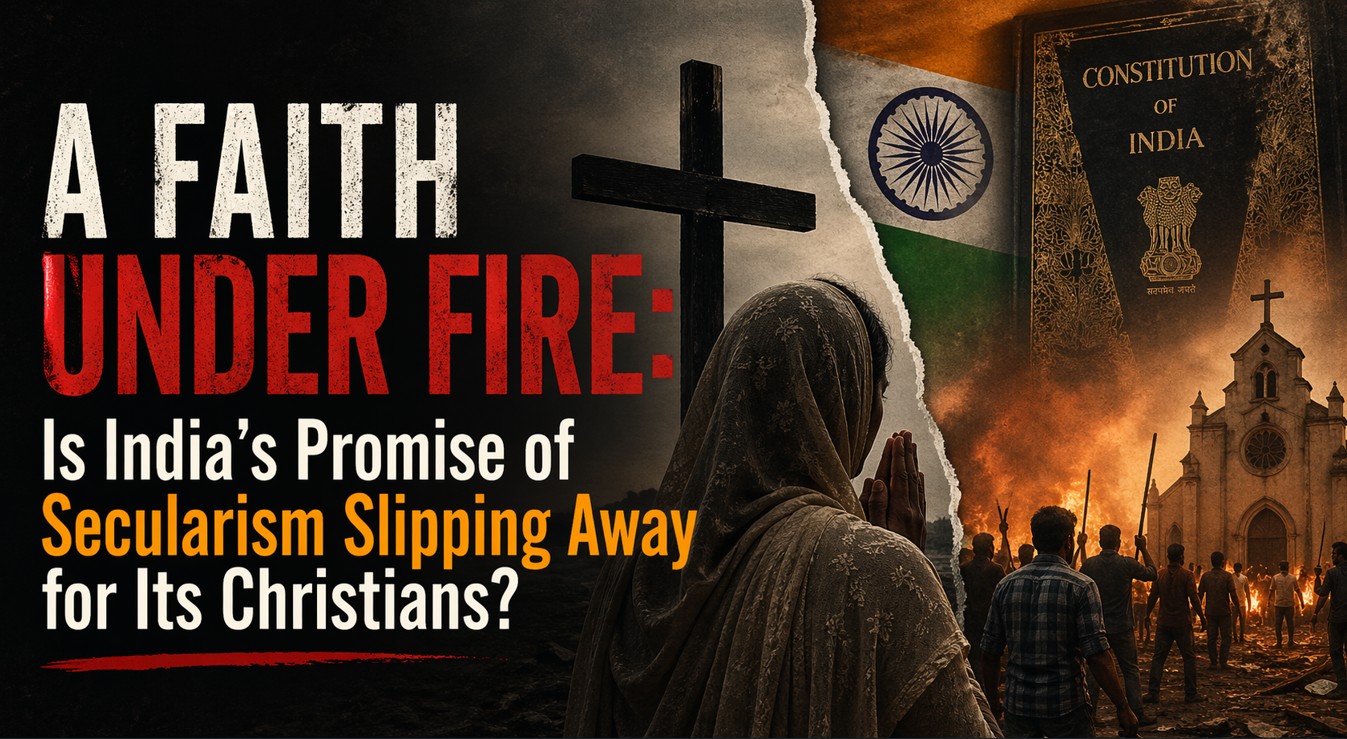
New Delhi, April 22, 2026 : India’s Christian community has long existed within a delicate balance—small in number, yet deeply embedded in the nation’s social fabric. For decades, priests, pastors, and Christian institutions carried out their work in education, healthcare, and humanitarian service with relatively limited interference.

But that balance, once fragile yet functional, is now under visible strain.
What was once a story of coexistence has, over time, evolved into one marked by suspicion, restriction, and, increasingly, hostility.
Historically, Christians in India practiced their faith with relative freedom. Churches functioned openly. Priests and pastors led congregations without systemic disruption. Christian schools and hospitals were widely respected, especially among marginalized communities.
While incidents of violence did occur in earlier decades, they were sporadic and often treated as aberrations rather than indicators of a broader pattern.


India’s constitutional promise—to “profess, practice, and propagate” religion—remained, in large part, intact in lived reality.
In recent years, the situation has shifted.
Across multiple states, there has been a rise in:
Violence has taken many forms—ranging from mob assaults to the destruction of religious spaces. Reports document incidents including arson, physical assaults, and attacks on clergy and institutions, reflecting a broader pattern of targeted hostility.
Priests, nuns and pastors, in particular, have increasingly found themselves at the frontline—facing intimidation, detention, and violence while performing religious duties.
While the present feels acute, it is not entirely without precedent.
India has witnessed episodes of anti-Christian violence over decades—particularly in tribal and rural regions. These incidents have often been tied to tensions around conversion, identity, and social change.
However, what distinguishes the present from the past is scale, frequency, and normalization.
Earlier, such violence appeared episodic. Today, it risks becoming systemic.
A defining feature of the present landscape is the expansion of anti-conversion laws, often framed as “Freedom of Religion” Acts.
These laws, now enacted in around a dozen states, prohibit conversion through “force,” “fraud,” or “allurement.”
States with such laws include Odisha, Madhya Pradesh, Gujarat, Uttar Pradesh, Karnataka, Haryana, and others.
While the stated intent is to prevent coercion, studies suggest a different outcome:
In practice, routine religious activities—prayer meetings, sermons, community outreach—are increasingly scrutinized and, at times, criminalized.
Alongside legal restrictions, financial regulations have added another layer of pressure.
The Foreign Contribution (Regulation) Act (FCRA) governs the ability of organizations in India to receive foreign funding. In recent years:
These restrictions have had a ripple effect:
For a community deeply engaged in social service, this has significantly constrained its institutional presence.
The tightening of laws and regulations is often justified by the narrative of widespread “forced conversions.”
Yet, demographic data shows relatively stable Christian population figures in many regions—raising questions about the scale of the phenomenon.
This gap between perception and measurable change suggests that the issue may be driven as much by narrative as by reality.
Christian Population from 1947 till 2026
In 1947/1951: ~2–2.3%
In 2020s/2026: ~2.3–2.4%
Change: Very minimal over 70+ years
The consequences are deeply personal.
Today:
In some areas, communities have been denied access to basic rights—including burial grounds—highlighting the extent of social fracture.
The shift is stark: from leading openly, to surviving cautiously.
In earlier decades, incidents of religious violence often drew swift condemnation.
Now, responses appear uneven.
There are increasing concerns that:
This inversion—where those at risk must retreat—marks a significant departure from earlier norms.
Perhaps the most significant transformation is this:
The combination of mob hostility, legal restrictions, and financial constraints has created a multi-layered challenge for the Christian fold.
India’s Constitution guarantees religious freedom—not just belief, but expression and propagation.
Yet today, that guarantee is increasingly contested in practice.
The question is no longer whether incidents occur—but whether the framework meant to protect minorities is functioning as intended.
The path forward will depend on whether India can reconcile:
For priests, nuns and pastors, and the wider Christian community, the present moment is one of uncertainty—but also resilience.
And yet—despite the fear, the fractures, and the uncertainty—there is something that has not been extinguished. In quiet homes where prayers continue in whispers, in small gatherings that persist despite disruption, in the courage of priests and pastors who still stand before their congregations knowing the risks—there is a resilience that refuses to yield. History has shown that faith, when tested, does not disappear; it deepens. And nations, when confronted with their own contradictions, are given a choice: to harden or to heal. If India chooses the latter—if it remembers the promise of dignity, freedom, and equal belonging—then this moment, however dark, may yet become a turning point. Not just for one community, but for the soul of the nation itself.
By Catholic Connect Reporter
© 2026 CATHOLIC CONNECT POWERED BY ATCONLINE LLP