- 29 April, 2026
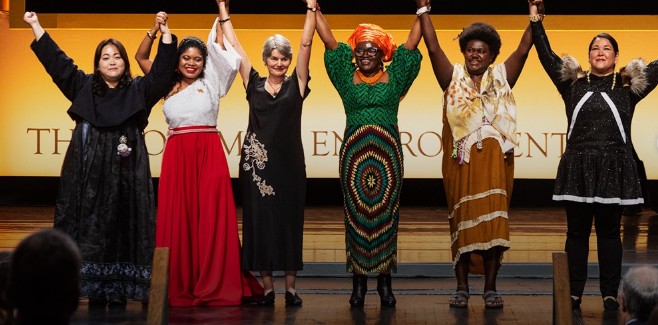
San Francisco , April 29, 2026: The 2026 Goldman Environmental Prize—widely known as the “Green Nobel Prize”—has made history by honoring an all-women group of grassroots environmental defenders for the first time. These six women, drawn from across the globe, have been recognized for their extraordinary courage in protecting ecosystems, defending vulnerable communities, and challenging powerful forces threatening the planet.

Established in 1989, the Goldman Environmental Prize celebrates individuals from six regions of the world who take significant risks to safeguard the environment. This year’s recipients—Iroro Tanshi (Nigeria), Borim Kim (South Korea), Sarah Finch (United Kingdom), Theonila Roka Matbob (Papua New Guinea), Alannah Acaq Hurley (United States), and Yuvelis Morales Blanco (Colombia)—represent a powerful example of grassroots leadership driving global change.
This milestone year highlights not only environmental progress but also the critical role women play in leading climate justice movements. Experts note that while women have long been at the forefront of environmental activism, their contributions have often gone underrecognized—making this year’s all-female cohort especially significant.
Each of the winners has taken bold action in their own region


In Nigeria, Iroro Tanshi has worked closely with local communities to prevent destructive wildfires and protect endangered species, demonstrating how grassroots conservation can safeguard biodiversity. Meanwhile, in South Korea, Borim Kim led a landmark youth-driven legal challenge that forced stronger government accountability on climate policy, reinforcing the idea that environmental protection is tied to human rights and future generations.
In the United Kingdom, Sarah Finch secured a groundbreaking legal victory requiring authorities to consider the full climate impact of fossil fuel projects—a ruling that has already influenced major environmental decisions.
Across the Atlantic, Alannah Acaq Hurley successfully led Indigenous-led efforts to block a massive mining project in Alaska, protecting one of the world’s most important ecosystems and sustaining local livelihoods.
Similarly, Yuvelis Morales Blanco in Colombia mobilized her community to resist harmful fracking projects, while Theonila Roka Matbob in Papua New Guinea has fought for accountability over environmental damage caused by large-scale mining operations. Together, these women embody a shared mission: defending both people and the natural world from exploitation and harm.
Their work reflects broader global challenges—climate change, biodiversity loss, industrial exploitation, and threats to Indigenous lands. Yet it also shows that local action can lead to transformative global impact. The Goldman Prize continues to emphasize that ordinary individuals, when driven by conviction and courage, can bring about extraordinary change.
Beyond recognition, the award amplifies the voices of these activists and provides them with resources and global platforms to expand their efforts. Over the years, the prize has honored more than 200 environmental defenders from nearly 100 countries, reinforcing its role as one of the world’s most prestigious environmental honors.
For many observers, the 2026 winners send a powerful message: environmental protection is inseparable from justice, dignity, and the protection of human life. Their stories are not just about conservation—they are about standing firm in the face of adversity, often at great personal risk.
In the final reflection, their work also resonates with the mission of the Conference of Catholic Bishops of India Ecology Commission, which encourages Catholics to embrace care for creation as a moral responsibility. Rooted in the vision of Laudato Si', this call reminds the faithful that protecting the Earth is part of living out one’s faith.
The witness of these environmental defenders invites Catholics worldwide to respond—not only with admiration, but with action. Through prayer, awareness, and responsible living, believers can contribute to safeguarding what the Church calls our “common home.”
In honoring these six women, the world is reminded that protecting creation is not just a global necessity—it is a shared human duty.
By Catholic Connect Reporter
© 2026 CATHOLIC CONNECT POWERED BY ATCONLINE LLP