- 04 October, 2026

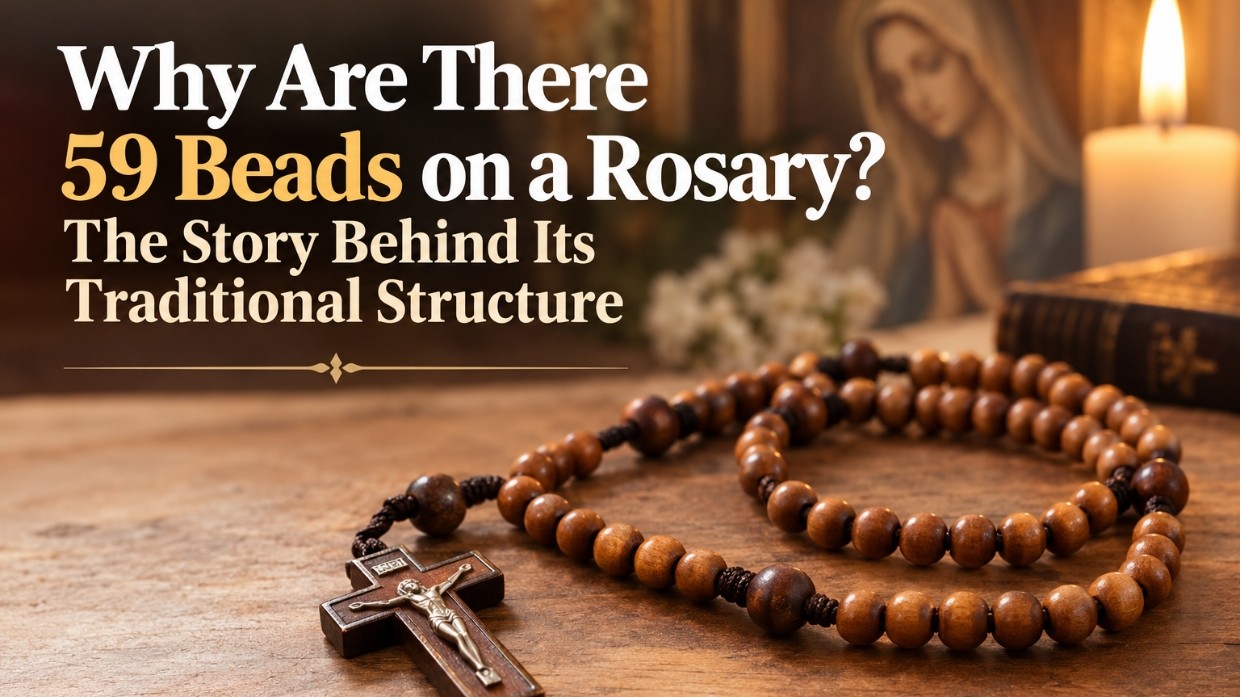
October 4, 2026: If you have ever held a Rosary in your hands, you may have noticed something you probably never stopped to count: 59 beads.


Fifty-nine may seem like an oddly specific number. Why not 50? Why not 60? And who decided that a Rosary should be arranged this way?
The answer is not simply a matter of counting. The 59 beads are the result of a centuries-old Christian tradition in which prayer, Scripture and meditation gradually came together in a form that Catholics could carry, touch and pray anywhere.
From Psalms to beads
The Rosary did not appear in its present form overnight. It developed gradually during the Middle Ages. Medieval Christians who could not pray all 150 Psalms of the Psalter, as monks did in the Divine Office, adopted other forms of repetitive prayer. The 150 Hail Marys traditionally associated with the Rosary developed as a popular parallel to the 150 Psalms.
The practice was promoted particularly by the Dominican tradition. A long-standing tradition associates the Rosary with St. Dominic, although historians today emphasise that the devotion took shape progressively rather than being created in one moment by a single person.
Over time, the prayers became organised into groups of ten Hail Marys, known as decades, with an Our Father marking the beginning of each decade. This gave the devotion the recognisable rhythm Catholics know today.
So, where do the 59 beads come from?
A traditional five-decade Rosary contains 53 small beads and six larger beads.
The 53 small beads are used for the 53 Hail Marys: 50 within the five decades, plus three at the beginning.
The six larger beads are used for the six Our Fathers: five marking the five decades, plus one at the beginning of the Rosary.
The opening sequence begins with the crucifix, followed by an Our Father, three Hail Marys and another Our Father before the five decades begin.
The three opening Hail Marys have traditionally been associated with an increase in faith, hope and charity.
Then come the five decades. Each contains one larger bead for the Our Father and ten smaller beads for the ten Hail Marys.
5 Our Fathers + 53 Hail Marys + 1 additional Our Father = 59 beads.
But the number itself is only part of the story.
The beads are meant to lead somewhere
The Rosary was never intended to be merely a counting exercise. The beads give the hands something to follow while the mind and heart contemplate the life of Christ.
With each decade, the person praying is invited to reflect on one of the mysteries of the Rosary — events from the lives of Jesus and Mary. The repeated Hail Marys create a steady rhythm, allowing the person praying to remain with the mystery rather than becoming distracted by the next words of the prayer.
The Vatican describes the Rosary as a Gospel-centred prayer in which the succession of Hail Marys provides the rhythm for contemplating the mysteries of Christ.
Even the beads themselves can carry meaning. St. John Paul II described them not merely as a counting mechanism but as a reminder of the continuing journey of Christian contemplation, with everything ultimately converging on Christ.
More than 59 beads
So, the next time you hold a Rosary, its 59 beads can be seen as more than a carefully arranged string.
They represent a prayer tradition that developed across centuries — from the desire of Christians to imitate the Psalter, through the growth of Marian devotion, to the structured meditation on the mysteries of Christ used by Catholics today.
The beads count the prayers, but they are not the destination.
They are there to help the person praying move from one prayer to the next, from one mystery to another, and ultimately, through Mary, to Christ.
By Catholic Connect Reporter
Continue Reading on Catholic Connect App
Get access to exclusive news articles & more.




© 2026 CATHOLIC CONNECT POWERED BY ATCONLINE LLP