- 06 July, 2026

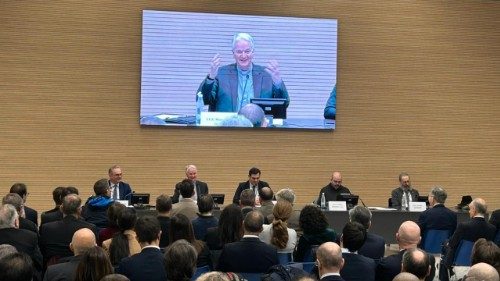
Vatican City, March 3, 2026: A seminar examining the promise and risks of artificial intelligence was held at the Vatican, organised by the Secretariat for the Economy and the Office of Labor of the Apostolic See (ULSA), with the “appreciation and encouragement” of the Pope.


The reflection opened with the well-known phrase attributed to Albert Einstein: “An abundance of means and a confusion of ends.” The quote was presented as an image of a contemporary world deeply influenced and challenged by emerging technologies. The interests surrounding these technologies are varied and far from “neutral.” In this context, the Holy See, free from military or commercial aims, was described as being in a unique position to encourage forms of global governance capable of ensuring that technological systems are “ethical from their design stage.”
These ideas formed part of the discussions at the seminar titled “Potential and Challenges of Artificial Intelligence,” held on Monday, 2 March, in Rome at the Salone San Pio X on Via della Conciliazione 5. The event was jointly organised by the Secretariat for the Economy and ULSA.


The seminar began with remarks by Professor Pasquale Passalacqua, Director of ULSA. He explained that Pope Leo XIV, having been informed of the initiative by its president, Monsignor Marco Sprizzi, had “appreciated and encouraged” the event and expressed his hope for “deeper awareness in this highly relevant and complex field.” The session was moderated by Alessandro Gisotti, Deputy Editorial Director of the Dicastery for Communication.
Among the speakers were Bishop Paul Tighe, Secretary of the Dicastery for Culture and Education; Franciscan friar Paolo Benanti, professor at the Pontifical Gregorian University and Luiss Guido Carli University; and Professor Corrado Giustozzi, who teaches in the Master’s Degree programme in Intelligent Systems Engineering at Rome’s Campus Bio-Medico University.
Addressing the widespread adoption of ChatGPT in 2022, Bishop Tighe described its consequences using the acronym VUCA: Volatility, Uncertainty, Complexity, and Ambiguity. In this context, he referred to recent developments, including the example of Anthropic, a U.S.-based company established to promote ethical AI, which has reportedly faced “government pressure to relax its ethical commitments regarding military and surveillance uses.”
He emphasised that technological innovation does not emerge in neutral environments but is closely linked to “geopolitical rivalries, commercial pressures, and personal ambitions.”
In response to these challenges, Bishop Tighe pointed to the document Antiqua et nova, which highlights the need for the “wisdom of the heart, capable of integrating the whole and its parts,” as a vital requirement for humanity today.
He further noted that the Church holds “moral authority” and possesses the capacity to convene competent dialogue partners, positioning it as a significant contributor in shaping the future development of artificial intelligence.
Summarising the discussion, Gisotti observed that the seminar also represented a concrete “commitment” by the ecclesial community.
Father Benanti focused his contribution on the ethical implications of artificial intelligence, advocating for a renewed “ethics of technology” that critically examines the “politics” embedded within technological models. He stated, “Every technological artifact, when it impacts a social context, functions as a configuration of power and a form of order.”
He described this as a pressing issue currently debated at “various tables,” ranging from the Holy See to the United Nations, where Benanti serves as the only Italian member of the UN Committee on Artificial Intelligence. In these settings, he noted, such “configurations of power” are increasingly shaped by commercial agreements. This trend is also evident in the information sphere, where the prominence of an article depends less on its quality and more on the position assigned to it by algorithms on web platforms. Benanti described this phenomenon as a “mediation of power.”
Professor Giustozzi’s intervention centred on the algorithm as a core element of artificial intelligence and the challenges linked to algorithm-based decision-making. One major concern, he explained, is bias, as algorithms can unintentionally or deliberately absorb prejudices that skew outcomes or lead to unfair results.
For this reason, the training phase — during which algorithms are developed through data input — is crucial. If the data used is incomplete or distorted, the outcomes produced by the algorithm will inevitably be inaccurate or discriminatory.
Courtesy: Vatican News
© 2026 CATHOLIC CONNECT POWERED BY ATCONLINE LLP