- 07 November, 2026

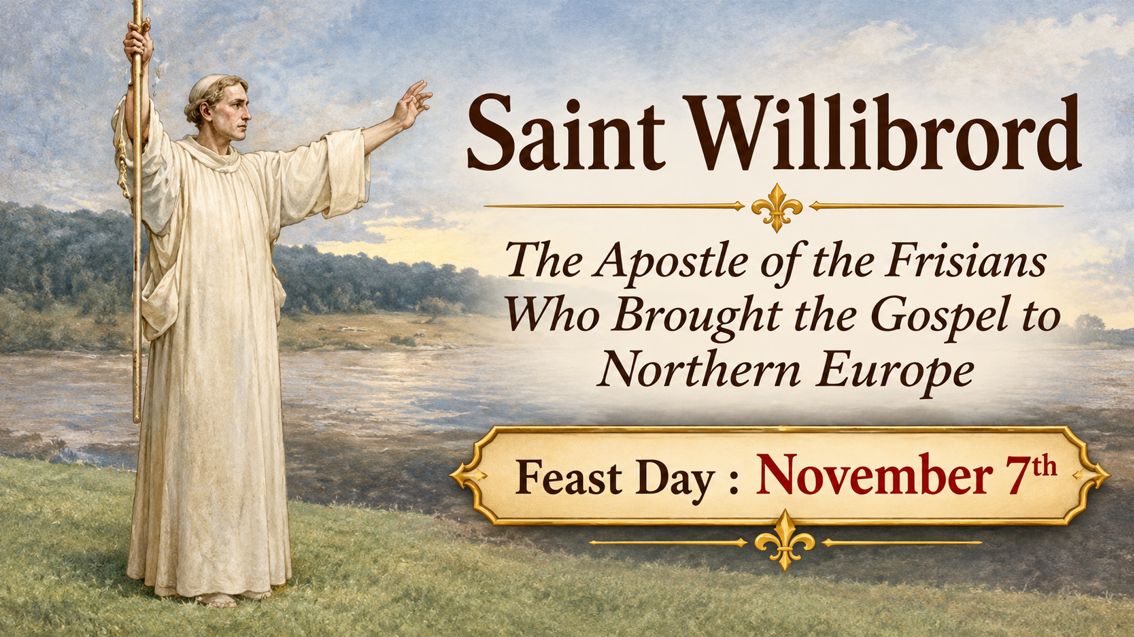
Luxembourg, November 7, 2026: Sharing the Gospel often requires courage, patience, and a willingness to travel beyond familiar surroundings. Saint Willibrord, an English missionary and bishop, dedicated his life to bringing Christianity to the people of Frisia, in present-day Netherlands and surrounding regions. Known as the Apostle of the Frisians, he became one of the great missionary pioneers of Northern Europe. His life reminds Catholics that faith can transform communities through perseverance, prayer, and loving service.

Willibrord was born in Northumbria, in northern England, around 658. His father, Wilgils, entrusted him to the care of the monastery at Ripon when he was young. There, Willibrord received his religious education under the guidance of Saint Wilfrid, an influential English bishop.
(CLICK HERE to follow Catholic Connect and to stay updated with Catholic News & Content)
At approximately twenty years of age, Willibrord travelled to Ireland to deepen his spiritual and theological formation. He spent twelve years at the monastery of Rath Melsigi, studying under Saint Egbert and other religious teachers. During this period, he developed a strong desire to become a missionary and share the Christian faith with people who had not yet encountered the Gospel.
Around 690, after becoming a priest, he set out for Frisia with eleven companions. Their mission would become one of the most important chapters in the history of Christianity in Northern Europe.
Willibrord understood that missionary work needed spiritual preparation and the support of the wider Church. He travelled to Rome and received approval for his mission from Pope Sergius I.
With the support of the Frankish ruler Pepin of Herstal, Willibrord established his missionary base in the region of Utrecht. In 695, he returned to Rome, where Pope Sergius consecrated him as a bishop and gave him the name Clement.
As bishop, Willibrord travelled extensively, preached the Gospel, established churches, and organised Christian communities. He also attempted missionary journeys into Denmark and other northern regions, although these efforts did not always succeed.
In 698, he founded the important monastery of Echternach, in present-day Luxembourg. It became a centre of prayer, education, and missionary activity. His work was sometimes interrupted by political conflicts and opposition from pagan rulers. After the death of Pepin, the Frisian ruler Radbod regained territory and disrupted many Christian communities.
Willibrord did not abandon his mission. After Radbod's death, he returned to Frisia and continued his work, receiving valuable assistance from Saint Boniface.
After decades of missionary service, Willibrord died on November 7, 739, at Echternach. He was buried at the monastery he had founded, and devotion to him spread throughout Europe.
His monastery became an important pilgrimage destination. The annual Dancing Procession of Echternach, a distinctive religious tradition in Luxembourg, is associated with devotion to Saint Willibrord and remains part of the region's cultural and spiritual heritage.
Saint Willibrord teaches us that spreading the Gospel requires patience, courage, and perseverance. His missionary journey reminds us not to become discouraged when our efforts do not produce immediate results.
He also shows the importance of building strong Christian communities through education, prayer, and service. Every Catholic can follow his example by sharing faith through kindness, welcoming others, and living according to Christ's teachings.
Saint Willibrord, Apostle of the Frisians, pray for us!
Visit the Spiritual section of Catholic Connect for more inspiring stories about saints, faith, prayer, and Catholic life.
By Catholic Connect Reporter
Relevant Keywords: Saint Willibrord, November 7 feast day, Apostle of the Frisians, Catholic saints, Bishop of Utrecht, missionary saints, Echternach Abbey, Saint Boniface, Christian missionaries, Luxembourg.



© 2026 CATHOLIC CONNECT POWERED BY ATCONLINE LLP