- 18 June, 2026

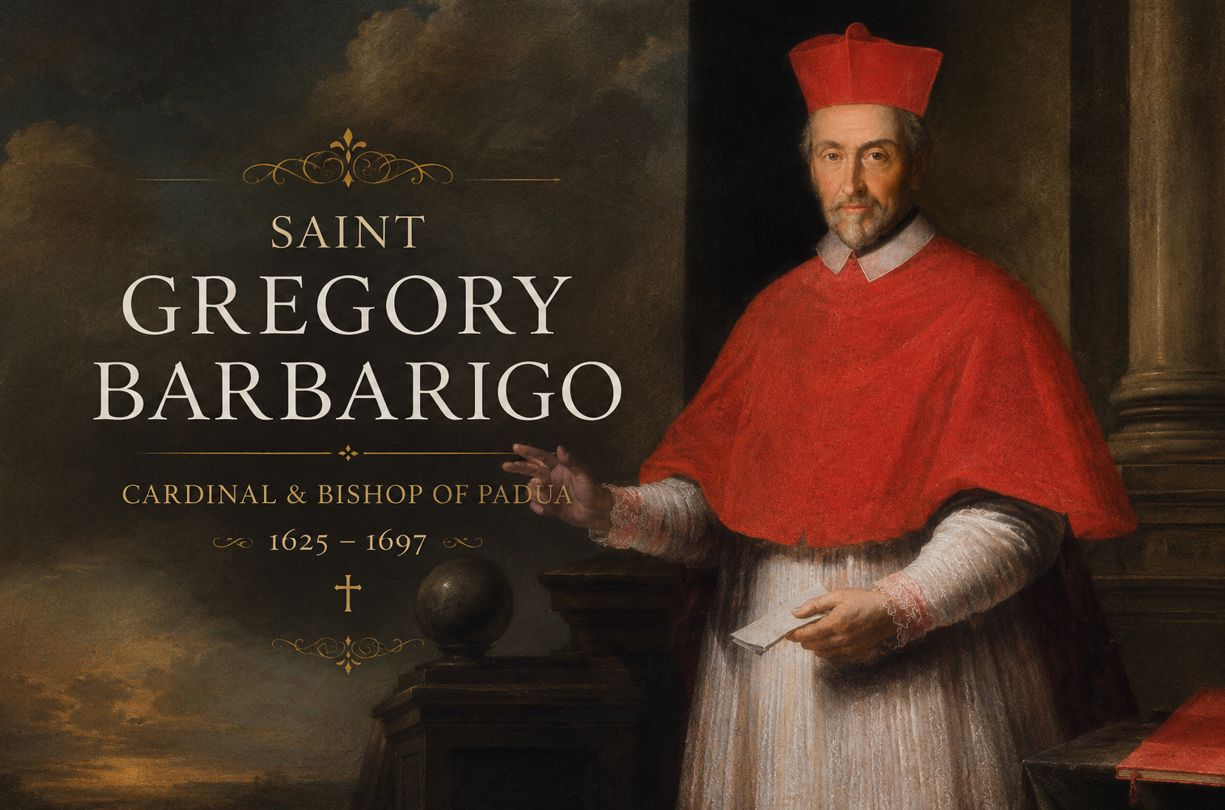
Italy, June 18, 2026: Why is Saint Gregory Barbarigo remembered as one of the greatest bishops and reformers of the Catholic Church? Discover the extraordinary story of the Italian cardinal who dedicated his life to educating priests, caring for the poor, strengthening faith communities, and renewing the Church after the Council of Trent.


Feast Day: 18 June
Born: 16 September 1625, Venice, Republic of Venice
Died: 18 June 1697, Padua, Italy
Canonized: 26 May 1960 by Pope John XXIII


Patron of: Educators, teachers, seminaries, students, and bishops
Known For: Church reform, founding schools and seminaries, pastoral care, promoting education, and serving the poor
Title: Bishop of Padua and Reformer of the Church
Few bishops in the history of the Church combined intellectual excellence, pastoral dedication, and personal holiness as profoundly as Saint Gregory Barbarigo.
Born into a noble Venetian family, Gregory could have enjoyed a life of privilege and influence. Instead, he chose a path of humility and service, giving his talents completely to God and the people entrusted to his care.
As a bishop and cardinal, he worked tirelessly to improve the education of priests, establish schools, support the poor, and bring the teachings of the Catholic faith closer to ordinary people.
More than three centuries after his death, Saint Gregory Barbarigo remains an inspiring example of a shepherd who led not through power, but through wisdom, compassion, and holiness.
He was born on 16 September 1625 in Venice, one of the most important cities of Europe at that time.
His father, Giovanni Francesco Barbarigo, was a respected Venetian senator and diplomat. Gregory received an excellent education and was introduced to the responsibilities that came with a life of public service.
However, his early years were marked by personal suffering. His mother died when he was young, and this experience deepened his awareness of human suffering and dependence on God.
Although he belonged to a wealthy family, Gregory developed a strong desire to serve others rather than seek personal comfort.
As a young man, Gregory studied law and became involved in diplomatic work.
In 1648, he accompanied the Venetian ambassador to the negotiations that led to the Peace of Westphalia, which ended the Thirty Years’ War in Europe.
During this period, he met Pope Alexander VII, who recognised Gregory’s intelligence, virtue, and spiritual depth.
This encounter changed the direction of his life.
Rather than continuing a political career, Gregory felt called to the priesthood. He abandoned worldly ambitions and dedicated himself entirely to serving the Church.
Gregory Barbarigo was ordained a priest in 1655.
Soon afterward, he was appointed Bishop of Bergamo and later became Bishop of Padua. He was eventually elevated to the rank of cardinal.
At a time when the Catholic Church was implementing reforms following the Council of Trent, Gregory became a passionate supporter of renewal.
He believed that a strong Church depended on well-formed priests, educated faithful, and communities united in faith.
His leadership focused not only on administration but on transforming hearts.
One of his greatest contributions was his commitment to education.
He understood that ignorance could weaken faith, while knowledge rooted in truth could strengthen Christian life.
As Bishop of Padua, he improved seminaries, established schools, encouraged theological studies, and promoted better formation for priests.
He founded libraries and supported the teaching of languages, including ancient biblical languages, so that Scripture and Church writings could be studied more deeply.
For him, education was not merely academic—it was a path toward holiness.
Despite his high position as bishop and cardinal, Gregory lived with remarkable simplicity.
He regularly visited parishes, preached to ordinary people, listened to their problems, and ensured that the poor received care.
He gave generously to those in need and used Church resources to help the suffering.
People remembered him not as a distant authority figure but as a compassionate father who knew and loved his flock.
Saint Gregory Barbarigo believed that priests needed strong spiritual and intellectual preparation.
He worked to improve seminaries by ensuring that future priests received proper education, discipline, and spiritual formation.
His efforts helped create a generation of clergy who were better prepared to serve the Church.
This commitment to priestly formation became one of the most important parts of his legacy.
Although Gregory Barbarigo became a cardinal, he never sought honour or recognition.
He continued living simply, focusing on prayer, service, and the needs of others.
His leadership style was based on humility. He believed that authority in the Church was a responsibility to serve, following the example of Christ the Good Shepherd.
His personal holiness inspired both clergy and lay people.
After decades of tireless ministry, Saint Gregory Barbarigo died on 18 June 1697 in Padua, Italy.
The people who knew him mourned the loss of a beloved bishop who had dedicated his entire life to their spiritual and material welfare.
Soon after his death, many began seeking his intercession and remembering his extraordinary example of Christian leadership.
The Church officially recognised Gregory Barbarigo’s holiness and canonised him on 26 May 1960.
Today, he is remembered as a model for bishops, teachers, educators, and all those involved in forming others in faith.
His life demonstrates that true reform begins with education, compassion, and personal holiness.
One of Saint Gregory’s greatest messages for the modern world is the importance of combining faith and knowledge.
He showed that education is not opposed to spirituality but can become a powerful instrument for discovering truth and serving God.
Schools, seminaries, and communities inspired by his vision continue to honour his belief that learning should lead people closer to Christ.
The life of Saint Gregory Barbarigo teaches important lessons:
Saint Gregory reminds believers that renewing the world often begins by forming minds and transforming hearts.
In a time when the Church and society face many challenges, Saint Gregory Barbarigo remains a powerful example of wisdom, charity, and faithful leadership.
He was a cardinal who lived simply, a scholar who cared for the uneducated, and a bishop who placed his people above himself.
From the canals of Venice to the churches and schools of Padua, his legacy continues to inspire generations.
He teaches that the strongest foundations of faith are built through truth, compassion, and love.
To know about more saints please visit the spiritual section.
By Catholic Connect Reporter
Saint Gregory Barbarigo, Saint Gregory Barbarigo feast day, Italian saints, Catholic bishops, Catholic reformers, saints of June, Bishop of Padua, Cardinal Gregory Barbarigo, Catholic education saints, seminary reform, Church reform saints, Venetian saints, Catholic educators
© 2026 CATHOLIC CONNECT POWERED BY ATCONLINE LLP