- 04 April, 2026

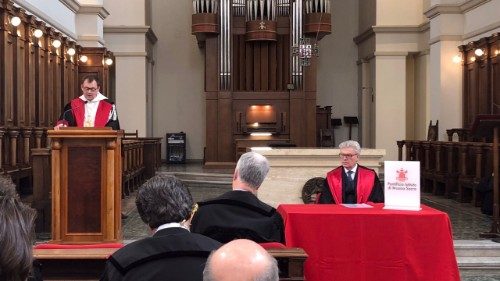
Vatican City, March 7, 2026: Sacred music in the liturgy should guide the faithful towards prayer and contemplation rather than serve as entertainment, Scottish composer and conductor Sir James MacMillan said while delivering a lecture at the Pontifical Institute of Sacred Music in Rome.

Sir MacMillan was awarded a Doctorate Honoris Causa in Sacred Music on Friday, March 6. During the ceremony, he delivered a Lectio Magistralis titled “The Sound of Silence: Sir James MacMillan’s Vision for Modern Sacred Music.”
Reflecting on the role of music in the Church, he stressed that music used during the Mass must support the prayer of the faithful and deepen their encounter with God.


“We don’t go to Mass to be entertained,” he said. “Sacred music in and outside the liturgy should channel our thoughts and prayers towards God.”
Sacred music in service of the liturgy
Sir MacMillan emphasised that sacred music has a specific responsibility within the liturgy. According to him, composers who write music for the Mass must ensure that their compositions help the worshipping community pray and reflect.
He explained that music used in the liturgy should carry the prayers and contemplations of the faithful and lead them spiritually towards the altar.
“Writing for the liturgy means creating music that helps the thoughts and prayers of the assembly rise towards God,” he noted.
Silence and prayer in sacred composition
During his lecture, Sir MacMillan also spoke about the importance of silence in sacred music. He described silence as an essential element in the creative process of composers and in the spiritual life of believers.
“Many composers recognise that silence is fundamental to their imagination. Music often begins in the silence of the heart,” he said.
He added that for Christians, silence is also the place where believers encounter God in prayer.
Tradition guiding sacred music
Sir MacMillan also reflected on the relationship between tradition and contemporary composition in Church music. He said that sacred music today should respect and draw inspiration from the rich musical heritage of the Church.
He pointed to Gregorian chant and Renaissance polyphony as foundational forms of Catholic musical tradition that continue to influence modern sacred compositions.
While encouraging creativity among composers, he stressed that new sacred music should remain rooted in the liturgical tradition of the Church.
Sacred music and the life of the Church
According to Sir MacMillan, sacred music plays a vital role in helping the faithful participate more deeply in the liturgy. When properly composed and performed, it strengthens the prayerful atmosphere of the Mass and draws the congregation closer to God.
His reflections highlighted the enduring importance of sacred music as a spiritual and liturgical expression within the life of the Church.
Courtesy: Vatican News
© 2026 CATHOLIC CONNECT POWERED BY ATCONLINE LLP