- 10 June, 2026

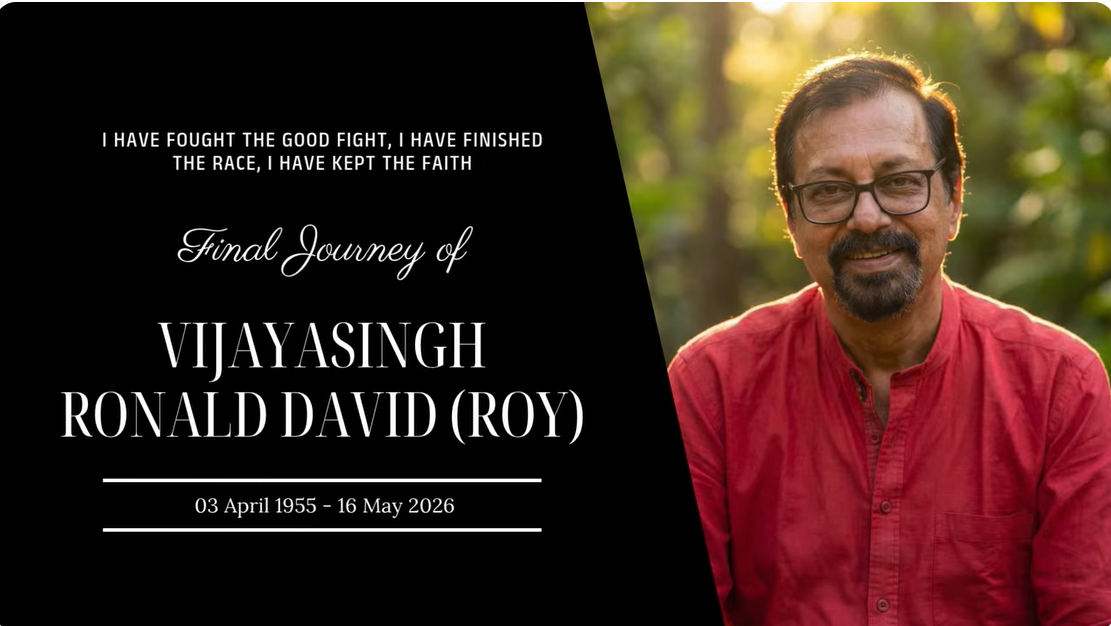
Coorg, June 10 2026: The passing of Vijayasingh Ronald David, affectionately known as Roy David, marked the end of an extraordinary chapter in the struggle for tribal rights and social justice in Karnataka. The veteran activist died on 16 May at the age of 71 after suffering a cardiac arrest while driving home to Kushalnagara from Bengaluru.


For thousands of Adivasi families across Kodagu, Mysore and beyond, Roy David was far more than an activist. He was a mentor, organiser, advocate and friend who spent over four decades standing beside some of India's most marginalised communities. His death has left a void not only among those who worked with him, but also among generations of tribal families whose lives were transformed through his dedication and courage.
Roy David founded the Coorg Organisation for Rural Development (CORD) in 1981. By 1984, the organisation had shifted its full focus towards the rights and welfare of forest-dwelling communities in Karnataka's Kodagu and Mysore districts.
His work began with the Soliga Adivasi communities, helping them organise and demand better nutrition and educational opportunities for their children. Through grassroots efforts, informal schools were established and dozens of children were enrolled in government schools, creating opportunities that had previously seemed out of reach.


What started as a local effort soon evolved into a powerful movement. Roy travelled from village to village, encouraging communities such as the Jenu Kuruba, Betta Kuruba, Yerava, Soliga and Mallekudiya people to unite and advocate for their rights.
His approach was simple but effective: empower people to speak for themselves and stand together for justice.
Throughout his life, Roy David refused to separate environmental concerns from human rights issues. He understood that forests, land, livelihoods, health, education and self-governance were deeply interconnected for indigenous communities.
One of his most significant contributions came through his involvement with the Budukattu Krishikara Sangha (BKS), or Tribal Farmers' Association, which emerged in the mid-1980s as a platform advocating for labour, land and forest rights.
Under his leadership and guidance, communities challenged forced evictions, fought displacement and demanded recognition of their traditional rights over forest lands.
His influence extended far beyond Karnataka. In 1992, he helped establish the National Adivasi Alliance, connecting indigenous movements across India and creating a stronger collective voice for tribal communities.
Roy David's commitment to justice came at a personal cost.
During the 1970s, while campaigning for land rights for tenant farmers in Mangalore, he survived a violent attack allegedly linked to powerful interests opposed to the movement. The assault left him with permanent loss of function in one hand.
Yet the injury never weakened his resolve.
Instead, it strengthened his determination to continue fighting for those whose voices often went unheard.
One of his most notable victories came in the late 1990s when local communities opposed the construction of a private tourist resort deep inside the Nagarahole forests. After years of protests and legal action, the Karnataka High Court halted the project and cancelled the lease on diverted forest land. The victory became a landmark example of community-led environmental action.
Later, Roy played a crucial role in supporting the implementation of the Forest Rights Act. He travelled extensively, helping forest communities understand their rights and navigate complex legal processes to secure recognition of their traditional lands.
Those who knew Roy David often speak not only of his activism but also of his generosity towards young researchers, students and emerging social workers. He freely shared his knowledge, experiences and stories, inspiring a new generation to engage with issues of justice and equality.
His life's guiding principle was reflected in the mission of CORD: the belief that injustice should never be accepted as inevitable and that meaningful change is possible through collective action.
While Roy David's passing represents a profound loss, his legacy continues to live on in the communities he empowered and the movements he helped build.
The schools established, the rights secured, the forests protected and the confidence instilled in countless tribal families remain enduring monuments to his life's work.
The greatest tribute to Roy David may not be found in memorials or speeches, but in the continued efforts of those who carry forward his vision of dignity, equality and justice.
Though one voice has fallen silent, the movement he nurtured continues to grow. And in that continuing struggle for a fairer society, Roy David's spirit will remain very much alive.
Courtesy : The Wire


© 2026 CATHOLIC CONNECT POWERED BY ATCONLINE LLP