- 29 September, 2026

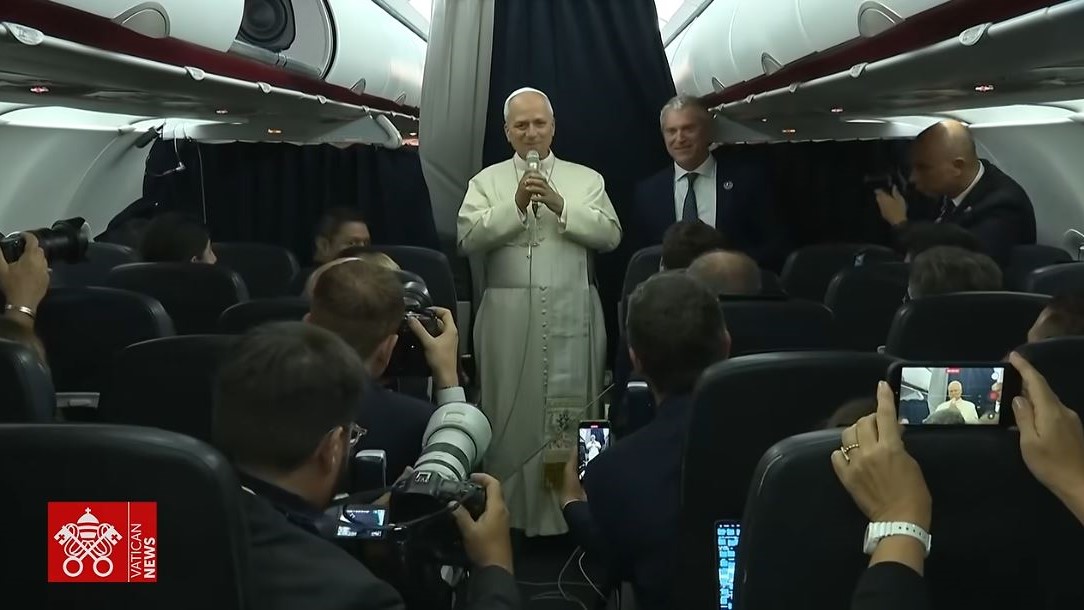
Metz, September 29, 2026: Pope Leo XIV called on Russia and Ukraine to engage in dialogue and seek ways to resolve their differences, while warning against rising military expenditure, the dangers of nuclear weapons and the human cost of war. Speaking to around 80 journalists aboard the flight from Metz to Rome at the conclusion of his apostolic journey to France, the Pope also addressed sexual abuse in the Church, end-of-life care, housing insecurity, artificial intelligence and the future of Christianity in Europe.


Reflecting on his four-day visit to France, Pope Leo said the journey had been filled with blessings, particularly his time at Lourdes, where he accompanied people who were sick and suffering.
“The four days were literally filled with many blessings. Almost miracles, I would say, especially the time at Lourdes, walking with, accompanying so many people who are sick and suffering and seeing how the grace of God's presence manifested in many different ways, touches people's hearts, transforms their lives,” he said.
He added that God's presence “restores dignity to the sick, the elderly, those who in some parts of society are discarded.”
The Pope also recalled the gathering of 80,000 young people at a stadium near Paris, describing their enthusiasm, joy and hope as among the significant moments of the journey.
Pope calls for dialogue between Russia and Ukraine
Responding to a question about the Russia-Ukraine conflict, Pope Leo reiterated the Church's commitment to peace and its opposition to violence, hatred and the growing dangers posed by increasingly destructive wars.
“The first thing would be to underline the principles of the Church’s social teaching, through which we seek not to promote violence, hatred, weapons and the dangers present in today’s world, including those posed by some national leaders who are once again beginning to speak of nuclear weapons, of wars that are becoming increasingly destructive, above all in terms of human life,” he said.
The Pope criticised the continued expansion of the military industry and the resources directed towards arms production.
“A small number of people are becoming immensely wealthy from an industry that promotes war. Yet these billions upon billions of euros or dollars could be used to solve problems such as world hunger, housing, unemployment and so on,” he said.
He said the world needed a different voice, one that did not simply call for increased military spending, which could heighten tensions and lead to further conflicts.
“We see how violence, how these powers that always seek to impose their will through force instead of engaging in dialogue and promoting negotiations over the differences that can naturally exist, bring us ever closer to a war, or several wars, conflicts such as those we see in the world today,” he said.
Emphasising the Church's responsibility to defend human dignity and the value of life, Pope Leo called for greater investment in healthcare and education rather than weapons.
“I believe the Church has a responsibility to promote those values, continually inviting leaders such as those of Russia and Ukraine, and other countries, to come, to sit down, to engage in dialogue, to seek ways of resolving problems without continuing these wars that no longer make sense,” he said.
He added: “So, in this sense, the Church continues to raise her voice. We cannot force anyone. At times it may seem futile, but we will keep speaking, we will keep inviting, we will keep proclaiming the Gospel.”
Pope addresses sexual abuse and healing
Asked whether he considered sexual abuse within the Church to be systemic, following his meeting with seven survivors in Lourdes, Pope Leo said he had invited them to help him communicate the Church's willingness to listen to other victims and accompany them in their search for healing.
“Several of them spoke about systemic abuse. Personally, I prefer to express it in a different way, although I did speak about some organizations within the Church who have, at times, if you will, as a system, been abusive,” he said.
The Pope stressed the distinction between abuse as a human problem and the additional harm caused when it occurs within the Church.
“Sexual abuse is first and foremost a human problem. When it happens within the Church, it actually has another whole dimension added to it, because people's lives of faith are deeply wounded and sometimes even destroyed,” he said.
He added that the Church had a particular responsibility to accompany survivors and help them seek healing, acknowledging that it had, in certain ways, been seen as responsible while also having an important role in helping survivors find healing.
Church's defence of life and housing concerns
Responding to a question about the relationship between Church and State in France, Pope Leo said his remarks on end-of-life care and the defence of life were not an attempt to enter French politics.
“I'm not entering into politics, we're applying the Gospel to people's lives,” he said, referring to the Church's social teaching. He added that the Church's mission was to preach the Gospel and reaffirm the words of Jesus Christ: “I am the way, the truth, and the life.”
“The defence of life is something that as you all know the Church teaches, believes very deeply,” he said.
Speaking about Lourdes and people living with sickness, disability and pain, he said their lives continued to have meaning and that the Church sought to remain close to them.
On housing insecurity, Pope Leo said communities, parishes, dioceses and governments needed to work towards fairer solutions, particularly for elderly people and those with disabilities. “The housing problem that exists in many countries today is a problem that a parish alone, a diocese alone or the Church itself cannot solve,” he said.
He called on political leaders and authorities to address the issue, adding that its underlying causes needed to be examined rather than responding only when emergencies arose.
Pope calls for responsible development of artificial intelligence
Addressing concerns about artificial intelligence and its potential risks to humanity, Pope Leo said he was not in a state of panic but believed warnings from experts should be taken seriously.
“If someone were to ask me, am I in panic mode? No, I'm not. I sleep at night,” he said. “I do think that the concerns raised by many of the experts, specialists in AI, should be taken seriously.”
The Pope called for political leaders, technology companies and social organisations to come together to examine existing developments and possible future risks. “To simply say, ‘Oh, it's not going to happen’, and close our eyes to it, I think is probably not the most responsible way to go about that,” he said.
He explained that the Vatican had established its own commission on artificial intelligence to coordinate its use within the Holy See and study its risks and benefits. The commission was also seeking to promote dialogue, study and investigation to ensure that AI did not reach a point where it could destroy humanity or remove human beings from the conversation.
“But we have to keep working, we can't sit back and pretend nothing is going to happen,” he said.
Pope expresses hope for the Church in Germany
Asked about declining Catholic numbers in Germany and the growth of extremist political groups, Pope Leo said he hoped to visit the country as Pope, although no date had been scheduled.
He said the only international trip definitely planned for the following year was World Youth Day in Korea.
Referring to the Church in Germany, he said: “I believe that if we find the true missionary spirit and the right way to go about it, there are still many, many people in Germany who want to live and celebrate their Christian and Catholic faith.”
The Pope acknowledged the challenges facing both Catholic and Protestant communities, while expressing hope that the Church could continue working with German Church leaders to respond to them.
He also cautioned against expressions of Christianity associated with hatred and division.
“The values of the Gospel, which are not about hatred and division, but they're about understanding and compassion and accompanying,” he said.
Pope Leo concluded by thanking those who had worked behind the scenes to organise the apostolic journey, including people in the Holy See, the French bishops and lay people involved in the various activities.
Courtesy: Vatican News

© 2026 CATHOLIC CONNECT POWERED BY ATCONLINE LLP