- 06 August, 2026

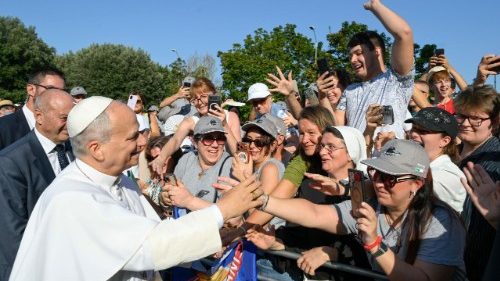
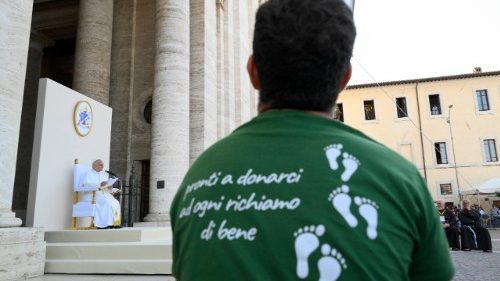
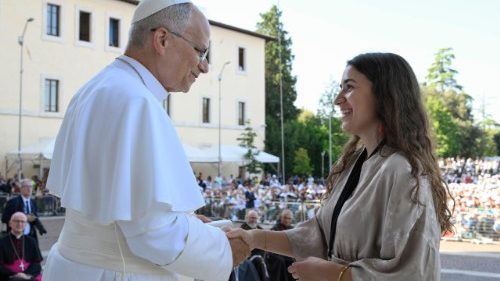
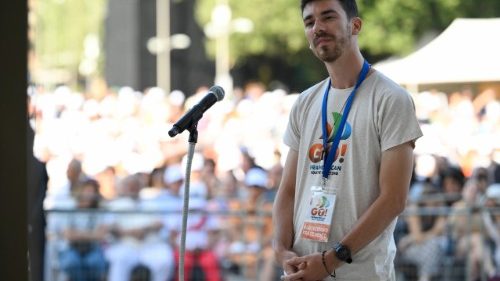
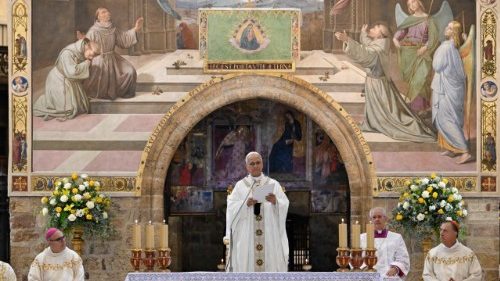
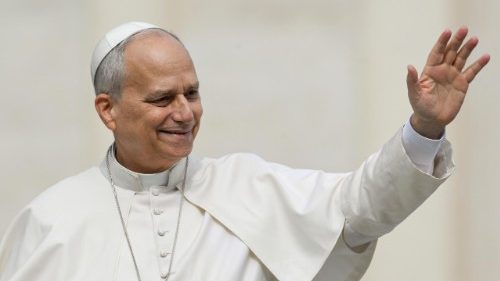
Vatican City, August 6, 2026: Pope Leo XIV began his pastoral visit to Assisi by meeting young people at Santa Maria degli Angeli, where he reflected on how the spiritual legacy of Saint Francis of Assisi can be lived today. Responding to questions from three young people, he addressed concerns about living the faith, serving others in a world shaped by oppression and consumerism, and remaining committed to the Church despite its challenges.
The Pope underlined that religion must never be used for political purposes and stressed that leadership should always be liberating, responsible and inclusive.
Going against the tide: Healing memories and fostering reconciliation
Karolina from Zagreb asked how Christians can remain authentic disciples of Christ and share a living faith beyond the walls of the Church.


In his reply, Pope Leo referred to the experience of war in her region of Europe, noting that it had suffered conflict only three decades ago, alongside “the dangerous intertwining of religious affiliation and nationalism.”
He praised the long-standing efforts of the Franciscans in promoting dialogue, saying their work has enabled Catholics, Orthodox Christians and Muslims to live together peacefully. He said this spirit of reconciliation must continue.
“Today, being faithful to this tradition of closeness means going against the tide, working to heal memories and fostering reconciliation. Christians will increasingly be called to become peacemakers in societies tempted to exploit religion in conflicts between different identities.”
Misinformation and prejudice create fear; Christ opens the heart
The Pope explained that being spiritual sons and daughters of Saint Francis means understanding the true meaning of Gospel radicalism.
It “is the opposite of fundamentalism: it does not make us blind and violent, but sensitive and attentive, always following Jesus and therefore humble and welcoming towards everyone. It is not easy, but it brings great joy.”
He said this path often requires making choices that may be unpopular while rejecting every form of manipulation.
“Bearing witness to Christ therefore remains both fascinating and demanding, because it opens our minds and hearts beyond artificial boundaries—that is, beyond the fears created by misinformation and the walls of prejudice.”
Technology makes us forget how to be together
Reflecting on Saint Francis’ teaching, Pope Leo said poverty has the power to draw people closer together even when they appear distant from one another.
He described the Church as a home open to everyone, a community that listens and experiences the joy of fraternity. It is also a place where people rediscover the value of being physically present with one another beyond the virtual world, as well as the importance of silence, which “is the opposite of war, with its violence, shouting and cruelty.”
“Dear young people, how beautiful it is to be together and ‘speak about God’ and, in His light, about life itself, in all its beauty, mystery and seriousness!”
“Bear witness to this way of living wherever you go, especially at a time when technology is making us forget how to be together as people of flesh and blood.”
Making a lifelong commitment is a revolutionary act
Giovanni from Bologna asked how young people can wholeheartedly say “yes” to God in a world that often struggles to look beyond the present or towards eternity. He also asked what had sustained Robert Prevost throughout his own vocation.
“Making a definitive choice is perhaps the most revolutionary act,” the Pope replied.
He observed that today there is “an occasionally confused understanding of freedom,” which can create the illusion “that problems can be solved by running away, by betraying others, or by taking only a few steps along constantly changing paths, without ever travelling far.”
The Pope warned that constantly chasing new experiences, relationships and possessions can reveal an inner emptiness and even reduce people to commodities. He contrasted this with authentic love.
“Deciding forever does not imprison us in a cage, but opens us to a greater dynamism. Love is an exodus, a road to be discovered, a journey that God undertakes with us. This is the true meaning of every vocation.”
Saying ‘yes’ to becoming Pope
Answering Giovanni’s question, Pope Leo shared part of his own vocational journey.
He said every important decision must be renewed daily and described vocation as “a journey of redemption and healing.” He added that it demands perseverance and constant vigilance because sin can cloud human judgement.
“In my experience, I can say that the Lord has never left me alone. He has always accompanied me, also giving me people with whom to walk. In my vocation to be a priest, a member of the Augustinian community and a missionary, I found a light that has guided me to this day, until I had to say ‘yes’ to a very special calling: that of being Pope.”
“In my experience, I can say that the Lord has never left me alone.”
The invisible walls dividing our cities
Luigi, a 22-year-old from Sicily, asked about obedience to the Successor of Peter, particularly when it becomes difficult or when scandals affect the Church. He asked how people can remain within “this healing Love”.
Pope Leo XIV said unity is central to the heart of Jesus. Referring to unity as the theme of his episcopal motto, he described it as something “revolutionary.” Despite the Church’s failures and wounds, he said, such unity remains possible and visible.
“Around Jesus, men and women who otherwise would never have met or spent time together become brothers and sisters. When this miracle of the Church continues to take place, thanks be to God, it remains astonishing even today in our cities, which are filled with invisible walls separating people from one another. How many forms of discrimination and inequality can end immediately once we recognize one another as brothers and sisters!”
The power of Jesus does not humiliate, but lifts up
The Pope said the Gospel reverses the logic of the world, echoing the message of the Magnificat.
He explained that genuine power is not measured by self-interest but by the willingness to serve others with humility.
“Not grasping, but receiving; not holding on, but giving back: this is the life of God, which heals the Church and makes her a free people, a place where people can breathe and find salvation.”
Concluding his address, Pope Leo said Jesus desires the Church to become His Body and reveal His life. He said this requires following Christ’s example and embracing a form of strength that does not humiliate others but raises them up.
Courtesy: Vatican News
© 2026 CATHOLIC CONNECT POWERED BY ATCONLINE LLP