- 04 April, 2026
Vatican City, March 4, 2026: “An ideal and pure Church, separated from the earth, does not exist; only the one Church of Christ, embodied in history.”

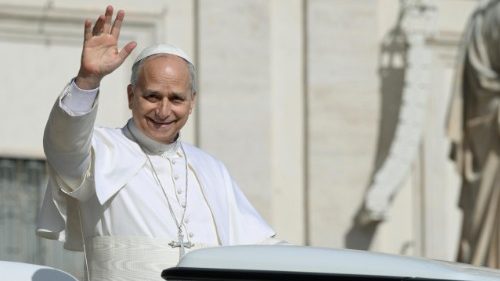
Pope Leo XIV shared this reflection during his weekly General Audience at the Vatican on Wednesday morning.
Continuing his catechesis on the Second Vatican Council’s Dogmatic Constitution Lumen gentium, the Holy Father reflected on how the document explains the mystery of the Church as both human and divine.
He recalled that while the first chapter of Lumen gentium primarily addresses what the Church is—describing her as a “complex reality”—the present reflection focuses on understanding what makes up this complexity.


Human fragility and the divine
The Pope explained that Lumen gentium teaches that the Church is a well-structured body where human and divine dimensions coexist “without separation and without confusion.”
On the human level, he said, the Church is made up of men and women who live the Christian life with both joy and struggle, marked by strengths and weaknesses, who proclaim the Gospel and become a sign of Christ’s presence as He walks with humanity through life.
“Yet this aspect,” Pope Leo said, “is not sufficient to describe the true nature of the Church, because it also has a divine dimension,” which “does not consist in an ideal perfection or spiritual superiority of its members, but in the fact that the Church is generated by God’s plan for humanity, realized in Christ.”
“Therefore,” he added, “the Church is at the same time an earthly community and the mystical body of Christ, a visible assembly and a spiritual mystery, a reality present in history and a people journeying towards heaven.”
Dimensions harmoniously integrated
The Holy Father emphasised that the human and divine aspects of the Church are harmoniously united, with neither dominating the other.
“The Church,” he reminded, “lives in this paradox. She is a reality that is both human and divine, which welcomes the sinful man and leads him to God.”
To explain this, Pope Leo pointed to how Lumen gentium draws on the life of Christ. “Those who met Jesus along the roads of Palestine experienced His humanity, His eyes, His hands, the sound of His voice.
Those who decided to follow Him were moved precisely by the experience of His welcoming gaze, the touch of His blessing hands, His words of liberation and healing.”
“At the same time, however, by following that Man,” he continued, “the disciples opened themselves to an encounter with God,” because “Christ’s flesh, His face, His gestures and His words visibly manifest the invisible God.”
The meaning of holiness
The Pope then invited the faithful to view the Church through the lens of Christ’s own reality. He noted that a closer look reveals a human dimension made up of real people, who at times reflect the beauty of the Gospel and at other times struggle and fall, like all human beings. Yet it is precisely through these members and their limited earthly condition that Christ’s presence and saving work are made visible.
He recalled the words spoken by Benedict XVI to the Swiss Bishops at the beginning of his pontificate, when he said that “there is no opposition between the Gospel and the institution.” Benedict had explained that “the structures of the Church serve precisely for the realization and concretization of the Gospel in our time.”
Building on this, Pope Leo stressed, “An ideal and pure Church, separated from the earth, does not exist; only the one Church of Christ, embodied in history.”
“This is what constitutes the holiness of the Church,” he reflected, “the fact that Christ dwells in Her and continues to give himself through the smallness and fragility of Her members.”
Witnesses of Christ’s love
Reflecting on this enduring mystery, the Pope said it reveals ‘God’s method,’ by which “He makes himself visible through the weakness of creatures, continuing to manifest Himself and to act.” Through this, believers are enabled today “to build up the Church: not only by organising its visible forms, but by building that spiritual edifice which is the body of Christ, through communion and charity among ourselves.”
In conclusion, Pope Leo encouraged the faithful to become authentic witnesses of Christ’s love, so that others may recognize in and among them the charity that marks true Christians and builds up the Church.
Courtesy: Vatican News
© 2026 CATHOLIC CONNECT POWERED BY ATCONLINE LLP