- 05 June, 2026

June 05, 2026: As the world observes World Environment Day on June 5, the Church in India finds itself standing at a sacred crossroads. The signs are all around us. Rivers shrinking. Forests thinning. Summers growing harsher. Villages waiting anxiously for rain. Cities drowning in plastic and smoke. The earth is weary. And so are the poor who depend on it most.


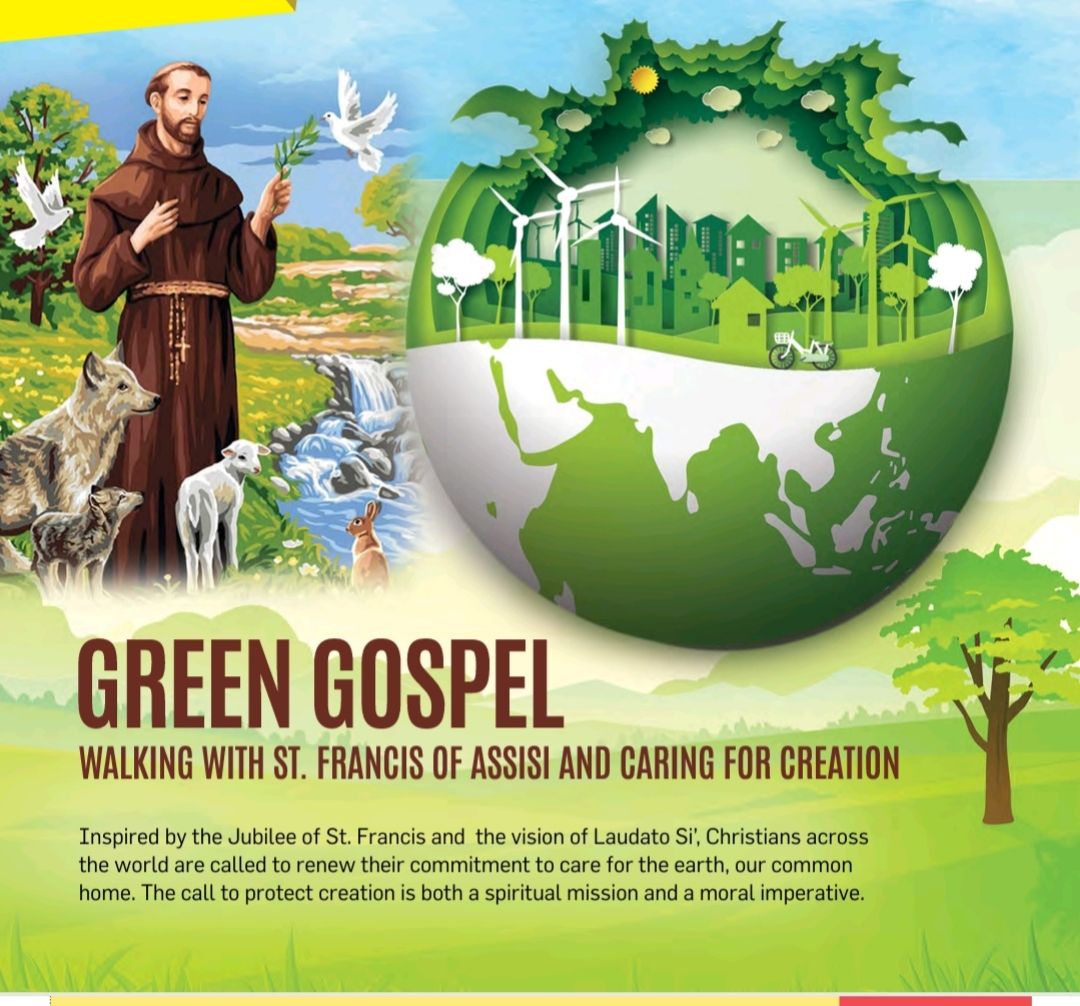
Into this wounded world comes the Jubilee Year of St. Francis of Assisi, inaugurated on January 10, 2026, to mark 800 years since the saint’s passage into eternal life. It is not merely a celebration of memory. It is a wake-up call. A spiritual alarm bell, ringing across convents, seminaries, parishes, schools, and Christian homes.
St. Francis still speaks powerfully to our age because he understood something fundamental — the earth is not merely a resource to exploit but a gift to protect. He saw the natural world as a family of brothers and sisters. “Brother Sun,” “Sister Moon,” “Brother Wind,” and “Sister Mother Earth” were not poetic symbols for him; they reflected a spirituality of deep relationship with creation and the Creator.


That spirituality has special meaning in India, a land where many cultures and traditions have long regarded nature with reverence. Rivers are honoured, mountains respected, trees protected, and animals treated with sacred regard. Yet modern consumerism and reckless development have weakened this ancient harmony.
Economic growth has undoubtedly lifted millions from poverty, but it has also brought environmental costs that can no longer be ignored.
In Punjab and Haryana, the Green Revolution once transformed India’s food security, but decades later the land itself is showing signs of exhaustion.
Groundwater levels continue to fall. Soil health has deteriorated. Excessive chemical use has damaged ecosystems and livelihoods alike. Along the coasts of Kerala and Tamil Nadu, fishing communities face rising seas and unpredictable weather patterns. In the North-East, forests and biodiversity remain under pressure. The Himalayan region witnesses landslides and melting glaciers with increasing frequency.
The ecological crisis is no longer separate from human suffering. The two are deeply connected.
This is precisely what Pope Francis emphasized in ‘Laudato Si’, his landmark encyclical on care for our common home. He reminded the world that “the cry of the earth and the cry of the poor” are inseparable.
Environmental destruction always falls hardest upon the vulnerable — farmers, tribal communities, fisherfolk, migrant labourers, and children. Climate change may be discussed in international conferences, but its harshest effects are experienced in villages, slums, and fragile communities.
For the Church in India, this reality cannot remain a peripheral concern. Care for creation is not a fashionable social cause added to Christian life; it flows directly from the Gospel itself. The Book of Genesis calls humanity not to dominate recklessly, but to “till and keep” the garden entrusted by God. Stewardship, not exploitation, lies at the heart of the Biblical vision.
This is why World Environment Day should mean more to Christians, especially priests and religious, than symbolic rallies or ceremonial tree planting. It should become a moment of examination for Catholic institutions, religious congregations, parishes, and families.
What kind of environmental values are our schools teaching children? Are our seminaries and houses of formation preparing future priests and religious to respond to ecological realities? Can our parishes reduce waste and adopt sustainable practices? Are Catholic institutions willing to move beyond token gestures and embrace long-term responsibility?
These are uncomfortable questions, but necessary ones.
Fortunately, many parts of the Indian Church are responding with sincerity and creativity. Across the country, religious congregations have quietly integrated ecological care into their ministries. Women religious promote kitchen gardening, organic farming, water conservation, and environmental awareness among rural communities. Many Catholic institutions work closely with indigenous groups to defend forests and land rights. Several dioceses have introduced solar energy projects, rainwater harvesting, and waste-management systems.
These efforts may not always attract headlines, but they reflect the Church at its best — close to the people, attentive to the vulnerable, and faithful to the Gospel.
The Jubilee Year of St. Francis offers an opportunity to deepen this commitment. It calls the Church not simply to environmental activism, but to ecological conversion. And conversion always begins within.
Modern society has normalised excess. Bigger lifestyles, endless consumption, and a culture of convenience have shaped even the spiritual imagination of many believers. Simplicity is often seen as weakness rather than wisdom. Yet, St. Francis embraced poverty and simplicity not because he rejected the world, but because he loved it rightly. He understood that greed eventually destroys both the earth and the human soul.
That lesson has become urgent today.
The environmental crisis is not only about carbon emissions or plastic waste. At its root lies a spiritual crisis — the inability to recognise limits, the obsession with consumption, and the illusion that human beings can endlessly take from the earth without consequence.
St. Francis offers another path. A gentler path.
Not a life of deprivation, but a life of balance.
Not domination, but fraternity.
Not greed, but gratitude.
Religious life in India carries a prophetic responsibility in this regard. Priests and nuns are called not merely to manage institutions, but to witness to values that challenge the culture around them. A convent that conserves water and avoids waste speaks powerfully in a society driven by excess. A parish that becomes plastic-free offers a silent but convincing homily. A Catholic school that teaches ecological responsibility as part of faith formation helps shape a more compassionate future.
Young people, in particular, are searching for authenticity. Many are deeply anxious about climate change and ecological collapse. They are more likely to trust a Church that acts than one that only speaks. This creates an important pastoral opportunity. Ecological responsibility can become a bridge between faith and youth engagement.
At the same time, the Church must recover the spiritual dimension of creation. Modern Christianity sometimes risks becoming disconnected from the natural world, as though prayer belongs only within church walls. Yet Scripture constantly points to creation as a sign of God’s presence. Jesus himself preached using images from nature — seeds, birds, lilies, vineyards, storms, and harvests.
The Church in India can enrich this awareness through liturgy, catechesis, retreats, and pastoral life. Celebrating the Season of Creation meaningfully, incorporating prayers for the environment into liturgies, encouraging ecological themes in catechism classes, and organising pilgrimages or retreats connected to nature can all help believers rediscover this forgotten dimension of faith.
There is also much the Church can learn from local and indigenous communities. Many tribal traditions still preserve a deep respect for forests, water, and land. Rural communities often understand interdependence and sustainability better than urban consumer culture does.
Development should not mean destroying the wisdom of those who know how to live responsibly with nature.
As India continues its journey toward economic progress, balancing development with ecological responsibility will remain one of the country’s greatest challenges. The Church cannot offer technical solutions to every problem, but it can offer moral clarity and spiritual leadership.
And that leadership is urgently needed.
Because environmental degradation ultimately raises moral questions: What kind of future are we leaving for coming generations? What does human dignity mean in a polluted and unequal world? Can economic growth be called successful if it destroys the very systems that sustain life?
The Jubilee Year of St. Francis invites Catholics in India to reflect deeply on these questions. It also invites action.
Every Catholic institution can become greener. Every parish can encourage sustainable living. Every religious congregation can integrate integral ecology into formation and ministry. Small actions, when multiplied across thousands of communities, can create meaningful change.
There is reason for hope. Across India and the world, many young people, faith communities, and ordinary citizens are working sincerely to protect the environment. The Church must walk with them, offering not only support but also spiritual depth.
St. Francis of Assisi remains one of the most admired saints in history because his life radiated authenticity. He not only preached peace but also lived peacefully with creation. He embraced the poor, rejected greed, and discovered joy in simplicity. Eight centuries later, his witness remains profoundly relevant to a world wounded by ecological destruction and restless consumerism.
As June 5 approaches, World Environment Day should become more than a calendar event for the Church in India. It should become a call to conscience.
The earth is crying out.
The poor are crying out.
And the Gospel calls us to listen.
May this Jubilee Year renew in the Indian Church a spirit of responsibility, humility, and care for our common home. And may future generations inherit not a wounded planet stripped of its beauty, but a living earth that still reflects the glory of the Creator.
By Fr. Suresh Mathew Pallivathukal
Download Catholic Connect App for Daily News Updates:
Android: Click here to download
Continue Reading on Catholic Connect App
Get access to exclusive news articles & more.
© 2026 CATHOLIC CONNECT POWERED BY ATCONLINE LLP