- 15 September, 2026

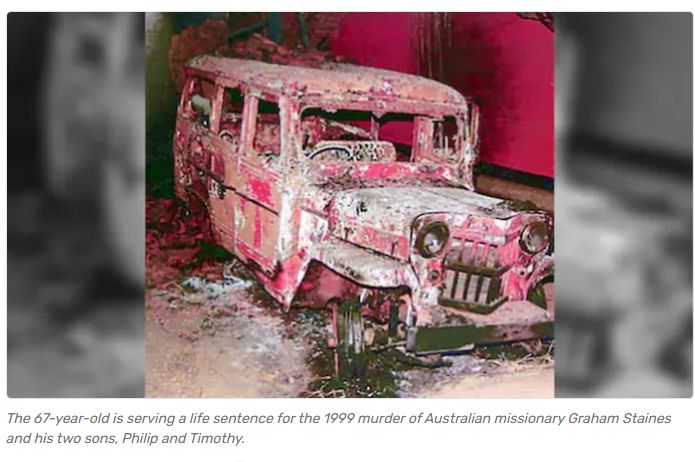
Bhubaneswar, September 15, 2026: The Odisha government has rejected the plea seeking premature release of Dara Singh, the convict serving a life sentence for the 1999 murder of Australian Christian missionary Graham Staines and his two minor sons, Philip and Timothy.

The decision comes days after the Supreme Court strongly criticised the state government for delaying a decision on Singh’s remission plea and directed the authorities to take a final call.
Singh, also known as Ravindra Pal, was convicted for his role in the attack at Manoharpur in Keonjhar district in January 1999, when Staines and his two sons were sleeping in their vehicle. The vehicle was set on fire, killing all three. The incident triggered widespread national and international condemnation and became one of the most notorious cases of violence against Christians in India.

A trial court initially sentenced Singh to death in 2003. The Orissa High Court later commuted the death sentence to life imprisonment, a decision upheld by the Supreme Court in 2011.
Singh had sought premature release after spending more than 26 years in prison. His plea had remained pending before the Odisha Sentence Review Board for more than two years.
On September 9, the Supreme Court had expressed strong displeasure over the delay. A bench of Justices Manoj Misra and Vijay Bishnoi warned that the concerned state secretary could be summoned if the government failed to take a decision before the next hearing. The court made it clear that the state could either accept or reject the remission plea, but could not keep the matter pending indefinitely.
The Supreme Court had earlier directed the State Sentence Review Board to decide Singh’s plea and inform the court of its decision. The proceedings had been delayed partly because a report from the District Jail, Keonjhar, had not been received.
The rejection means Singh will continue to serve his life sentence, subject to any further legal challenge available to him.
The Staines killings have remained a deeply sensitive chapter in India’s history of communal and religious violence. Graham Staines had worked among people affected by leprosy and tribal communities in Odisha for several decades. His widow, Gladys Staines, chose to remain in India after the killings and publicly spoke of forgiveness.
The Odisha government’s decision comes as the Supreme Court is scheduled to take up the matter again on September 17, when the state is expected to place its decision before the court.
Courtesy India Today




© 2026 CATHOLIC CONNECT POWERED BY ATCONLINE LLP