- 26 August, 2026

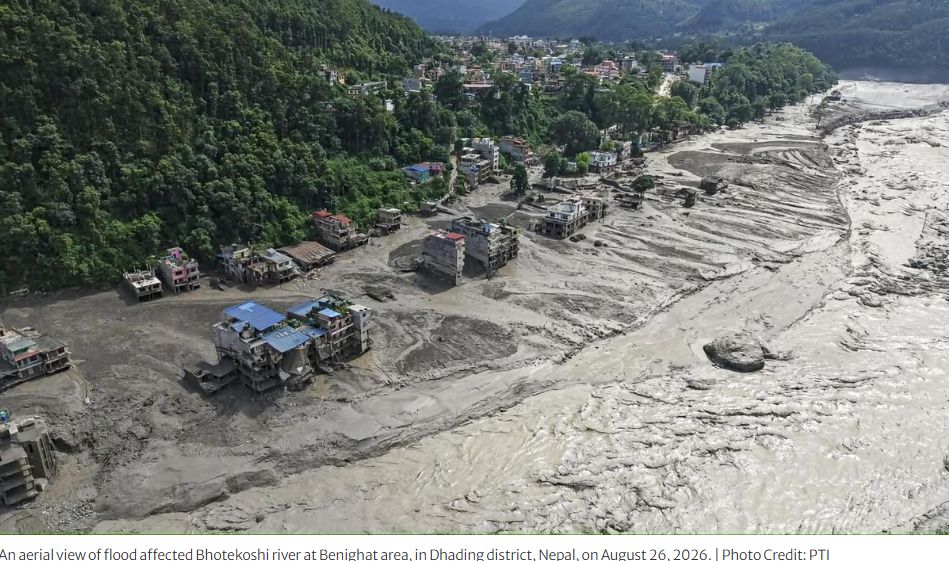
Nepal, August 26, 2026: Nepal is facing a major humanitarian emergency after a sudden flash flood struck the country’s northern Rasuwa district on Wednesday, 26 August, leaving dozens dead and hundreds of people missing. The disaster struck along the Nepal–Tibet border, with the Bhote Koshi river and surrounding settlements bearing the force of torrents of water, mud and debris.


According to reports available on Wednesday, more than 100 had died across Nepal and neighbouring Tibet, while hundreds remained unaccounted for. The precise toll remained uncertain as rescue teams struggled to reach some of the worst-affected areas.
The scale of the destruction has been compounded by damaged roads, bridges and communications, making it difficult for authorities to establish the full extent of the tragedy.
The flood caused extensive destruction in parts of Rasuwa, particularly around Timure and Syapru Besi. Homes and other buildings were swept away, while bridges and sections of vital infrastructure were destroyed.


The devastation also affected power infrastructure and hydropower projects along the river. The destruction of roads and bridges has severely complicated efforts to bring emergency assistance to isolated communities.
On the Tibetan side of the border, the nearby Gyirong area also suffered significant damage. Authorities in both Nepal and China have been carrying out search-and-rescue operations as the disaster continues to unfold.
One of the most distressing aspects of the disaster is the large number of people who remain missing. More than 340 foreign tourists were among those reported unaccounted for, including people from India, the United Kingdom, the United States and several other countries.
Nepal's tourism authorities have been working with travel agencies and security agencies to establish the whereabouts of missing visitors. The situation remains fluid, however, and officials have warned that communication difficulties mean that information is still being verified.
For families anxiously waiting for news, the uncertainty is almost as devastating as the destruction itself.
Early assessments indicate that the disaster was linked to a massive landslide or avalanche of rock and debris that entered the river, causing the waterway to overflow suddenly. Reuters reported that the landslide may have followed a magnitude 4.4 earthquake, although investigations into the precise chain of events are continuing.
The event highlights the particular vulnerability of the Himalayan region, where steep terrain, unstable slopes, rapidly changing weather conditions and retreating glaciers can combine to create sudden and destructive flooding.
Experts have also warned that the Himalayas are experiencing increasingly serious climate-related risks. The Hindu Kush Himalaya region is warming rapidly, while glaciers are retreating and extreme weather events are becoming more frequent.
Nepal's Army, police and other emergency personnel have been deployed to affected areas. Helicopters are being used where possible, although high water levels, damaged infrastructure and difficult mountain terrain have hampered rescue operations.
Authorities have also issued warnings to communities downstream and urged people living near rivers to move to safer areas. There are concerns that further flooding could occur if debris blocks the river upstream and subsequently gives way.
China has likewise begun emergency operations on the Tibetan side, while Nepal has appealed for assistance from neighbouring countries.
For Nepal's families, this disaster is more than a headline or a natural phenomenon. It represents lives suddenly lost, homes destroyed and loved ones whose fate remains unknown.
As rescue workers continue their dangerous work, communities across the region are waiting and praying for survivors. The tragedy also serves as a reminder of the importance of early-warning systems, responsible development and stronger disaster preparedness in vulnerable Himalayan communities.
Those affected by the floods need not only emergency assistance but also the assurance that they have not been forgotten.
As Nepal confronts the aftermath of one of its most devastating disasters of the year, the immediate priority remains clear: save lives, find the missing and bring relief to those who have lost everything.
Courtesy : The Hindu
Photo Courtesy : PTI
© 2026 CATHOLIC CONNECT POWERED BY ATCONLINE LLP