- 19 October, 2026

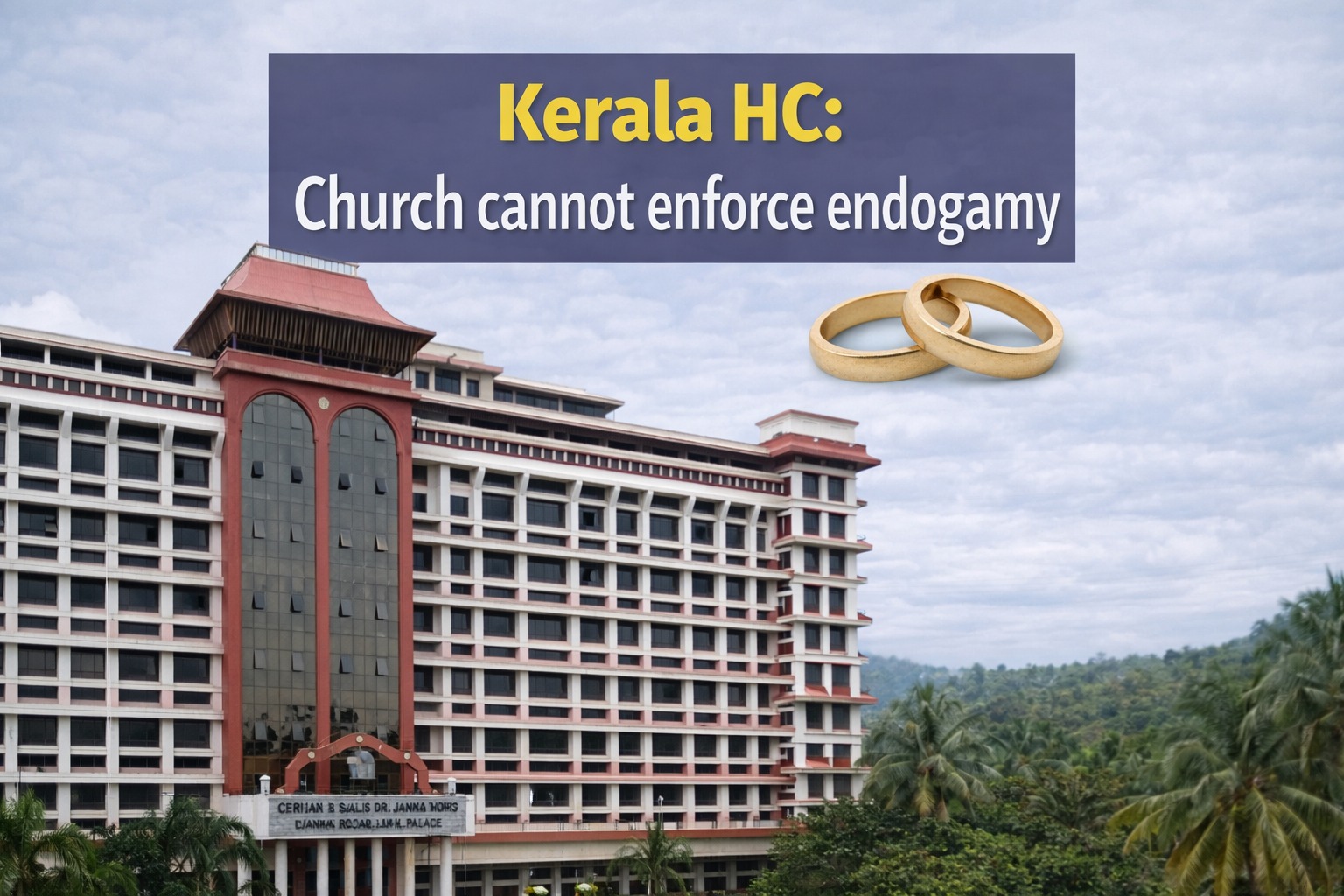
Kochi, March 24, 2026: In a significant ruling, the Kerala High Court stated that the Knanaya Catholic Church cannot enforce endogamy, interfere in the personal lives of its members, or deny sacraments to those who marry outside the community.


After nine days of hearings, Justice Easwaran S dismissed the Church’s appeal and upheld earlier decisions in favour of the Knanaya Catholic Naveekarana Samithi (KCNS), a reform group that has long opposed forced endogamy.
The verdict is expected to benefit Justin John, an autorickshaw driver from Kasaragod. Since 2023, he has been seeking to have his marriage with Vijimol Shaji solemnised at St. Anne’s Parish in Kottody. While Vijimol is a Catholic, she does not belong to the Knanaya community. The Kottayam Archeparchy, which serves only Knanaya faithful, had refused to conduct the marriage on that basis.
The judgment also strengthens the case of Biju Uthup (69), who first approached the court in 1989 after being denied a ‘vivaha kuri’ for his marriage. He is currently pursuing a separate case before the Kottayam Munsiff Court regarding his daughter’s membership in the Church. Both Justin John and Biju Uthup were respondents in the KCNS case.
The court made it clear that while individuals may personally choose endogamy, the Church as an institution cannot impose it.
The ruling directly challenges the practices of the Knanaya Catholic Archeparchy of Kottayam. Though it functions within the broader Catholic Church under the Pope, the Archeparchy maintains that its members are of Jewish origin and emphasizes “purity of blood or race,” restricting marriages with Catholics outside its jurisdiction. It claims to govern around three lakh faithful across India and abroad.
Those who chose to marry outside the community were often denied a ‘vivaha kuri’—a required no-objection certificate for Church marriages—or compelled to formally exit the Church by signing a ‘permission to leave the eparchy’ (PLEX).
The High Court firmly rejected such authority. As Justice Easwaran stated, the institutional promotion of endogamy is “impermissible in law.”
The court also observed that the Church failed to establish endogamy as an essential religious practice or binding custom. It ruled that the Church has no authority to control personal decisions through coercion, expulsion, or excommunication.
“The autonomy of an individual in this regard is absolute,” the court said, adding that religious freedom cannot be used to violate constitutional rights. Denying sacraments, including marriage rites, on the basis of not following endogamy goes against “constitutional morality, individual autonomy and equality.”
The court further clarified that while individuals may voluntarily follow endogamy, any institutional attempt to regulate or promote it amounts to unlawful interference.
A legal battle spanning decades
The case began in 1989 when Biju Uthup, then a DRDO employee, moved the court after being denied a ‘vivaha kuri.’
In 2014, the KCNS formally challenged the practice of endogamy. While they initially received favourable rulings, the matter became complicated in 2017 when the High Court issued observations against endogamy without hearing the Church. This led to a review and an appeal before the Supreme Court.
In 2018, the Supreme Court set aside the High Court’s decision due to procedural lapses and ordered a fresh hearing after giving all parties a fair opportunity.
During the recent hearings, the court noted that the Church introduced a formal bylaw on endogamy only in 2008—nearly two decades after Biju Uthup’s case began. The court viewed this disclosure critically, noting that such information had been withheld earlier.
The Latest Legal Challenge
In 2023, Justin John faced a similar situation when the Church initially issued a no-objection certificate for his engagement but later denied permission for the wedding unless he agreed to leave the Church. He refused and challenged the decision.
On May 18, 2025, Justin and Vijimol exchanged garlands outside her church, but their marriage could not be solemnised within the Knanaya Church.
Justin later approached the High Court, alleging contempt of earlier court directions and holding Church authorities accountable.
Speaking after the verdict, Biju Uthup said his decades-long struggle had gained renewed strength. He expressed hope that others would now speak up against the practice.
The case marks a decisive moment in balancing religious customs with individual rights, affirming that personal freedom cannot be overridden by institutional control.
Courtesy: ON Manorama


© 2026 CATHOLIC CONNECT POWERED BY ATCONLINE LLP