- 25 May, 2026

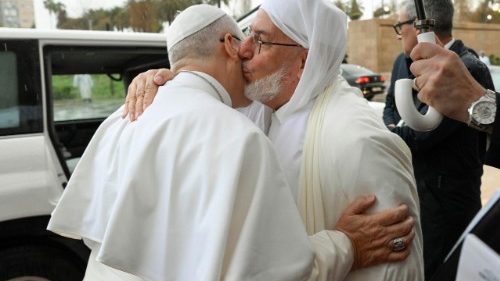
Vatican, April 24, 2026: As Pope Leo XIV concludes his Apostolic Journey to Algeria, Cameroon, Angola, and Equatorial Guinea, Cardinal George Koovakad, Prefect of the Dicastery for Interreligious Dialogue, reflects on the Pope’s vision of religions contributing to justice, social stability, and peaceful coexistence among peoples.

The interreligious dimensions of Pope Leo XIV’s Apostolic Journey held particular importance, especially in Algeria and Cameroon, as well as in his addresses to civil authorities and the diplomatic corps in Angola and Equatorial Guinea.
He presented a consistent vision of dialogue among religions as a privileged route to peace, reconciliation, and social stability. Viewed together, the different stages of the journey reveal a single unifying thread, where symbolic actions and words align within the same theological and pastoral framework.


In Algeria, the visit was from the beginning oriented towards fostering bridges and reconciliation. The Pope described it as “a valuable opportunity to continue with the same voice, with the same message, that we wish to convey: to promote peace, reconciliation, respect and consideration for all peoples,” invoking Saint Augustine as “a very important bridge in interreligious dialogue.”
In his address to civil authorities in Algiers, he placed universal fraternity at the forefront: “we are brothers and sisters, for we have the same Father in heaven,” presenting faith as a unifying principle capable of supporting justice, solidarity, and peace.
This direction was made visible through his gestures, particularly during his visit to the Great Mosque, where he reaffirmed “the dignity of every human being.” He added that: “We can learn to respect one another, live in harmony and build a world of peace.” The message he inscribed in the book of honour—“May the mercy of the Most High keep in peace and freedom the noble Algerian people and the whole human family”—effectively encapsulates this universal vision.
At the Basilica of Our Lady of Africa, dialogue was expressed in a practical and everyday manner, as reflected in his words that faith “does not isolate, but opens us up; it unites us, but does not create confusion; it brings us closer, without homogenizing.”
Finally, in Annaba, the Augustinian perspective grounded the journey in a deeper spiritual dimension, connecting the search for God with the building of peace and the practice of charity: “faith in the one God… unites people according to perfect justice, which calls everyone to charity.”
In Cameroon, within a context shaped by the Anglophone crisis which has not escalated into a religious conflict, the Pope clearly underlined the constructive role of religions when they are not distorted by the “poison of fundamentalism.”
In his address to civil authorities, he urged all to “reject the logic of violence and war” and instead embrace “a peace that is unarmed… and disarming,” highlighting the shared responsibility of States and religious leaders in preventing conflicts.
The most notable moment was the meeting in Bamenda, where Christian, Muslim, and traditional leaders offered a concrete example of lived fraternity.
As the Imam stated, “We thank God that this crisis did not degenerate into a war of religion…,” while the Pope pointed to the Peace Movement as “a model for the whole world,” cautioning against “those who manipulate religion… to their own gain.” This encounter demonstrated how interreligious dialogue can emerge from shared suffering and evolve into a path of reconciliation.
In meetings with Muslim representatives and with the Bishops, Pope Leo emphasised the common responsibility to build peace and the importance of a realistic dialogue, capable of acknowledging the internal diversity of religious communities and encouraging authentic inculturation.
In Angola, addressing the diplomatic corps, the Pope expanded the perspective to the entire African continent, drawing attention to challenges related to conflicts and divisions.
“Africa urgently needs to overcome situations and dynamics of conflict and enmity… Only in encounter in encounter does life flourish. Dialogue is the first step,” he said.
In this context, he also referred to the teaching of Pope Francis, underlining the continuity of the magisterium on dialogue and peace.
In Equatorial Guinea, he stressed shared values such as the formation of consciences and the centrality of the common good.
“In a world wounded by arrogance, people hunger and thirst for justice,” he said, adopting the appeal of Pope Francis: “Today we also have to say ‘thou shalt not’ to an economy of exclusion and inequality. Such an economy kills.”
In his overall reflection, Pope Leo XIV explicitly recalled the legacy of Pope Francis, highlighting his commitment to “universal fraternity” and to “an authentic respect for all men and all women.”
The entire journey is thus characterised by several unifying themes. These include fraternity as the basis of coexistence, the rejection of any misuse of religion, and the crucial role of religious leaders in mediating conflicts.
From this perspective, the experiences across the various countries are not isolated occurrences, but rather form a coherent and practical proposal for advancing, in the contemporary world, an interreligious dialogue capable of fostering peace, justice, and stable coexistence among peoples.
Courtesy: Vatican News

© 2026 CATHOLIC CONNECT POWERED BY ATCONLINE LLP