- 13 November, 2026
PILAR, November 11, 2026: Religious leaders from Hindu, Muslim and Christian communities have called for greater interfaith cooperation in addressing the ecological crisis, stressing that environmental protection is a shared responsibility that transcends religious boundaries.


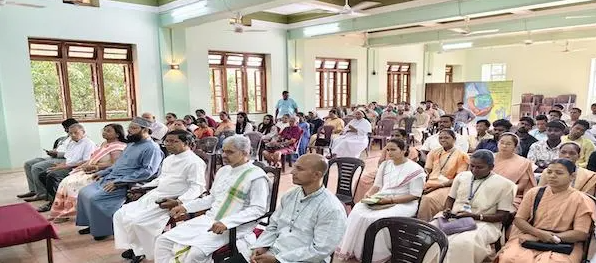
The call was made during an interfaith dialogue titled Samvaad – A Dialogue of Theological Exchange, held at Br. Albert Hall, Pilar Seminary, Goa, on November 11.
Organised by the Solidarity Forum of the Society of Pilar in collaboration with Sadbhav and the Conference of Religious India for Goa and Daman, the programme explored the theme, ‘The Theology of Creation, Stewardship, and Human Responsibility’.
Representatives of the three faiths opened the dialogue with readings on creation from the Atharva Veda, the Quran and the Book of Psalms.
Satish Suryakant Gaude, assistant professor of Sanskrit at Swami Brahmanand Mahavidyalaya, Kundaim, presented the Hindu perspective, highlighting the significance of the five classical elements that sustain life. He warned that their neglect could endanger human survival and invoked the principle of Vasudhaiva Kutumbakam (the world is one family) to underline the need for collective action to preserve ecological balance.
Hafeez Abul Kalam Khan, imam of Masjid Mehboob E Subhani in Cortalim, said environmental protection was a responsibility shared by all humanity. Describing human beings as stewards rather than owners of the Earth, he called for collective efforts to safeguard nature.
Presenting the Christian perspective, Father Mateus Fernandes, manager of Miracles High School, Sanguem, drew on Pope Francis' encyclical Laudato Si', describing creation as a divine gift entrusted to humanity rather than a resource to be exploited.
He cautioned that excessive consumption disproportionately affects poor and vulnerable communities. He urged schools, parishes and religious institutions to translate ecological concern into practical action through water conservation, reduced plastic use, tree protection and prevention of food waste.
Moderating the discussion, Ida Rose Miller Mukherjee of Sadbhav emphasised the complementary roles of science, politics and theology in responding to environmental challenges. She called for a shift in attitudes, from consumerism to care and from greed to gratitude.
The gathering brought together seminarians, religious sisters and students from Hindu and Muslim educational institutions across Goa.
Father Elvis Fernandes, convenor of the Solidarity Forum and Sadbhav, welcomed the participants and underscored the importance of interreligious engagement in fostering mutual understanding.
Seminarian Agustine Coelho proposed the vote of thanks, while Jisha Ponnachan concluded the programme with a prayer.
The dialogue highlighted the potential of interfaith collaboration in promoting ecological responsibility and protecting the natural world for future generations.
Courtesy : Matters India





© 2026 CATHOLIC CONNECT POWERED BY ATCONLINE LLP