- 15 October, 2026

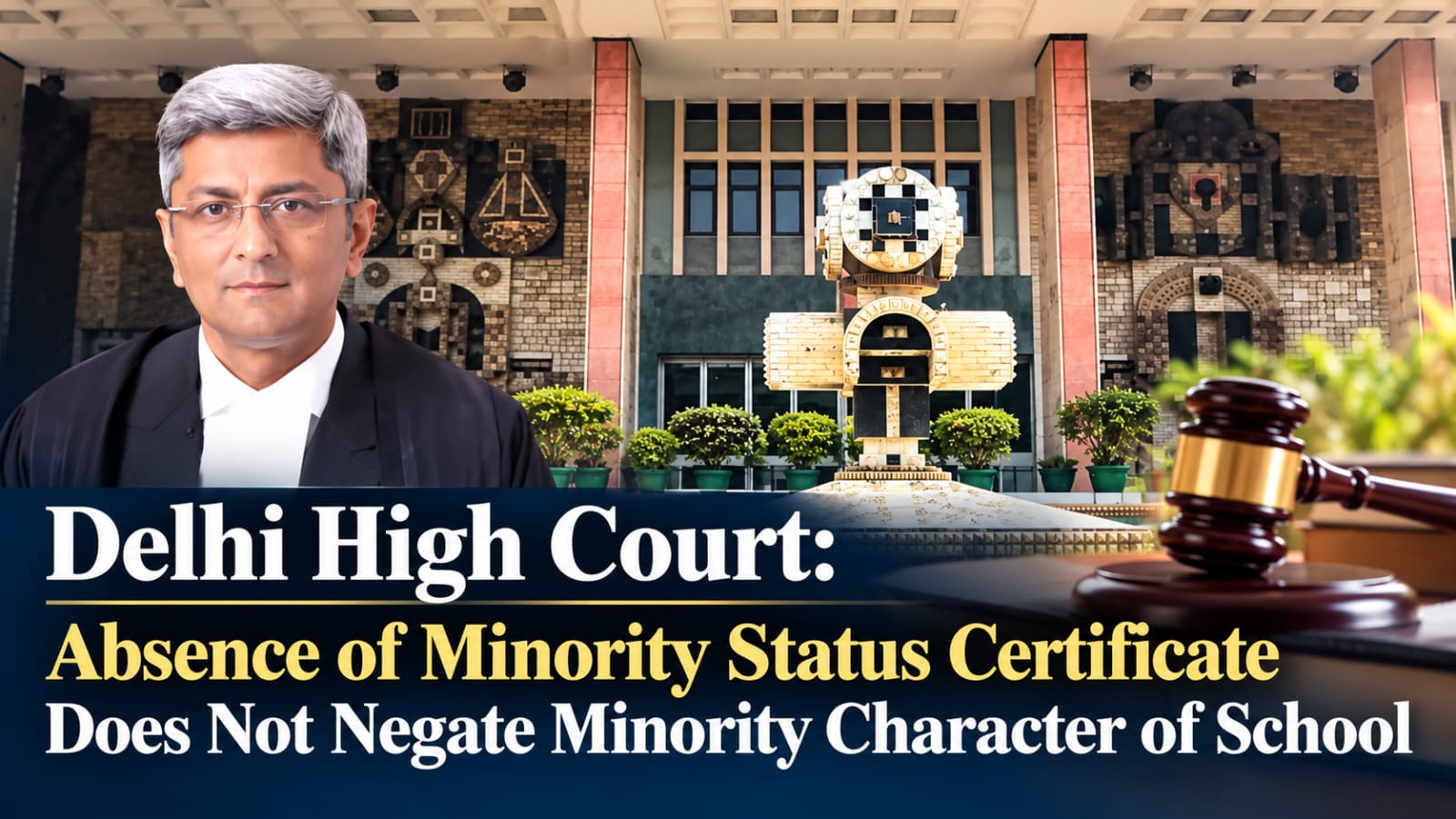
NEW DELHI, October 15, 2026: The Delhi High Court has ruled that the absence of a Minority Status Certificate does not, by itself, disqualify an educational institution from being recognised as a minority institution, declaring Hemnani Public School an unaided linguistic minority institution entitled to constitutional protection under Article 30(1).



Justice Sanjeev Narula held that a certificate may formally recognise or provide evidence of an institution’s minority status, but does not create the constitutional right itself. The Court also ruled that Section 8(2) of the Delhi School Education Act, 1973, and Rules 118 and 120 of the Delhi School Education Rules do not apply to unaided minority schools.
The judgment arose from a dispute over the termination of the school’s Vice-Principal, Ipsa Gurnani. The Court set aside the Delhi School Tribunal’s order and restored her appeal for consideration of her objections concerning the fairness of the disciplinary proceedings.
“The absence of a Minority Status Certificate is not, by itself, conclusive against minority status,” the Court observed, adding that the institution’s status must be determined by examining its establishment and administration in the light of the constitutional and statutory framework.
Minority Status and Legal Dispute
Gurnani was suspended on July 23, 2016, and terminated on February 10, 2017, following a disciplinary inquiry in which the school said she did not participate.
On March 28, 2017, the Directorate of Education declared her suspension void for want of approval and directed the school to pay her full salary for the suspension period. The school did not challenge that order.
The Delhi School Tribunal subsequently set aside her termination on December 22, 2017, treating the school as a non-minority institution because it did not possess a Minority Status Certificate. The school challenged the Tribunal’s decision, while Gurnani sought implementation of the Directorate’s order concerning her suspension.
Examining the school’s status, the High Court considered its 1991 Scheme of Management, which identified the Sindhi Education Society as its parent body, along with a 1982 judgment recognising Sindhi as a linguistic minority in Delhi.
Although the earlier judgment had not specifically determined Hemnani Public School’s status, the Court found that the school’s own records established its minority character.
Relying on the judgments in Frank Anthony, G. Vallikumari and C.S. Clarke, the Court held that Section 8(2) of the Delhi School Education Act and Rules 118 and 120 of the Rules were inapplicable to the school. It also rejected the contention that the ruling in C.S. Clarke was per incuriam.
Referring to Sisters of St. Joseph of Cluny, the Court said it was unnecessary to treat the observations concerning the statutory jurisdiction of the National Commission for Minority Educational Institutions as an exhaustive statement of the law.
“The DST could not treat the absence of a certificate as the end of the enquiry,” the Court held, concluding that Hemnani Public School was an unaided linguistic minority educational institution on the basis of the material before it.
Tribunal to Examine Disciplinary Procedure
While recognising the school’s minority status, the Court clarified that the management’s disciplinary authority remained subject to the requirement of a fair procedure.
The record supported Gurnani’s objection that some persons who testified against her may also have been members of the disciplinary body. However, the Court left this issue, along with the question of whether she had been provided with the inquiry report, for the Tribunal to examine.
The Court also held that Sections 8(4) and 8(5) of the Delhi School Education Act apply to minority schools. Under these provisions, a suspension lapses if the required approval is not obtained within 15 days.
The Tribunal was directed to decide the remaining grounds of Gurnani’s appeal within four months of receiving the case record.
The school was further directed to pay the amount due for the suspension period within eight weeks, after deducting the subsistence allowance already paid. Her entitlement to payment for the period after February 10, 2017, will depend on the Tribunal’s decision.
The case is titled Hemnani Public School v. Ipsa Gurnani & Anr. (Neutral Citation: 2026:DHC:9031).
Senior Advocate Dinesh Agnani, along with advocates Hemant Manjani and Tarun Aswani, appeared for the school. Advocates Kuldeep Kumar, Syed Nilofar Akhtar and Latika Choudhary represented the respondent.
Courtesy: Verdictum



© 2026 CATHOLIC CONNECT POWERED BY ATCONLINE LLP