- 25 June, 2026

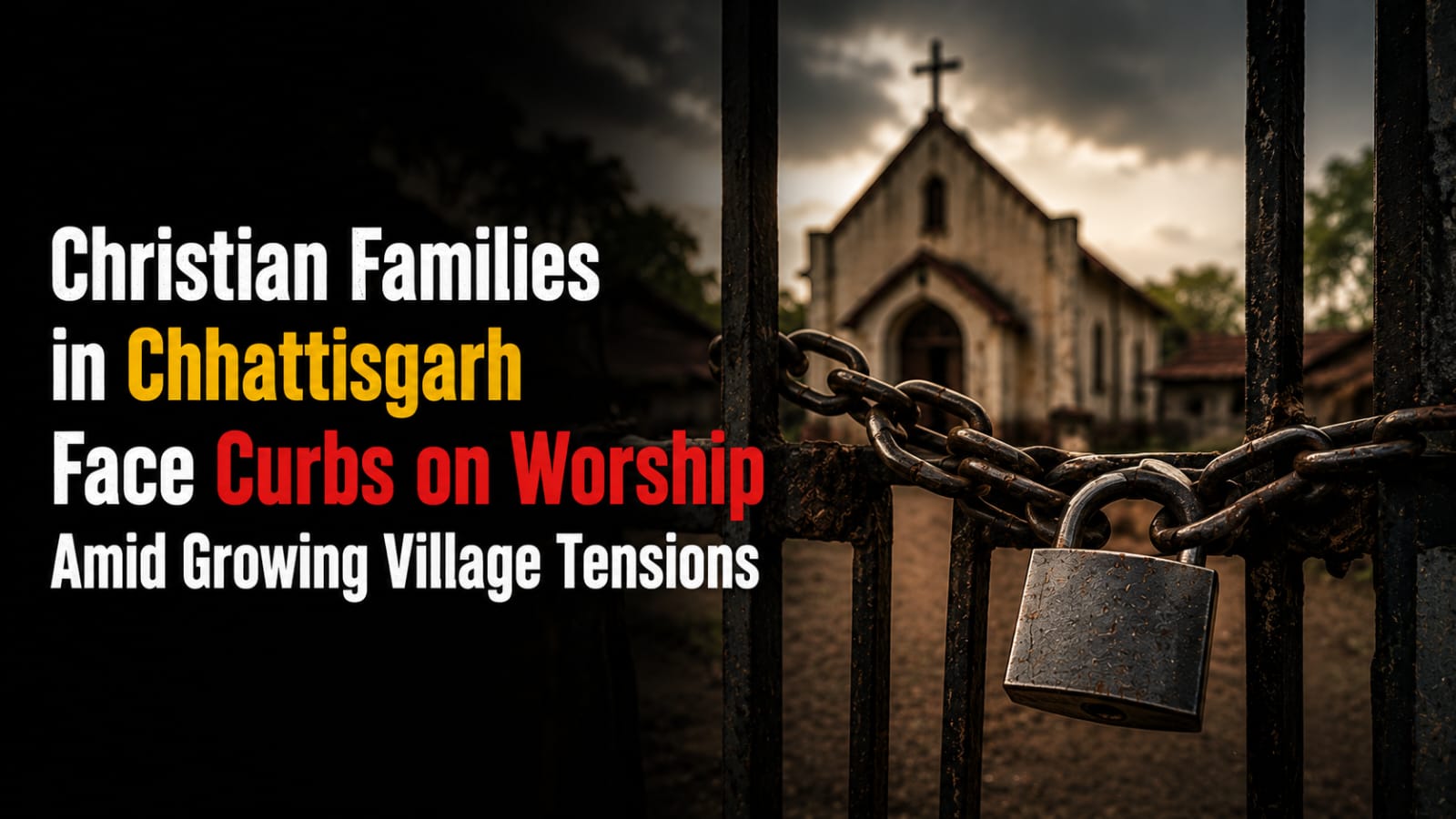
Narayanpur, Chhattisgarh, June 25, 2026 — Fresh concerns over religious freedom have emerged from Chhattisgarh’s Narayanpur district after several Christian families were reportedly asked to refrain from conducting prayers and other religious activities as part of a settlement reached following a village dispute linked to religious conversion.


According to local reports, tensions flared in the village after objections were raised by some residents over the presence and religious practices of Christian families. District authorities intervened to defuse the situation and reportedly facilitated a compromise that allowed the families to continue living in the village. However, the agreement is said to have included restrictions on Christian worship, including prayers in homes and religious gatherings.
The reported conditions have sparked criticism from Christian rights advocates, who argue that such restrictions violate fundamental constitutional protections.


(CLICK HERE to follow Catholic Connect for regular News and Content)
A.C. Michael, National Coordinator of the United Christian Forum and President of the Catholic Association of the Archdiocese of Delhi, condemned the reported curbs, describing them as unconstitutional and contrary to India's democratic principles.
“Such actions are completely against the Constitution of India and the law of the land,” Michael said. “Article 25 guarantees every individual the freedom to profess, practice and propagate religion. No authority has the right to prevent a person from practicing his or her faith.”
He stressed that the right to religious freedom extends to every person residing in India, regardless of nationality, and questioned the role of officials who allegedly endorsed the restrictions.
“If government authorities have accepted such conditions, they have acted against their constitutional responsibilities,” he said.
Despite facing pressure and social ostracism, the affected Christian families have remained steadfast in their faith, Michael noted.
“The faith of these families remains strong. They have chosen not to abandon their belief in Jesus despite social boycott and various forms of pressure. They continue to practice Christianity out of personal conviction and free will,” he said.
The incident highlights the continuing challenges faced by Christian communities in parts of central India, where allegations of religious conversion have frequently triggered social tensions and disputes. Human rights groups have repeatedly expressed concern over instances in which Christian families have been subjected to discrimination, exclusion from community life, and restrictions on worship.
Michael emphasized that the primary responsibility of the administration is to ensure peace and protect the rights of all citizens equally, irrespective of their religion, caste, or social background.
“The job of the administration is to provide a peaceful atmosphere for all people and to treat every citizen equally, irrespective of caste, creed, or religion,” he said. “When authorities fail to uphold these principles, they fail in their constitutional duty.”
He further argued that any unequal treatment of citizens on the basis of religion undermines the constitutional guarantee of equality before the law enshrined in Articles 14 to 18 of the Constitution.
“All public servants take an oath to faithfully and impartially discharge their duties and uphold the Constitution. Their actions must reflect that commitment,” Michael said.
The reported restrictions have renewed debate over the protection of religious freedom in rural areas, where local social dynamics often intersect with questions of faith and identity. For the Christian families involved, the immediate challenge remains balancing their desire to live peacefully in their native village while preserving their constitutional right to worship according to their beliefs.
As rights advocates continue to monitor the situation, the episode serves as another reminder of the fragile state of religious harmony in some parts of Chhattisgarh, where disputes over faith continue to test both community relations and the administration’s commitment to safeguarding fundamental freedoms.
By Catholic Connect Reporter


© 2026 CATHOLIC CONNECT POWERED BY ATCONLINE LLP