- 19 June, 2026

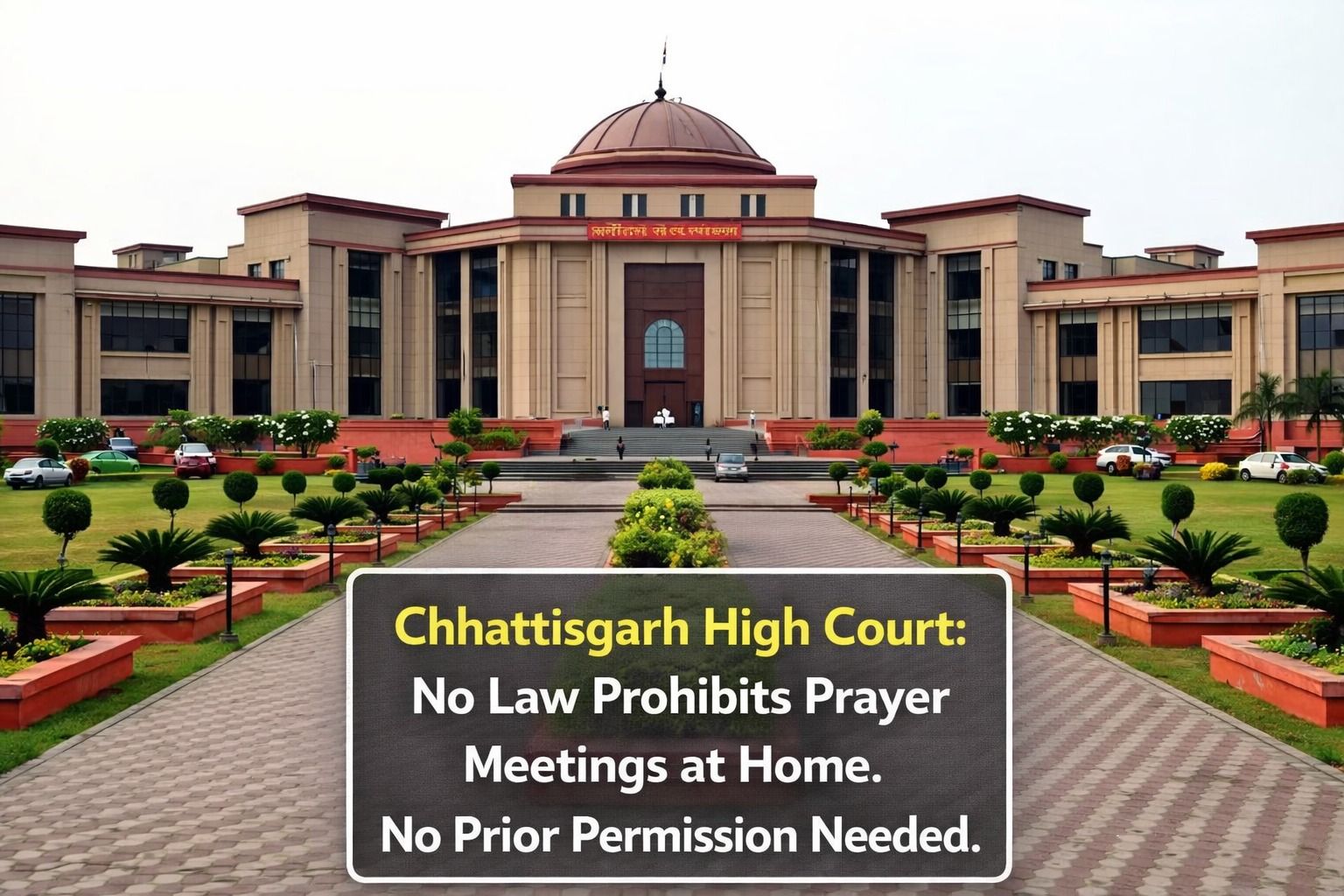
April 2, 2026: In a significant affirmation of religious freedom, the Chhattisgarh High Court has ruled that individuals are legally permitted to organise prayer meetings within their own homes without seeking prior approval from authorities, provided no laws are violated.


The ruling came in response to a writ petition filed by Christian residents who sought to quash notices issued by local police restraining them from conducting prayer gatherings in their dwelling. The petitioners argued that such actions infringed upon their fundamental rights and constituted unwarranted interference.
Hearing the matter, a Single Bench comprising Justice Naresh Kumar Chandravanshi observed that there exists no legal provision prohibiting individuals from holding prayer meetings in their own residences. The court categorically stated that prior permission from any authority is not required for such gatherings, as long as they are conducted within the bounds of the law.


In its order, the Bench noted that the petitioners had been organising prayer meetings for Christian faithful at their residence since 2016 on land they lawfully owned. It further underscored that the absence of any nuisance or unlawful activity during these meetings invalidated the basis for police intervention.
The petitioners, represented by advocate Pritam Singh, contended that the local Station House Officer had repeatedly issued notices under Section 94 of the Bharatiya Nagarik Suraksha Sanhita, 2023, thereby obstructing their religious practice despite no complaints of disturbance or breach of peace.
On behalf of the state, Deputy Government Advocate Shobhit Mishra defended the actions of the authorities.
In its reasoning, the court clarified that while authorities retain the right to act in cases of noise pollution or threats to public order, such action must be based on actual violations. “If there is any nuisance caused or a law and order situation arises, it is always open for the authorities to take necessary action under relevant statutes,” the Bench stated.
Directing the police and concerned officials to refrain from interfering in the lawful exercise of civil and religious rights, the court quashed the impugned notices, bringing relief to the petitioners.
The judgment is being viewed as a reaffirmation of the constitutional guarantee of religious freedom, particularly in the context of private worship, and offers clarity on the limits of administrative intervention in matters of faith.
Courtesy: The Verdictum



© 2026 CATHOLIC CONNECT POWERED BY ATCONLINE LLP