- 30 April, 2026
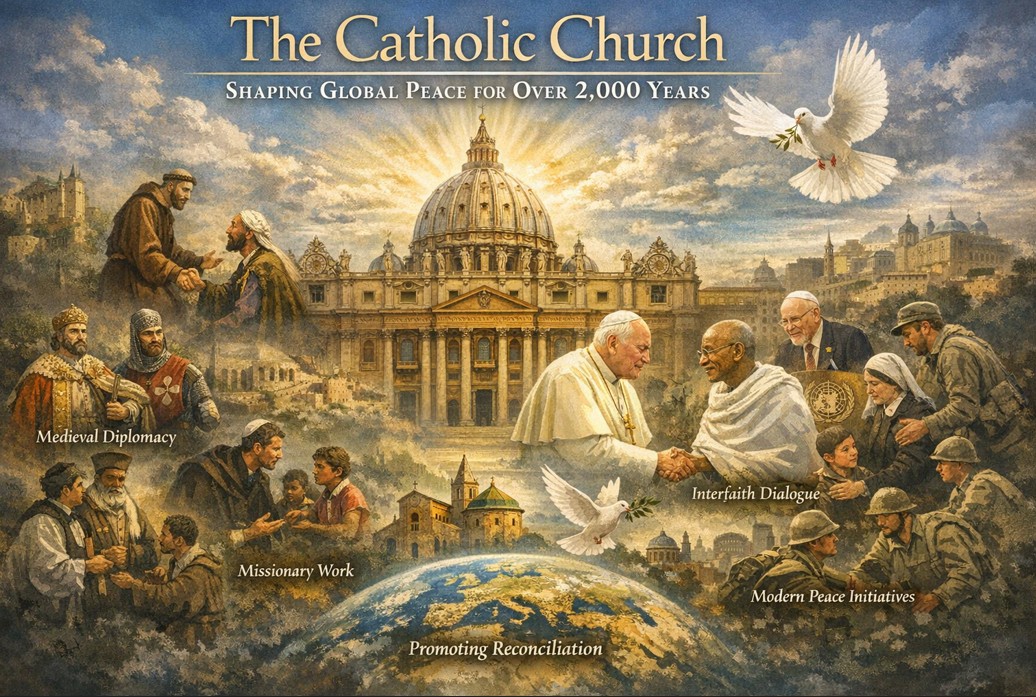
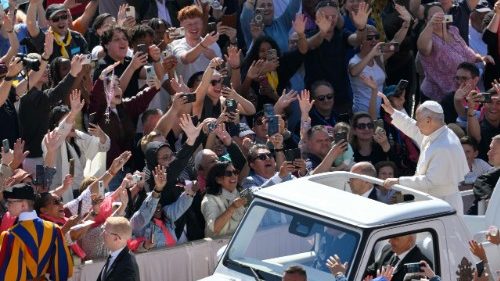
Vatican City, April 9, 2026: In a world often marked by conflict and division, the Catholic Church continues to stand as one of the most enduring voices for peace—drawing from over two millennia of spiritual teaching, moral leadership, and diplomatic engagement.

From the teachings of Jesus Christ to the modern interventions of leaders like Pope Francis and Pope Leo XIV, the Church’s journey reflects a remarkable evolution—one that blends faith with global responsibility.
The origins of the Church’s peace mission lie in the words of Jesus Christ, who taught principles such as loving one’s enemies and choosing forgiveness over retaliation.
In the early centuries under the Roman Empire, many Christians embraced non-violence, often refusing military service. These teachings laid the moral groundwork for what would become one of the longest-standing peace traditions in human history.


As Europe entered the medieval period, the Church began formal efforts to limit violence. Movements like the “Peace of God” and the “Truce of God” sought to protect civilians and restrict warfare to specific times.
These initiatives marked some of the earliest organized attempts to regulate conflict and uphold human dignity.
During this period, the papacy increasingly stepped into the role of mediator among kings and nations. What began as moral guidance gradually evolved into active diplomacy.
By the Renaissance, the Church had established itself as a significant diplomatic force, shaping early forms of international negotiation.
In the wake of devastating conflicts like the Thirty Years' War, the Church emphasized dialogue over warfare more strongly.
By the 19th century, the Holy See had gained recognition as a neutral diplomatic entity, advocating for peace amid rising nationalism and unrest.
The two World Wars tested the Church’s commitment to peace on an unprecedented scale.
During World War I, Pope Benedict XV called for disarmament and negotiation. Later, in World War II, Pope Pius XII engaged in humanitarian and diplomatic efforts.
Despite challenges, the Church remained a consistent advocate for peace.
During the Cold War, the Church played a crucial role in easing tensions.
Pope John XXIII appealed for peace during the Cuban Missile Crisis, while Pope John Paul II supported peaceful movements that contributed to major political transformations in Eastern Europe.
One of the clearest demonstrations of Vatican diplomacy came during the Argentina–Chile conflict, where Church mediation helped prevent war and led to peaceful resolution.
This reinforced the Vatican’s role as a trusted neutral facilitator.
In the 21st century, the Church has continued its peace mission with renewed focus.
Pope John Paul II opposed the Iraq War, while Pope Francis helped restore diplomatic relations between the United States and Cuba.
The Church has also supported peace efforts in regions like South Sudan and Colombia, emphasizing reconciliation.
Under Pope Leo XIV, the Church continues to call for ceasefires, dialogue, and unity in global conflicts especially in Ukraine and Middle East.
His leadership reflects a continuation of the Church’s mission:
Across 2,000 years, the Catholic Church has consistently:
However, its history also includes involvement in conflicts such as the Crusades.
This dual legacy highlights the Church’s evolution into a leading advocate for peace and reconciliation.
From the teachings of Jesus Christ to the diplomatic efforts of modern Popes, the Catholic Church’s journey in peacebuilding remains both profound and ongoing.
In today’s uncertain world, its message continues to resonate—urging humanity toward compassion, dialogue, and unity.
On the global stage, beyond politics and power, the Church’s enduring mission remains clear: peace is not just an ideal, but a shared responsibility.
By Catholic Connect Reporter
________________________
Catholic Church peace history, Vatican diplomacy, role of Catholic Church in world peace, Pope Francis peace efforts, Pope Leo XIV peace message, Christian teachings on peace, Catholic Church mediation history, Vatican global diplomacy, Church role in conflicts, Catholic peace initiatives
© 2026 CATHOLIC CONNECT POWERED BY ATCONLINE LLP