- 22 May, 2026

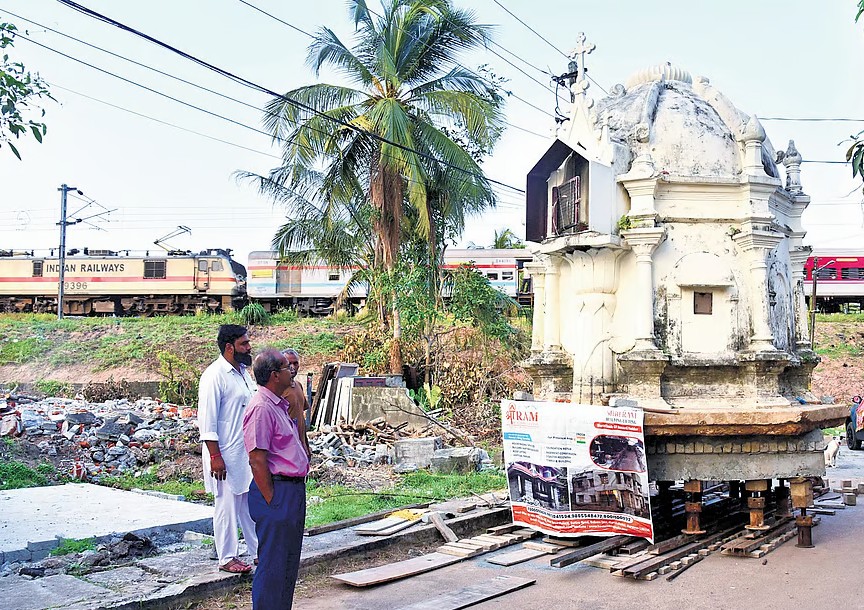
Kochi, March 27, 2026: In a remarkable blend of heritage preservation and engineering innovation, a 200-year-old wayside shrine belonging to St. John’s Nepumsian Church is being carefully relocated to make way for railway expansion, without compromising its historical and spiritual significance.


Situated at Konthuruthy in Thevara, the 15-foot-tall shrine, locally known as a kurishadi, has stood for over two centuries as a place of prayer and devotion for the local community. Deeply connected to the history of the waterside village, it has long been a symbol of faith and continuity.
In a rare and thoughtful decision, the church authorities chose preservation over opposition, opting to relocate the shrine 26 metres away onto church-owned land. This ensures that the structure remains intact while allowing ongoing infrastructure development. The shrine, originally built in 1823 in a distinctive Portuguese style, is considered one of the few surviving examples of its kind in the region.
The relocation marks a first-of-its-kind effort in India, where an entire wayside cross structure is being moved using a lifting and shifting technique. Despite the demolition and reconstruction of the main church in 1992, the shrine had been preserved as a living link to the past until the recent railway expansion necessitated its movement.


The complex operation involves lifting the entire structure using 25 hydraulic jacks and precision gear systems, managed by a team of skilled workers. The project, which began in mid-March, is being carried out with meticulous care to ensure that not a single element of the shrine’s antiquity is disturbed.
The work is being executed by a specialised heritage relocation firm with experience in preserving historic structures across India. The process includes gradually raising the shrine and moving it safely to its new location, where it will continue to serve as a place of worship for generations to come.
This initiative reflects a harmonious balance between development and preservation, demonstrating that progress need not come at the cost of heritage. By choosing to protect the shrine while accommodating modern infrastructure needs, the parish community has set a meaningful example of respect for both faith and history.
The relocation is expected to be completed by the end of March, after which the shrine will once again stand as a symbol of devotion—rooted not just in its original place, but in the enduring faith of the people it serves.
News Courtesy Manisha V C S (The Indian Express)
Photo Courtesy A Sanesh
© 2026 CATHOLIC CONNECT POWERED BY ATCONLINE LLP